586 posters, 8 topics, 23 sessions, 1,077 authors, 622 institutions
ePostersLive by SciGen Technologies S.A. All rights reserved.
ISQua's 40th International Conference 2024
24th - 27th September 2024 | Istanbul, Türkiye

P680
Digital transformation to a paper-free medical laboratory by the ESG concept
Poster Presenter
Authors
Affiliations
Part of Topic
Navigating Climate Change and Sustainability in Healthcare System
Digital transformation to a paper-free medical laboratory by the ESG concept
YAFANG HUANG*1, CHIN YI CHUNG1, SHIH YI CHEN1, LIANG LAN HSING 1
1Medical Laboratory, Pingtung christian hospital, PINGTUNG, Taiwan
INTRODUCTION
According to the UN IPCC report, the global net human-caused carbon dioxide (CO2) should be reduced to"net zero" around 2050 to reduce the greenhouse effect. When many industries are achieving strategic goals related to energy conservation and carbon reduction, the health care industry seems very far behind the goal. In 2023, the Climate Change Response Act was enforced by Taiwan government to reduce and manage greenhouse gas emissions for global environmental protection and the sustainability of human life.
AIM
As an ISO15189 qualified medical laboratory, we followed the TAF-AR-10 guidelines and obligations to keep all patient laboratory records for at least 6 years. It is crucial to convert a paper-based record into an electronic medical record (EMR) in order to save storage space and record integrity. In this project, we applied several approaches to transformation paper-based laboratory in to low carbon electronic medical laboratory.
METHOD
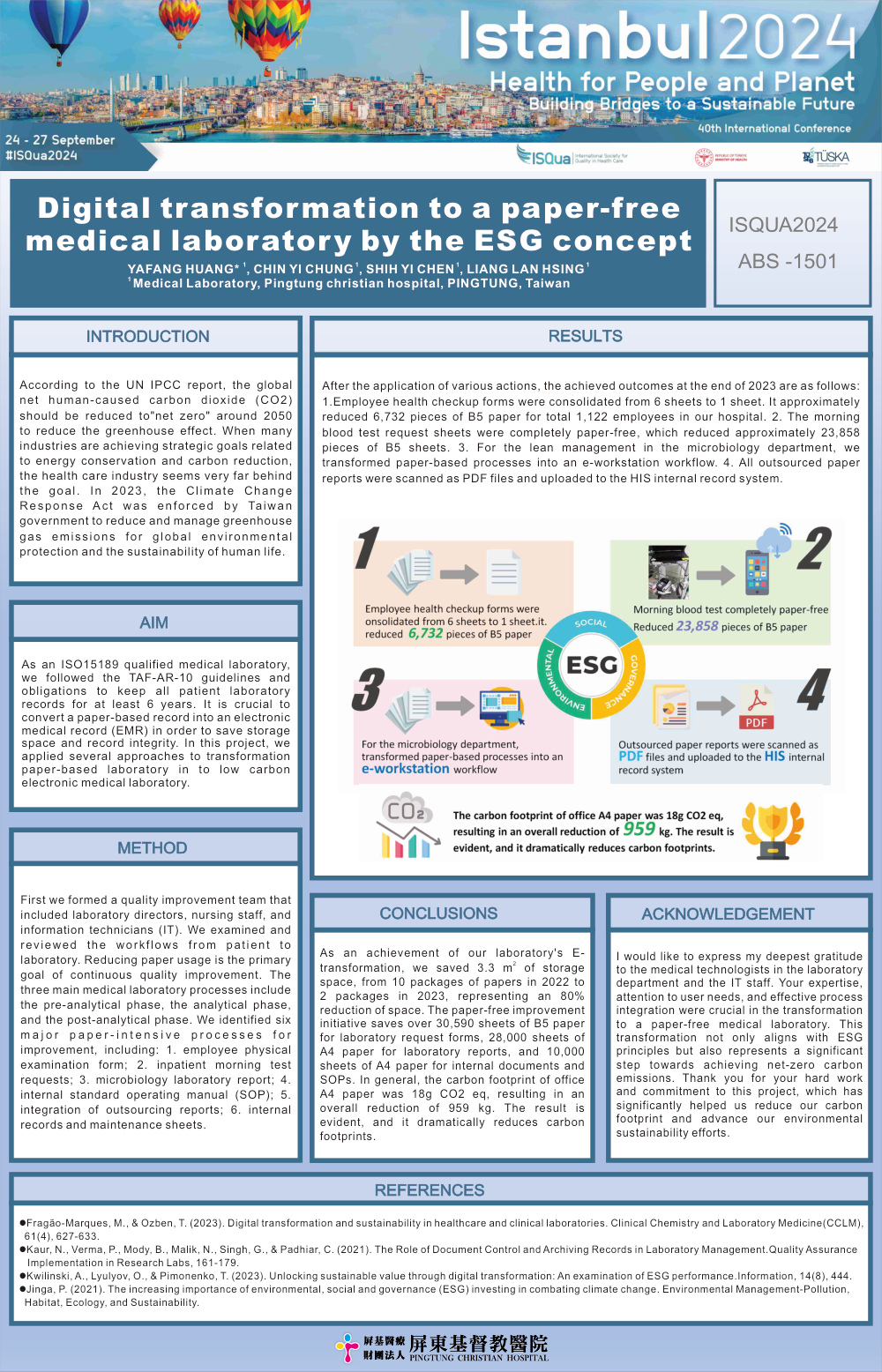
First we formed a quality improvement team that included laboratory directors, nursing staff, and information technicians (IT). We examined and reviewed the workflows from patient to laboratory. Reducing paper usage is the primary goal of continuous quality improvement. The three main medical laboratory processes include the pre-analytical phase, the analytical phase, and the post-analytical phase. We identified six major paper-intensive processes for improvement, including: 1. employee physical examination form; 2. inpatient morning test requests; 3. microbiology laboratory report; 4. internal standard operating manual (SOP); 5. integration of outsourcing reports; 6. internal records and maintenance sheets.
RESULTS
After the application of various actions, the achieved outcomes at the end of 2023 are as follows: 1. Employee health checkup forms were consolidated from 6 sheets to 1 sheet. It approximately reduced 6,732 pieces of B5 paper for total 1,122 employees in our hospital. 2. The morning blood test request sheets were completely paper-free, which reduced approximately 23,858 pieces of B5 sheets. 3. For the lean management in the microbiology department, we transformed paper-based processes into an e-workstation workflow. 4. All outsourced paper reports were scanned as PDF files and uploaded to the HIS internal record system.
CONCLUSIONS
As an achievement of our laboratory's E-transformation, we saved 3.3 m2 of storage space, from 10 packages of papers in 2022 to 2 packages in 2023, representing an 80% reduction of space. The paper-free improvement initiative saves over 30,590 sheets of B5 paper for laboratory request forms, 28,000 sheets of A4 paper for laboratory reports, and 10,000 sheets of A4 paper for internal documents and SOPs. In general, the carbon footprint of office A4 paper was 18g CO2 eq, resulting in an overall reduction of 959 kg. The result is evident, and it dramatically reduces carbon footprints.
ACKNOWLEDGEMENT
I would like to express my deepest gratitude to the medical technologists in the laboratory department and the IT staff. Your expertise, attention to user needs, and effective process integration were crucial in the transformation to a paper-free medical laboratory. This transformation not only aligns with ESG principles but also represents a significant step towards achieving net-zero carbon emissions. Thank you for your hard work and commitment to this project, which has significantly helped us reduce our carbon footprint and advance our environmental sustainability efforts.
REFERENCES