Loading...

586 posters, 8 topics, 23 sessions, 1,077 authors, 622 institutions

ePostersLive by SciGen Technologies S.A. All rights reserved.

ISQua's 40th International Conference 2024

24th - 27th September 2024 | Istanbul, Türkiye

ISQua's 40th International Conference 2024 banner

P675

A Comprehensive Approach for Designing a Sustainable Energy Management System
Poster Presenter

Rajanen Jeyabalan

Part of Topic

Navigating Climate Change and Sustainability in Healthcare System

As the premier government link organization in providing integrated cardiovascular and thoracic care, Institut Jantung Negara (IJN) also known as National Heart Institute of Malaysia is committed to a comprehensive green initiative to reduce CO2 emissions, with the primary goal of becoming a Green Healthcare facility (Frumkin et al., 2007).  

To complement the national aspiration to reduce 40% CO2 emission by 2030 (Malaysia International Trade Investment, 2018).


The primary objective of IJN’s energy management program is to achieve 10% energy saving by 2025 compared to the baseline year of 2018.


To determine actual energy performance, IJN uses TWO methods specified by the International Performance Measurement and Verification Protocol (IPMVP) to measure overall energy performance.

§Option B : Calculation of the static factor measurement and verification for the entire facility, and
§Option C : Regression analysis was used to assess the impact of various clinical and environmental variables on energy consumption.
 

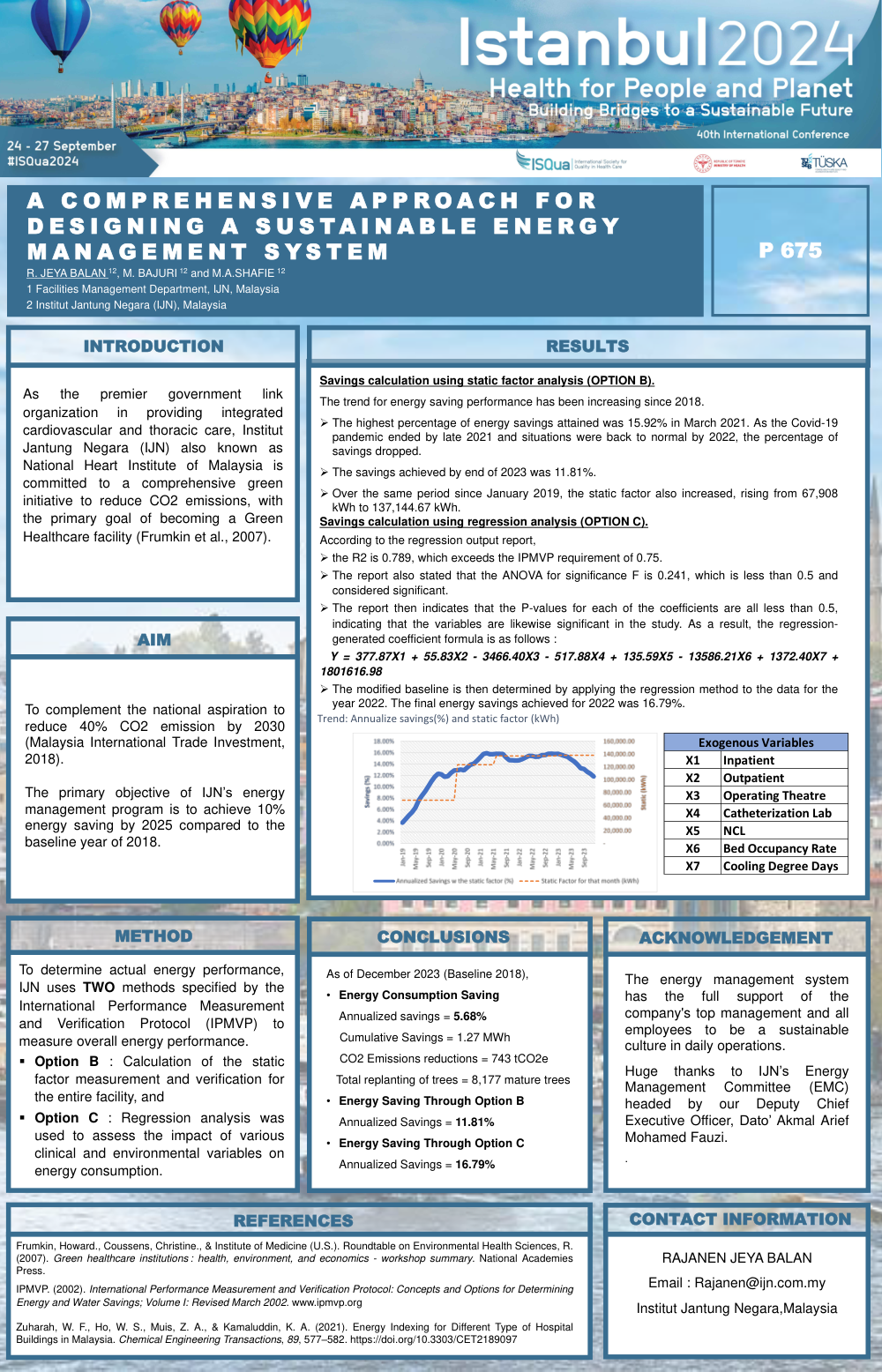
Savings calculation using static factor analysis (OPTION B).

The trend for energy saving performance has been increasing since 2018.

ØThe highest percentage of energy savings attained was 15.92% in March 2021. As the Covid-19 pandemic ended by late 2021 and situations were back to normal by 2022, the percentage of savings dropped.
ØThe savings achieved by end of 2023 was 11.81%.
ØOver the same period since January 2019, the static factor also increased, rising from 67,908 kWh to 137,144.67 kWh.

Savings calculation using regression analysis (OPTION C).

According to the regression output report,

Øthe R2 is 0.789, which exceeds the IPMVP requirement of 0.75.
ØThe report also stated that the ANOVA for significance F is 0.241, which is less than 0.5 and considered significant.
ØThe report then indicates that the P-values for each of the coefficients are all less than 0.5, indicating that the variables are likewise significant in the study. As a result, the regression-generated coefficient formula is as follows :

   Y = 377.87X1 + 55.83X2 - 3466.40X3 - 517.88X4 + 135.59X5 - 13586.21X6 + 1372.40X7 +       1801616.98

ØThe modified baseline is then determined by applying the regression method to the data for the year 2022. The final energy savings achieved for 2022 was 16.79%.
 

As of December 2023 (Baseline 2018),

•Energy Consumption Saving

    Annualized savings = 5.68%

    Cumulative Savings = 1.27 MWh

    CO2 Emissions reductions = 743 tCO2e

   Total replanting of trees = 8,177 mature trees

•Energy Saving Through Option B

    Annualized Savings = 11.81%

•Energy Saving Through Option C

    Annualized Savings = 16.79%

 
ISQua's 40th International Conference 2024 » banner
Copyright © 2015-2026, ePostersLive® SciGen is a registered trademark of SciGen Technologies S.A. Patent pending.

This website and third-party tools we use rely on cookies for the best user experience. By selecting "I agree", you agree to cookie usage as described in our Privacy Policy.