293 posters, 56 videos, 24 topics, 13 sessions, 658 authors, 215 institutions
ePostersLive by SciGen Technologies S.A. All rights reserved.
ISMICS 2025 Annual Meeting
28 - 31 May, 2025 | Istanbul, Turkey

P49
Active Chest Tube Clearance In Eras Program Improves Outcomes And Reduces Resource Use After Cardiac Surgery
Poster Presenter
Part of Topic
New Tech
Active Chest Tube Clearance Added to an Enhanced Recovery After Cardiac Surgery (ERAS) Program
Improves Outcomes and Reduces Resource Utilization
Marc Gerdisch MD, Chanice Johns RN, Manesh Parikshak MD, Andrew Barksdale MD, Louis P. Perrault MD, PhD
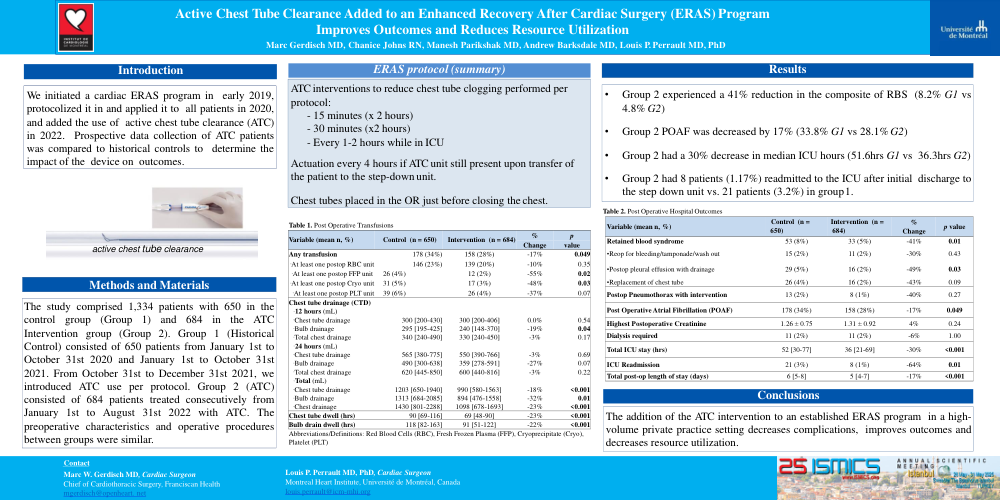
We initiated a cardiac ERAS program in early 2019, protocolized it in and applied it to all patients in 2020, and added the use of active chest tube clearance (ATC) in 2022. Prospective data collection of ATC patients was compared to historical controls to determine the impact of the device on outcomes.
The study comprised 1,334 patients with 650 in the control group (Group 1) and 684 in the ATC Intervention group (Group 2). Group 1 (Historical Control) consisted of 650 patients from January 1st to October 31st 2020 and January 1st to October 31st 2021. From October 31st to December 31st 2021, we introduced ATC use per protocol. Group 2 (ATC) consisted of 684 patients treated consecutively from January 1st to August 31st 2022 with ATC. The preoperative characteristics and operative procedures between groups were similar.
ATC interventions to reduce chest tube clogging performed per protocol:
Actuation every 4 hours if ATC unit still present upon transfer of the patient to the step-down unit. Chest tubes placed in the OR just before closing the chest.
Group 2 experienced a 41% reduction in the composite of RBS (8.2% G1 vs 4.8% G2)
Group 2 POAF was decreased by 17% (33.8% G1 vs 28.1% G2)
Group 2 had a 30% decrease in median ICU hours (51.6hrs G1 vs 36.3hrs G2)
Group 2 had 8 patients (1.17%) readmitted to the ICU after initial discharge to the step down unit vs. 21 patients (3.2%) in group 1.
The addition of the ATC intervention to an established ERAS program in a high-volume private practice setting decreases complications, improves outcomes and decreases resource utilization.