293 posters, 56 videos, 24 topics, 13 sessions, 658 authors, 215 institutions
ePostersLive by SciGen Technologies S.A. All rights reserved.
ISMICS 2025 Annual Meeting
28 - 31 May, 2025 | Istanbul, Turkey

P45
Robotic Endoscopic Off-pump Pericardiectomy: Early And Long-term Outcomes
Poster Presenter
Authors
Affiliations
Part of Topic
New Tech
Robotic Endoscopic Off-Pump Pericardiectomy: Early and Long-term Outcomes
Background and Methods
Constrictive pericarditis is a rare condition in which an inelastic, thickened pericardium impedes cardiac filling, resulting in high mortality if untreated (up to 90%). [1]
Pericardiectomy offers definitive treatment when medical therapy fails, traditionally performed via a sternotomy, phrenic-to-phrenic approach. [2]
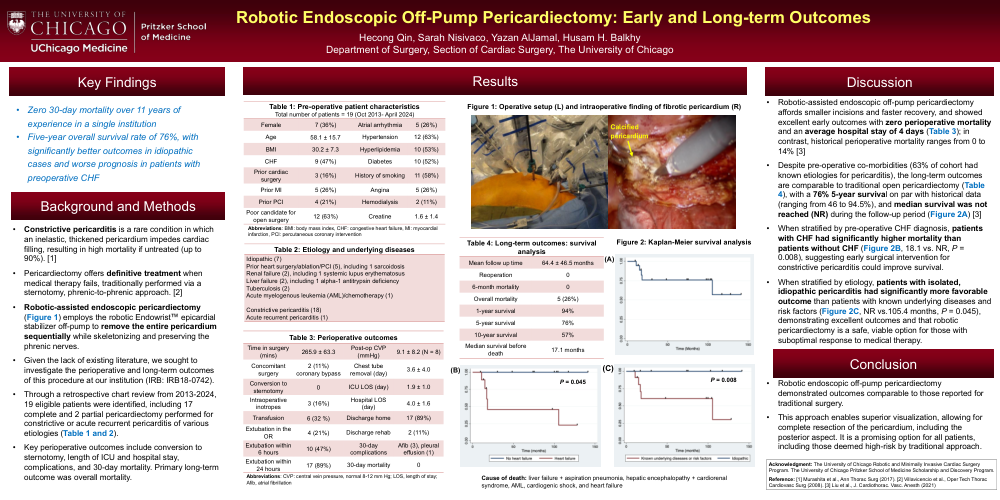
Robotic-assisted endoscopic pericardiectomy (Figure 1) employs the robotic Endowrist™ epicardial stabilizer off-pump to remove the entire pericardium sequentially while skeletonizing and preserving the phrenic nerves.
Given the lack of existing literature, we sought to investigate the perioperative and long-term outcomes of this procedure at our institution (IRB: IRB18-0742).
Through a retrospective chart review from 2013-2024, 19 eligible patients were identified, including 17 complete and 2 partial pericardiectomy performed for constrictive or acute recurrent pericarditis of various etiologies (Table 1 and 2).
Key perioperative outcomes include conversion to sternotomy, length of ICU and hospital stay, complications, and 30-day mortality. Primary long-term outcome was overall mortality.
Results and Discussion
Robotic-assisted endoscopic off-pump pericardiectomy affords smaller incisions and faster recovery, and showed excellent early outcomes with zero perioperative mortality and an average hospital stay of 4 days (Table 3); in contrast, historical perioperative mortality ranges from 0 to 14% [5]
Despite pre-operative co-morbidities (63% of cohort had known etiologies for pericarditis), the long-term outcomes are comparable to traditional open pericardiectomy (Table 4), with a 76% 5-year survival on par with historical data (ranging from 46 to 94.5%), and median survival was not reached (NR) during the follow-up period (Figure 2A) [5]
When stratified by pre-operative CHF diagnosis, patients with CHF had significantly higher mortality than patients without CHF (Figure 2B, 18.1 vs. NR, P = 0.008), suggesting early surgical intervention for constrictive pericarditis could improve survival.
When stratified by etiology, patients with isolated, idiopathic pericarditis had significantly more favorable outcome than patients with known underlying diseases and risk factors (Figure 2C, NR vs.105.4 months, P = 0.045), demonstrating excellent outcomes and that robotic pericardiectomy is a safe, viable option for those with suboptimal response to medical therapy.
Conculsions
Robotic endoscopic off-pump pericardiectomy demonstrated outcomes comparable to those reported for traditional surgery.
This approach enables superior visualization, allowing for complete resection of the pericardium, including the posterior aspect. It is a promising option for all patients, including those deemed high-risk by traditional approach.