293 posters, 56 videos, 24 topics, 13 sessions, 658 authors, 215 institutions
ePostersLive by SciGen Technologies S.A. All rights reserved.
ISMICS 2025 Annual Meeting
28 - 31 May, 2025 | Istanbul, Turkey
P43
Development And Fidelity Validation Of A 3d Printed Minimal Access Mitral Valve Surgery Simulator
Poster Presenter
Authors
Apurva H Bharucha, Abigail White, John Moore, Mehdi Eskandari, Fatemeh Habibi Nameghi, Ritesh Kanyal, Phillip MacCarthy, Habib Khan, Max Baghai, Gianluigi Bisleri, Ishtiaq Ahmed, Ranjit Deshpande
Affiliations
King's College Hospital, London, United Kingdom, University of Alberta, Edmonton, Canada, Western University, London, Ontario, Canada, University of Toronto, Toronto, Ontario, Canada, Royal Sussex County Hospital, Brighton, United Kingdom
Part of Topic
New Tech
DEVELOPMENT AND FIDELITY OF A 3D-PRINTED MINIMAL ACCESS MITRAL VALVE SURGERY SIMULATOR
APURVA H BHARUCHA1, ABIGAIL WHITE2, JOHN MOORE3, MEHDI ESKANDARI1, FATEMEH H NAMEGHI1, RITESH KANYAL1, PHILLIP MACCARTHY1,
HABIB KHAN1, MAX BAGHAI1, GIANLUIGI BISLERI4, ISTIAQ AHMED5, RANJIT DESHPANDE1
1. King’s College Hospital, London 2. University of Alberta, Edmonton, Canada 3. Western University, London, ON, Canada 4. University of Toronto, Toronto, ON, Canada, 5. Royal Sussex County Hospital, Brighton, United Kingdom
1. BACKGROUND
Minimally invasive mitral valve surgery (MIMVS) is associated with a lower incidence of post-operative bleeding, pain and shorter lengths of hospital stay compared to sternotomy whilst having equivalent outcomes. As such, there is a drive towards increasing provision of MIMVS in the UK. MIMVS is associated with an adverse learning curve, representing a key barrier to expanding service provision especially given the challenges facing modern surgical training1. Simulation training has been shown to enhance surgical skills.
This British and Irish Society of Minimally Invasive Surgery (BISMICS) supported work aimed to design, manufacture and validate the fidelity of a 3D printed MIMVS training platform for integration into a future UK training programme1.
2. METHODS
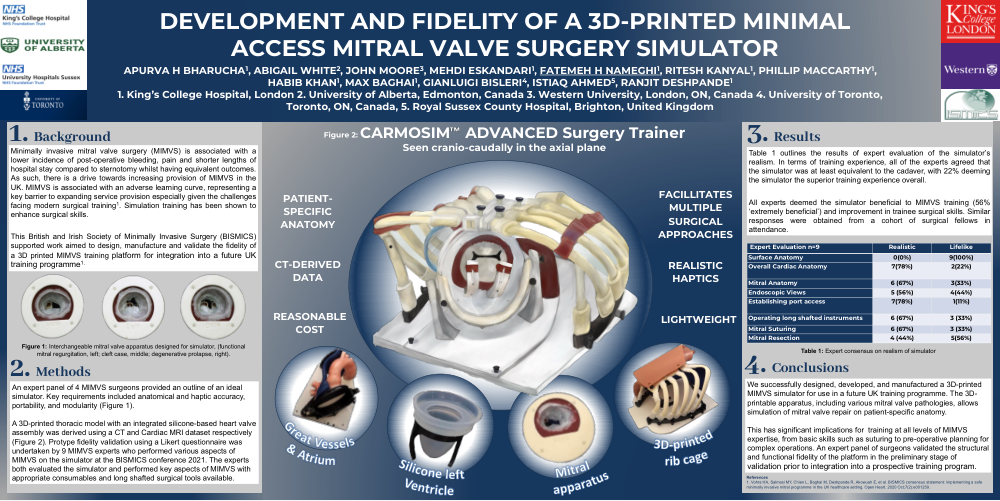
An expert panel of 4 MIMVS surgeons provided an outline of an ideal simulator. Key requirements included anatomical and haptic accuracy, portability, and modularity (Figure 1).
A 3D-printed thoracic model with an integrated silicone-based heart valve assembly was derived using a CT and Cardiac MRI dataset respectively (Figure 2). Protype fidelity validation using a Likert questionnaire was undertaken by 9 MIMVS experts who performed various aspects of MIMVS on the simulator at the BISMICS conference 2021. The experts both evaluated the simulator and performed key aspects of MIMVS with appropriate consumables and long shafted surgical tools available.
3. RESULTS
Table 1 outlines the results of expert evaluation of the simulator’s realism. In terms of training experience, all of the experts agreed that the simulator was at least equivalent to the cadaver, with 22% deeming the simulator the superior training experience overall.
All experts deemed the simulator beneficial to MIMVS training (56% ‘extremely beneficial’) and improvement in trainee surgical skills. Similar responses were obtained from a cohort of surgical fellows in attendance.
4. CONCLUSIONS
We successfully designed, developed, and manufactured a 3D-printed MIMVS simulator for use in a future UK training programme. The 3D-printable apparatus, including various mitral valve pathologies, allows simulation of mitral valve repair on patient-specific anatomy.
This has significant implications for training at all levels of MIMVS expertise, from basic skills such as suturing to pre-operative planning for complex operations. An expert panel of surgeons validated the structural and functional fidelity of the platform in the preliminary stage of validation prior to integration into a prospective training program.
REFERENCES
1. Vohra HA, Salmasi MY, Chien L, Baghai M, Deshpande R, Akowuah E, et al. BISMICS consensus statement: implementing a safe minimally invasive mitral programme in the UK healthcare setting. Open Heart. 2020 Oct;7(2):e001259.