293 posters, 56 videos, 24 topics, 13 sessions, 658 authors, 215 institutions
ePostersLive by SciGen Technologies S.A. All rights reserved.
ISMICS 2025 Annual Meeting
28 - 31 May, 2025 | Istanbul, Turkey

P42
Robotic Endoscopic Cardiac Surgery In Patients With Previous Coronary Artery Bypass Grafting: A Safer Alternative?
Poster Presenter
Authors
Sarah Nisivaco, Hiroto Kitahara, Kaitlin Grady, Won Hee Oh, Husam H Balkhy
Affiliations
Part of Topic
New Tech
Robotic endoscopic cardiac surgery in patients with previous coronary artery bypass grafting: A safer alternative?
Objective
Redo heart surgery after prior coronary bypass (CABG) can be complicated by cardiac and/or graft injury during re-sternotomy. A robotic approach has the potential to eliminate the risks of re-sternotomy. We present a series of patients undergoing robotic totally-endoscopic cardiac surgical procedures after prior CABG.
Methods
Of 1,860 patients who underwent robotic cardiac surgery at our institution between 7/2013-5/2025, 51 patients had previous CABG and are the subject of this review. Re-operative robotic procedures included both epicardial and intracardiac procedures. Perioperative and early clinical outcomes were reviewed.
Results
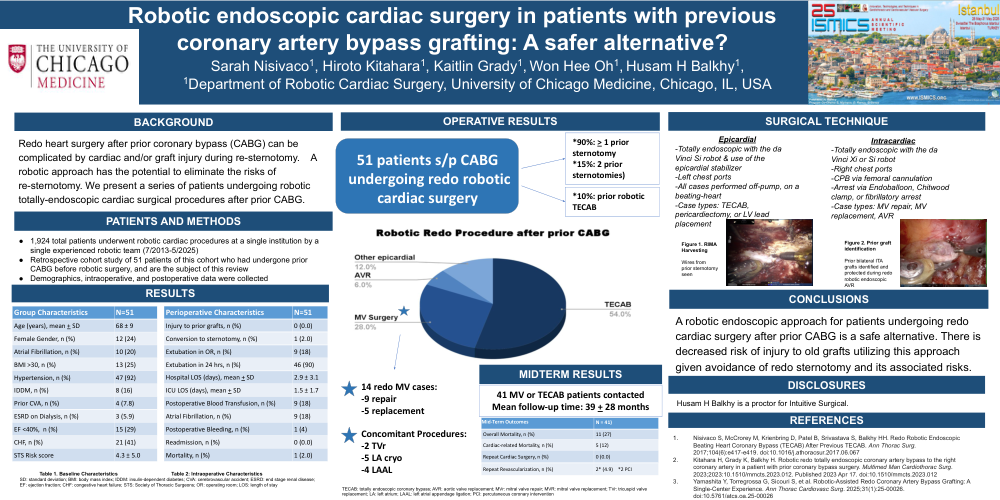
Of 51 patients undergoing robotic cardiac surgery after prior CABG – 90% (45 patients) had undergone at least 1 sternotomy (of which 16% had 2 previous sternotomies). 5 patients had prior coronary bypass via robotic TECAB.
The robotic re-operative procedures performed were as follows: 27 patients (54%) TECAB; 14 (28%) robotic MV surgery (10 repair, 4 replacement); 3 (6%) robotic AVR; 1 pericardiectomy; and 5 robotic epicardial LV lead placements - Figure-1.
Mean age was 68±8.3 years, mean STS score was 4.3±5.0%. All TECABs were performed beating-heart. In intracardiac cases, the most common arrest method was fibrillatory arrest–60%. There were no graft injuries. There was 1 intraoperative conversion to sternotomy (for RV bleeding during TECAB after prior open CABG).
32 patients (64%) were extubated in the OR or within 6 hours postoperatively. Overall mean hospital LOS was 2.9±3.1 days (ICU LOS 1.5±1.8 days). Postoperatively, 18% had new AF and 4% had AKI. There were no take-backs for bleeding, MI, or strokes. There was 1 hospital mortality (O/E mortality ratio 0.2) in a third-time redo TECAB patient with prior and intraoperative vein graft occlusion. There were 5 readmissions (10%). Mean time to return to full activities and work was 15.3±10 and 13.7±15 days, respectively.
Conclusions
A robotic endoscopic approach for patients undergoing redo cardiac surgery after prior CABG is a safe alternative. There is decreased risk of injury to old grafts utilizing this approach given avoidance of redo sternotomy and its associated risks.