293 posters, 56 videos, 24 topics, 13 sessions, 658 authors, 215 institutions
ePostersLive by SciGen Technologies S.A. All rights reserved.
ISMICS 2025 Annual Meeting
28 - 31 May, 2025 | Istanbul, Turkey

P46
Enhancing Surgical Planning And Intraoperative Support For Anatomic Lung Resections Using Three-dimensional Reconstructive Technology
Poster Presenter
Part of Topic
New Tech
Introduction
•Randomized controlled trials show sublobar resections are superior to lobectomy for small peripheral non-small cell lung cancers1,2
•Preserve lung function while maintaining oncologic standards
•Unfamiliarity with segmental anatomy, including aberrant vasculature, might hinder adoption of sublobar resections outside clinical trials
•Hypothesis: 3D reconstruction may allow for better preoperative planning compared to computed tomography (CT) scans alone
•Aim: a pilot study to explore the feasibility and utility of incorporating 3D reconstruction into operative workflow and intraoperative decision-making in patients undergoing sublobar resection
Methods
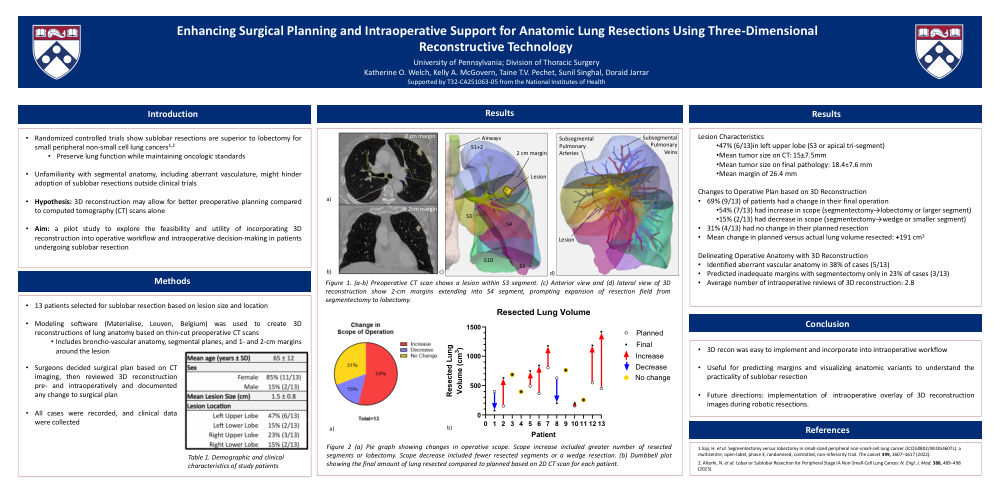
•13 patients selected for sublobar resection based on lesion size and location
•Modeling software (Materialise, Leuven, Belgium) was used to create 3D reconstructions of lung anatomy based on thin-cut preoperative CT scans
•Includes broncho-vascular anatomy, segmental planes, and 1- and 2-cm margins around the lesion
•Surgeons decided surgical plan based on CT imaging, then reviewed 3D reconstruction pre- and intraoperatively and documented any change to surgical plan
•All cases were recorded, and clinical data were collected
Results
Lesion Characteristics
•47% (6/13)in left upper lobe (S3 or apical tri-segment)
•Mean tumor size on CT: 15±7.5mm
•Mean tumor size on final pathology: 18.4±7.6 mm
•Mean margin of 26.4 mm
Changes to Operative Plan based on 3D Reconstruction
•69% (9/13) of patients had a change in their final operation
•54% (7/13) had increase in scope (segmentectomy→lobectomy or larger segment)
•15% (2/13) had decrease in scope (segmentectomy→wedge or smaller segment)
•31% (4/13) had no change in their planned resection
•Mean change in planned versus actual lung volume resected: +191 cm3
Delineating Operative Anatomy with 3D Reconstruction
•Identified aberrant vascular anatomy in 38% of cases (5/13)
•Predicted inadequate margins with segmentectomy only in 23% of cases (3/13)
•Average number of intraoperative reviews of 3D reconstruction: 2.8
Conclusions
•3D recon was easy to implement and incorporate into intraoperative workflow
•Useful for predicting margins and visualizing anatomic variants to understand the practicality of sublobar resection
•Future directions: implementation of intraoperative overlay of 3D reconstruction images during robotic resections.