293 posters, 56 videos, 24 topics, 13 sessions, 658 authors, 215 institutions
ePostersLive by SciGen Technologies S.A. All rights reserved.
ISMICS 2025 Annual Meeting
28 - 31 May, 2025 | Istanbul, Turkey
P48
Automated Titanium Fastener Use In Low-risk Patients Undergoing Minimally Invasive Mitral Valve Repair
Poster Presenter
Authors
Mark Lutz, Shaelyn M. Cavanaugh, Karikehalli Dilip, Ahmad Nazem, Anton Cherney, Zhandong Zhou, Kyle Purrman, Jude S. Sauer, Charles Lutz
Affiliations
SUNY Upstate Medical University, University of Rochester, Department of Surgery, St. Jospeh's Health Hospital, St. Joseph's Health Hospital, LSI SOLUTIONS
Part of Topic
New Tech
Objective:
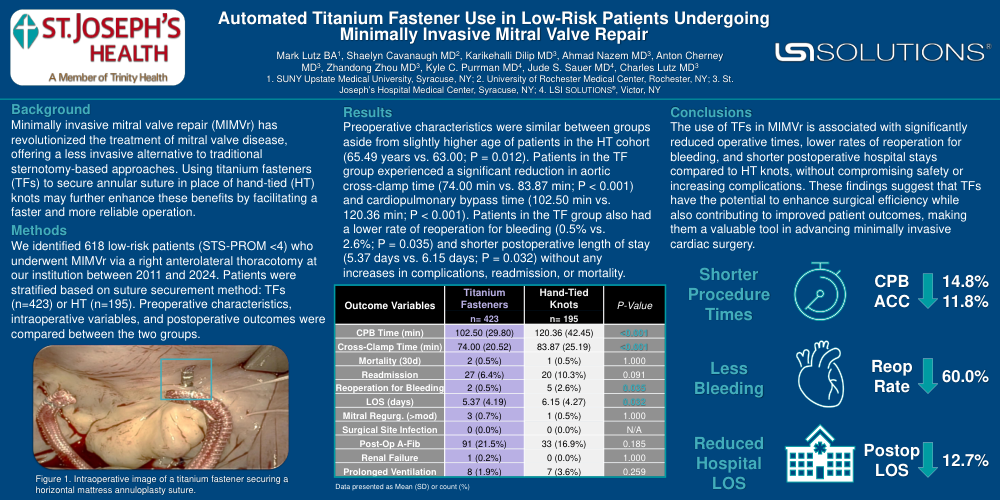
Minimally invasive mitral valve repair (MIMVr) has revolutionized the treatment of mitral valve disease, offering a less invasive alternative to traditional sternotomy-based approaches. Using titanium fasteners (TFs) to secure annular suture in place of hand-tied (HT) knots may further enhance these benefits by facilitating a faster and more reliable operation.
Methods:
We identified 618 low-risk patients (STS-PROM <4) who underwent MIMVr via a right anterolateral thoracotomy at our institution between 2011 and 2024. Patients were stratified based on suture securement method: TFs (n=423) or HT (n=195). Preoperative characteristics, intraoperative variables, and postoperative outcomes were compared between the two groups.
Results:
Preoperative characteristics were similar between groups aside from a small but significant increase in the age of patients in the HT cohort (65.49 years vs. 63.00; P = 0.012). Patients in the TF group experienced a statistically significant reduction in aortic cross-clamp time (74.00 min vs. 83.87 min; P < 0.001) and cardiopulmonary bypass time (102.50 min vs. 120.36 min; P < 0.001). Patients in the TF group also had a lower rate of reoperation for bleeding (0.5% vs 2.6%; P = 0.035) and shorter postoperative length of stay (5.37 days vs. 6.15 days; P = 0.032) without any increases in complications, readmission or mortality.
Conclusion:
The use of TFs in MIMVr is associated with significantly reduced operative times, lower rates of reoperation for bleeding, and shorter postoperative hospital stays compared to HT knots, without compromising safety or increasing complications. These findings suggest that TFs have the potential to enhance surgical efficiency while also contributing to improved patient outcomes, making them a valuable tool in advancing minimally invasive cardiac surgery.