Loading...

167 posters, 28 videos, 9 topics, 12 sessions, 337 authors, 160 institutions

ePostersLive by SciGen Technologies S.A. All rights reserved.

ISMICS 2023 Annual Meeting

31 May - 3 June, 2023 | Boston, MA

ISMICS 2023 Annual Meeting banner

PC86

Preventing Coronary Artery Obstruction Using A Designed Device During Transcatheter Aortic Valve Replacement
Part of Topic

Valve - Transcatheter Therapies

Preventing Coronary Artery Obstruction Using A Designed Device During Transcatheter Aortic Valve Replacement

Background:

•Transcatheter aortic valve replacement (TAVR) induced coronary artery obstruction (CAO) is a rare but devasting complication.
•Current preventive strategies need additional procedures and may be associated with adverse events.
•This study aimed to evaluate the early safety and efficacy of stand-alone TAVR using the J-Valve (Jianshi JieCheng Medical Technology Co. Ltd, Shanghai, China) in patients at potential high risk for CAO.
 

Patients:

•A total of 22 consecutive patients (age 72 ± 9 years; 86.4% female; STS 5% (3%-21%)) at potential high risk for CAO were retrospectively identified from January 2015 to July 2022 at Zhongshan Hospital, Fudan university.
•All patients had at least 2 classical risk factors for CAO by pre-procedural CT analysis: coronary height < 10 mm, sinus of Valsalva diameter < 30 mm, and virtual transcatheter heart valve to coronary distance  < 4 mm
•20 patients had native aortic disease, and 2 patients had bioprosthetic degeneration

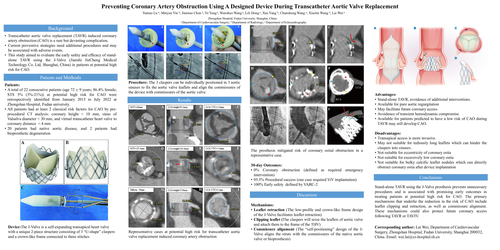
Device: The J-Valve is a self-expanding transapical heart valve with a unique 2-piece structure consisting of 3 “U-shape” claspers and a crown-like frame connected to three stitches

Procedure: The 3 claspers can be individually positioned in 3 aortic sinuses to fix the aortic valve leaflets and align the commissures of the device with commissures of the aortic valve.

30-day Outcomes:

•0% Coronary obstruction (defined as required emergency intervention)
•95.5% Procedural success (one case required ViV implantation)
•100% Early safety  defined by VARC-2
 

Mechanisms:

•Leaflet retraction (The low-profile and crown-like frame design of the J-Valve facilitates leaflet retraction)
•Clipping leaflet (The claspers will seize the leaflets of aortic valve and attach them to the frame of the THV)
•Commissure alignment (The “self-positioning” design of the J-Valve aligns the struts with the commissures of the native aortic valve or bioprosthesis)

Advantages:

•Stand-alone TAVR, avoidance of additional interventions.
•Available for pure aortic regurgitation
•May facilitate future coronary access
•Avoidance of transient hemodynamic compromise
•Available for patients predicted to have a low risk of CAO during TAVR may still develop CAO.

Disadvantages:

•Transapical access is more invasive.
•May not suitable for tediously long leaflets which can hinder the claspers into sinuses.
•Not suitable for eccentricity of coronary ostia
•Not suitable for excessively low coronary ostia
•Not suitable for bulky calcific leaflet nodules which can directly obstruct coronary ostia after device implantation
 
Conclusion:

Stand-alone TAVR using the J-Valve prosthesis prevents unnecessary procedures and is associated with promising early outcomes in treating patients at potential high risk for CAO. The primary mechanisms that underlie the reduction in the risk of CAO include leaflet clipping and retraction, as well as commissure alignment. These mechanisms could also protect future coronary access following TAVR or TAVIV.

ISMICS 2023 Annual Meeting » banner
Copyright © 2015-2026, ePostersLive® SciGen is a registered trademark of SciGen Technologies S.A. Patent pending.

This website and third-party tools we use rely on cookies for the best user experience. By selecting "I agree", you agree to cookie usage as described in our Privacy Policy.