167 posters, 28 videos, 9 topics, 12 sessions, 337 authors, 160 institutions
ePostersLive by SciGen Technologies S.A. All rights reserved.
ISMICS 2023 Annual Meeting
31 May - 3 June, 2023 | Boston, MA

PC85
Perioperative Predictors Of Early Mortality Following Transcatheter Aortic Valve Implantation
Poster Presenter
Authors
Affiliations
Part of Topic
Valve - Transcatheter Therapies
Perioperative predictors of early mortality following transcatheter aortic valve implantation
Takayuki Kawashima, Tomoyuki Wada, Takashi Shuto, Kunio Yufu,
Tomoko Fukuda, ShuichiroYamauchi, NaohikoTakahashi, Shinji Miyamoto
Oita University Hospital , JAPAN
BACKGROUNDS
Transcatheter aortic valve implantation (TAVI) has become the gold standard treatment for high surgical risk patients with aortic stenosis (AS), and its indications are expanding. On the other hand, early mortality has also been experienced. We retrospectively investigated perioperative predictors of early mortality within 1 year after TAVI.
METHODS
From March 2013 to December 2021, 233 patients underwent TAVI at our institution. Four patients of procedural failure and one patient of cancer death were excluded from the analysis. Mortality within 1 year after TAVI was defined as early mortality. Predictors of early mortality were evaluated using clinical variables including patient and procedural characteristics.
TAVI in Oita University Hospital
Results
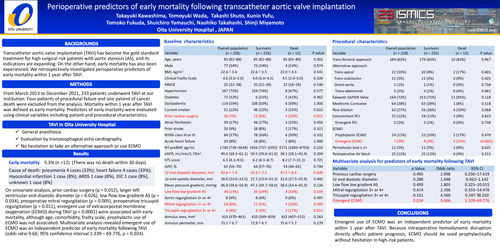
Early mortality 5.3% (n =12) (There was no death within 30 days)
Cause of death: pneumonia 4 cases (33%); heart failure 4 cases (25%); myocardial infarction 1 case (8%); ARDS 1 case (8%), DIC 1 case (8%), unknown 1 case (8%)
On univariate analysis, prior cardiac surgery (p = 0.012), larger left ventricular end-diastolic diameter (p = 0.026), low flow low gradient AS (p = 0.034), preoperative mitral regurgitation (p = 0.005), preoperative tricuspid regurgitation (p = 0.011), emergent use of extracorporeal membrane oxygenation (ECMO) during TAVI (p < 0.0001) were associated with early mortality, although age, comorbidity, frailty scale, prophylactic use of ECMO was not associated. Multivariate analysis revealed emergent use of ECMO was an independent predictor of early mortality following TAVI (odds ratio 9.66; 95% confidence interval 1.339 – 69.776, p = 0.024).
CONCLUSIONS
Emergent use of ECMO was an independent predictor of early mortality within 1 year after TAVI. Because intraoperative hemodynamic disruption directly affects patient prognosis, ECMO should be used prophylactically without hesitation in high-risk patients.