167 posters, 28 videos, 9 topics, 12 sessions, 337 authors, 160 institutions
ePostersLive by SciGen Technologies S.A. All rights reserved.
ISMICS 2023 Annual Meeting
31 May - 3 June, 2023 | Boston, MA

PC84
Transcatheter Mitral Valve-in-valve For Pregnancy With Anti-phospholipid Syndrome
Poster Presenter
Authors
Affiliations
Part of Topic
Valve - Transcatheter Therapies
Video
Transcatheter Mitral Valve-in-Valve for pregnancy with Anti-Phospholipid Syndrome
Zhenzhong Wang, Lishan Zhong, Shuo Xiao, Dou Fang, Fengzhen Han, Huanlei HUANG
Guangdong Provincial People’s Hospital, China
Abstract: We describe the management experience of a transcatheter mitral valve-in-valve (TMViV) replacement in a high-risk pregnant woman with bioprosthetic valve failure and antiphospholipid syndrome (APS). To our knowledge, this is the first case of cardiac surgery with complex systemic immune disease and safe maternal and infant outcomes.
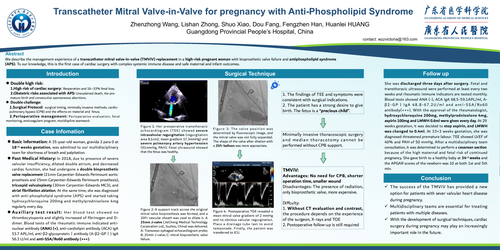
Introduction: Double high risk: 1.High risk of cardiac surgery: Reoperation and 16~33% fetal loss; 2.Obstetric risks associated with APS: Unexplained death, the pre- mature birth and consecutive spontaneous abortions. Double challenge: 1.Surgical Protocol: surgical timing, minimally invasive methods, cardio- pulmonary bypass (CPB) and the effects on material and fetus; 2.Perioperative management: Perioperative evaluation, fetal monitoring, anticoagulant program, mutidispline teamwork.
Case information: Basic information: A 35-year-old woman, gravida 2 para 0 at 18+4 weeks gestation, was admitted to our multidisciplinary team for shortness of breath and palpitation. Past Medical History: In 2018, due to presence of severe valvular insufficiency, dilated double atrium, and decreased cardiac function, she had undergone a double bioprosthetic valve replacement (21mm Carpentier-Edwards Perimount aortic prosthesis and 25mm Carpentier-Edwards Perimount prosthesis), tricuspid valvuloplasty (30mm Carpentier-Edwards MC3), and atrial fibrillation ablation. At the same time, she was diagnosed with anti-phospholipid syndrome (APS) and started taking hydroxychloroquine 200mg and methylprednisolone 4mg regularly every day. Auxiliary test result: Her blood test showed no thrombocytopenia and slightly increased of fibrinogen and D-dimer. Blood tests of the rheumatic immune indicated anti-nuclear antibody (ANA) (+), anti-cardiolipin antibody (ACA) IgA 53.7 APL/ml, anti-β2-glycoproteinⅠantibody (A-β2-GPⅠ) IgA 56.3 U/ml and anti-SSA/Ro60 antibody (+++).
1. The findings of TEE and symptoms were consistent with surgical indications. 2. The patient has a strong desire to give birth. The fetus is a “precious child”.
Minimally invasive thoracoscopic surgery and median thoracotomy cannot be performed without CPB support.
TMViV: Advantages: No need for CPB, shorter operation time, smaller wound Disadvantages: The presence of radiation, only bioprosthetic valve, more expensive. Diffculty: 1. Without CT evaluation and contrast, the procedure depends on the experience of the surgeon, X-rays and TOE 2. Postoperative follow-up is still required.
Follow-up: She was discharged three days after surgery. Fetal and transthoracic ultrasound were performed at least every two weeks and rheumatic immune indicators are tested monthly. Blood tests showed ANA (-), ACA IgA 68.5-59.1APL/ml, A-β2-GP Ⅰ IgA 48.8-67.2U/ml and anti-SSA/Ro60 antibody(+++). With the approval of the rheumatologist, hydroxychloroquine 200mg, methylprednisolone 4mg, aspirin 100mg and LMWH 0.6ml were given every day. At 29 weeks gestation, it was decided to stop aspirin, and LMWH was changed to 0.4ml. At 33+3 weeks gestation, she was diagnosed threatened premature labour. TEE showed LVEF of 40% and PAH of 50 mmHg. After a multidisciplinary team consultation, it was determined to perform a cesarean section because of the high maternal and fetal risk of continued pregnancy. She gave birth to a healthy baby at 34+1 weeks and the APGAR scores of the newborn was 10 at both 1st and 5th min.
Conclusion: The success of the TMViV has provided a new option for patients with sever valvular heart disease during pregnancy. Multidisciplinary teams are essential for treating patients with multiple diseases. With the development of surgical techniques, cardiac surgery during pregnancy may play an increasingly important role in the future.