167 posters, 28 videos, 9 topics, 12 sessions, 337 authors, 160 institutions
ePostersLive by SciGen Technologies S.A. All rights reserved.
ISMICS 2023 Annual Meeting
31 May - 3 June, 2023 | Boston, MA

PC83
The Mitracut Technique To Prevent Left Ventricular Outflow Tract Obstruction During Transcatheter Mitral Valve Replacement
Poster Presenter
Authors
Markus Mach, Tillman Kerbel, Thomas Poschner, Anna Bartunek, Guenther Laufer, Martin Andreas
Affiliations
Part of Topic
Valve - Transcatheter Therapies
The Mitracut Technique To Prevent Outflow Tract Obstruction After Transapical Mitral Valve Replacement
Authors: Markus Mach, Tillmann Kerbel, Thomas Poschner, Anna Bartunek, Guenther Laufer, Martin Andreas.
Medical University of Vienna, Vienna, Austria.
Abstract:
BACKGROUND: This study sought to report the first-in-human experience with a new minimal-invasive surgical hybrid technique to split the
anterior mitral valve leaflet (AML) and prevent iatrogenic left ventricular outflow tract (LVOT) obstruction during transapical transcatheter
mitral valve replacement.
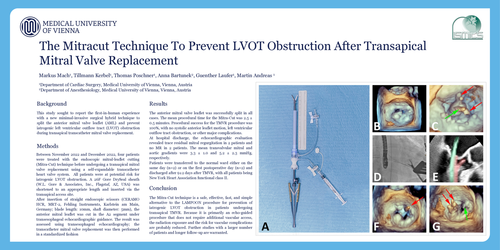
METHODS: Between November 2022 and December 2022, four patients were treated with the endoscopic mitral-leaflet cutting (Mitra-Cut)
technique before undergoing a transapical mitral valve replacement using a self-expandable transcatheter heart valve system. All patients
were at potential risk for iatrogenic LVOT obstruction. A 26F Gore DrySeal sheath (W.L. Gore & Associates, Inc., Flagstaf, AZ, USA) was
shortened to an appropriate length and inserted via the transapical access site. After insertion of straight endoscopic scissors (CERAMO HCR,
MRT-2, Fehling Instruments, Karlstein am Main, Germany; blade length: 10mm, shaft diameter: 5mm), the anterior mitral leaflet was cut in
the A2 segment under transesophageal echocardiographic guidance. The result was assessed using transesophageal echocardiography; the
transcatheter mitral valve replacement was then performed in a standardized fashion.
RESULTS:The anterior mitral valve leaflet was successfully split in all cases. The mean procedural time for the Mitra-Cut was 2.5 ± 0.5
minutes. Procedural success for the TMVR procedure was 100%, with no systolic anterior leaflet motion, left ventricular outflow tract
obstruction, or other major complications. At hospital discharge, the echocardiographic evaluation revealed trace residual mitral
regurgitation in 2 patients and no MR in 2 patients. The mean transvalvular mitral and aortic gradients were 3.3 ± 1.0 and 5.2 ± 2.3 mmHg,
respectively. Patients were transferred to the normal ward either on the same day (n=2) or on the first postoperative day (n=2) and
discharged after 9±2 days after TMVR, with all patients being New York Heart Association functional class II.
CONCLUSIONS:The Mitra-Cut technique is a safe, efective, fast, and simple alternative to the LAMPOON procedure for prevention of
iatrogenic LVOT obstruction in patients undergoing transapical TMVR. Because it is primarily an echo-guided procedure that does not require
additional vascular access, the radiation exposure and the risk for vascular complications are probably reduced. Further studies with a larger
number of patients and longer follow-up are warranted.