477 posters, 14 topics, 2,065 authors, 1,055 institutions
ePostersLive by SciGen Technologies S.A. All rights reserved.
The Joint EBJIS-MSIS 2026 Conference
17 - 19 September, 2026 | Porto, Portugal

PP29
Microbial causes of prosthetic joint infections at a Swedish secondary hospital 2010 to 2022
Poster Presenter
Authors
Tove Gustafsson, Jesper Ericsson, Olof Skoldenberg, Magnus Hedenstierna, Agata Rysinska, Johan Ursing
Affiliations
Danderyd Hospital, Department of Infectious Diseases, Stockholm, Sweden; Karolinska Institutet, Department of Clinical Sciences at Danderyd Hospital, Stockholm, Sweden, Karolinska Institutet, Department of Clinical Sciences at Danderyd Hospital, Stockholm, Sweden; Danderyd Hospital, Department of Orthopaedics, Stockholm, Sweden, Danderyd Hospital, Karolinska Institutet
Part of Topic
Microbiology
Conclusion
The spectrum of bacteria causing prosthetic joint infection (PJI) has not changed significantly over the twelve years study period despite changes in culturing techniques.
Current empiric antibiotic therapy with cefotaxime and vancomycin remains adequate.
Aim
To describe microbiological causes of primary prosthetic joint infections at a Swedish regional referral centre for PJI.
Methods
Retrospective cohort study conducted at Danderyd hospital in Stockholm, Sweden 2010-2022.
Inclusion criteria
- PJI in hip, knee or shoulder (EBJIS criteria)
- primary PJI, defined as infection in joint which had been infection free for ≥2 years
- age ≥18 years
The associations between sex, age, BMI, year of infection, site and type of infection, and causative organisms were assessed using logistic regression.
Results
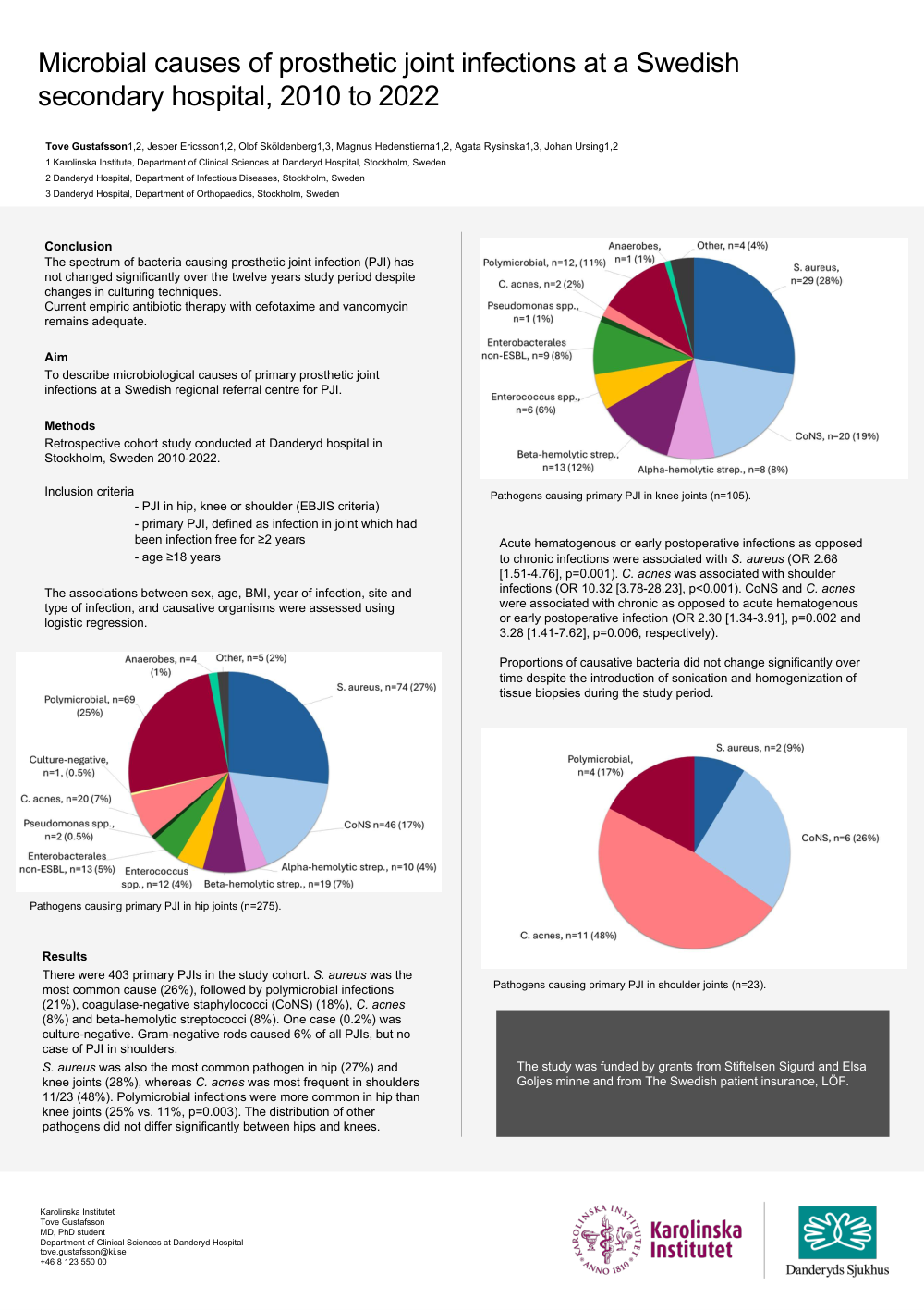
There were 403 primary PJIs in the study cohort. S. aureus was the most common cause (26%), followed by polymicrobial infections (21%), coagulase-negative staphylococci (CoNS) (18%), C. acnes (8%) and beta-hemolytic streptococci (8%). One case (0.2%) was culture-negative. Gram-negative rods caused 6% of all PJIs, but no case of PJI in shoulders.
S. aureus was also the most common pathogen in hip (27%) and knee joints (28%), whereas C. acnes was most frequent in shoulders 11/23 (48%). Polymicrobial infections were more common in hip than knee joints (25% vs. 11%, p=0.003). The distribution of other pathogens did not differ significantly between hips and knees.
Acute hematogenous or early postoperative infections as opposed to chronic infections were associated with S. aureus (OR 2.68 [1.51-4.76], p=0.001). C. acnes was associated with shoulder infections (OR 10.32 [3.78-28.23], p<0.001). CoNS and C. acnes were associated with chronic as opposed to acute hematogenous or early postoperative infection (OR 2.30 [1.34-3.91], p=0.002 and 3.28 [1.41-7.62], p=0.006, respectively).
Proportions of causative bacteria did not change significantly over time despite the introduction of sonication and homogenization of tissue biopsies during the study period.