477 posters, 14 topics, 2,052 authors, 1,056 institutions
ePostersLive by SciGen Technologies S.A. All rights reserved.
The Joint EBJIS-MSIS 2026 Conference
17 - 19 September, 2026 | Porto, Portugal

EP014
Is there an impact of osteoblast-internalization on Cutibacterium acnes biofilm production?
Poster Presenter
Part of Topic
Basic Science
Is there an impact of osteoblast internalization on Cutibacterium acnes biofilm production?
Introduction/Aim
C. acnes is a commensal bacterium that colonizes the pilosebaceous follicles of the skin microbiota. This species is involved in device-related infections particularly insidious shoulder infections leading to prosthesis loosening.
In vitro models have demonstrated the ability of C. acnes to be internalized by osteoblasts. This internalization could act as a stress factor for the bacteria altering their metabolic state.
The study aimed to investigate the impact of C. acnes internalization on its ability to produce biofilm.
Methods
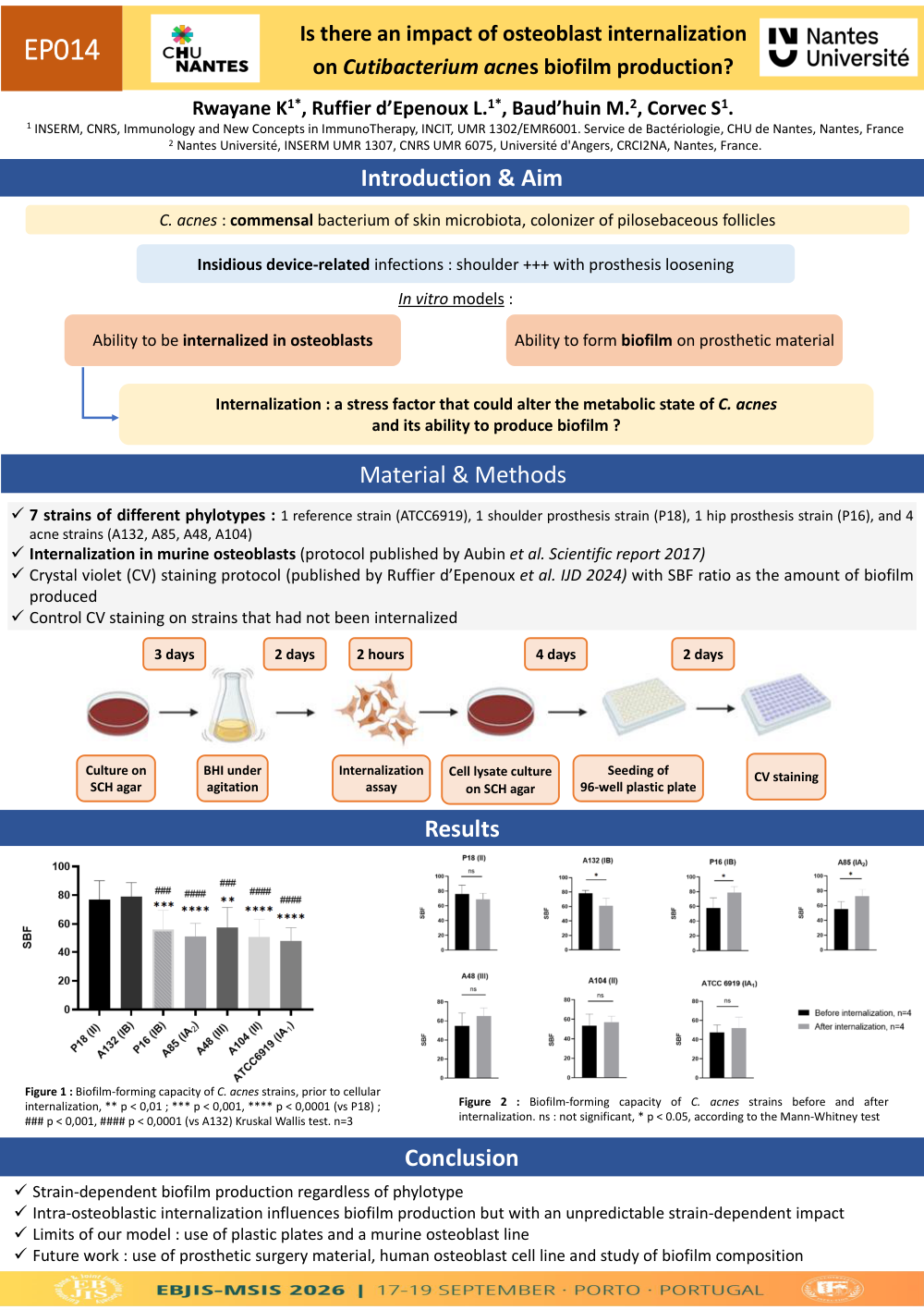
7 C. acnes strains belonging to different phylotypes were selected : 1 ATCC reference strain, 1 shoulder prosthesis strain, 1 hip prosthesis strain, and 4 acne strains. Strains were internalized into murine osteoblast cells, according to the protocol published by Aubin et al. Cell lysates were seeded and incubated for 4 days under anaerobic conditions. Resulting colonies were then used to seed a 96-well plastic plate. After 2 days of incubation under anaerobic conditions, biofilms were stained using crystal violet (CV) method. The amount of biofilm produced was expressed as the SBF ratio. Control CV staining was also performed on strains that had not been internalized.
Results
Before osteoblast internalization, the results revealed marked variability in biofilm production among the strains. Strains P18 and A132, belonging to phylotypes II and IB respectively, are distinguished by significantly higher levels of biofilm production.
For three strains, internalization significantly altered biofilm production. The impact of internalization varied by strain: an increase in biofilm production was observed for strains A48 (+18.9%), A104 (+6.6%), P16 (+36.2%), A85 (+31.1%), and ATCC6919 (+9.7%), while a decrease was observed for strains P18 (-9.7%) and A132 (-22.2%).
Conclusions
Interestingly, the strains that are most likely to form biofilms in our model belong to phylotypes II and IB, which are typivally linked to osteo-articular infections.
Our data show that biofilm production is strain-dependent, regardless of phylotype. Intra-osteoblastic internalization appears to influence biofilm production ability but the impact seems to be strain-dependent and difficult to predict.
Using plastic plates and a murine osteoblast line limit the interpretation of these experiments.
Our future work will use prosthetic surgery material such as titanium alloys as well as a human osteoblast cell line. Finally, since CV staining reflects the total biomass of the biofilm, studying its composition would provide a better understanding of its complex structure.