477 posters, 14 topics, 2,065 authors, 1,055 institutions
ePostersLive by SciGen Technologies S.A. All rights reserved.
The Joint EBJIS-MSIS 2026 Conference
17 - 19 September, 2026 | Porto, Portugal

EP013
Beyond the germ: Rethinking implant-related infections as ahost microbiota biomaterial ecosystem
Poster Presenter
Authors
Debora Coraca-Huber, Christopher Spiegel, Brenda Moraes, Rohit Arora
Affiliations
Medical University Innsbruck, Innsbruck, Austria, Medizinische Universit?t Innsbruck, Research Laboratory for Biofilms and Implant Associated Infections (BIOFILM LAB), Department of Orthopaedics and Traumatology, Medical University of Innsbruck, Austria, Departmento de Odontologia Restauradora, Faculdade de Odontologia de Piracicaba, Universidade Estadual de Campinas, Piracicaba, SP, Brazil, Department of Orthopaedics and Traumatology, Medical University of Innsbruck, Austria
Part of Topic
Basic Science
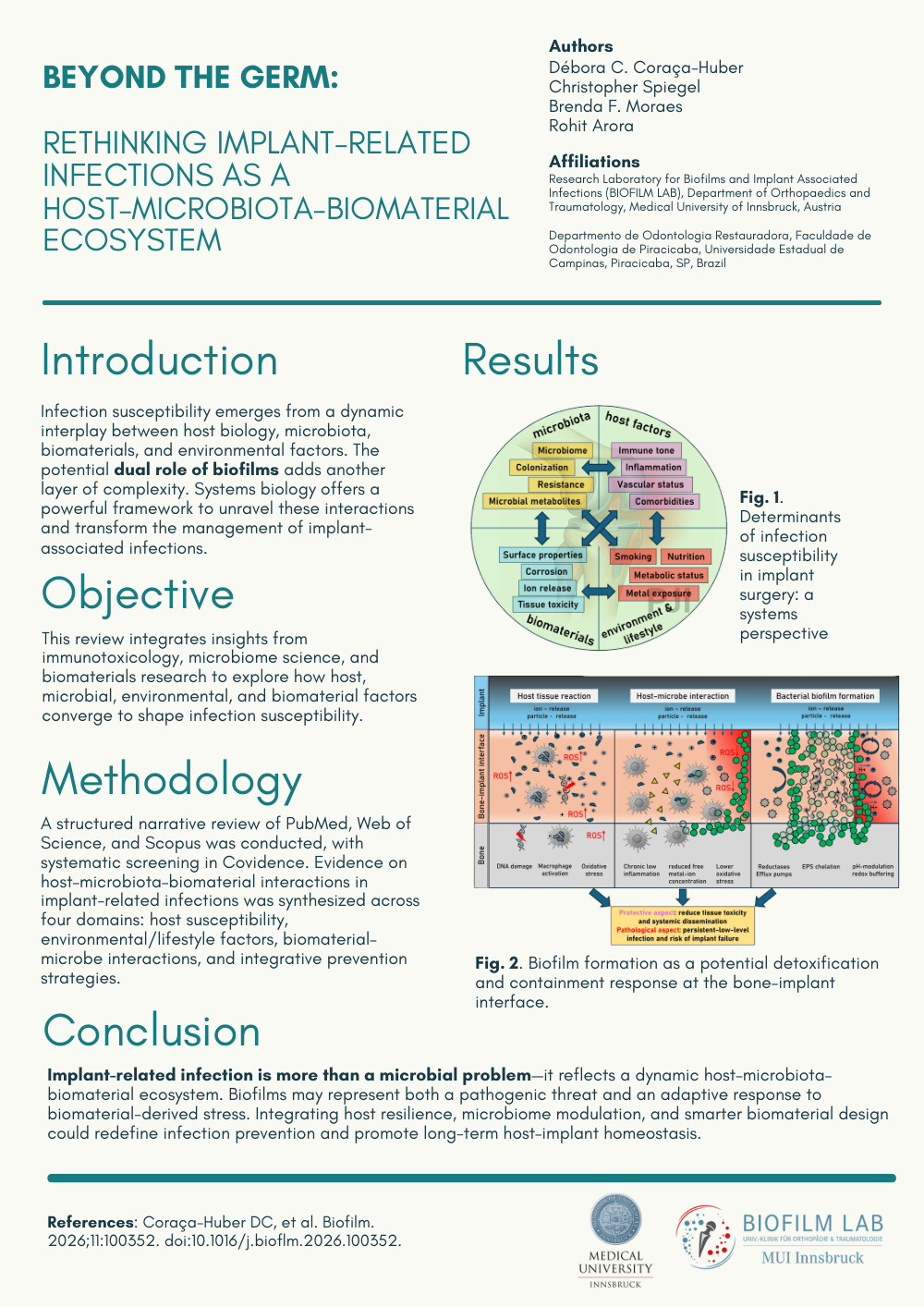
BEYOND THE GERM: RETHINKING IMPLANT-RELATED INFECTIONS AS A HOST–MICROBIOTA-BIOMATERIAL ECOSYSTEM
Introduction
Infection susceptibility emerges from a dynamic
interplay between host biology, microbiota,
biomaterials, and environmental factors. The
potential dual role of biofilms adds another
layer of complexity. Systems biology offers a
powerful framework to unravel these interactions
and transform the management of implantassociated
infections.
Objective
This review integrates insights from
immunotoxicology, microbiome science, and
biomaterials research to explore how host,
microbial, environmental, and biomaterial factors
converge to shape infection susceptibility.
Methodology
A structured narrative review of PubMed, Web of
Science, and Scopus was conducted, with
systematic screening in Covidence. Evidence on
host–microbiota–biomaterial interactions in
implant-related infections was synthesized across
four domains: host susceptibility,
environmental/lifestyle factors, biomaterial–
microbe interactions, and integrative prevention
strategies.
Conclusion
Implant-related infection is more than a microbial problem—it reflects a dynamic host–microbiota–
biomaterial ecosystem. Biofilms may represent both a pathogenic threat and an adaptive response to
biomaterial-derived stress. Integrating host resilience, microbiome modulation, and smarter biomaterial design
could redefine infection prevention and promote long-term host–implant homeostasis.