477 posters, 14 topics, 2,065 authors, 1,055 institutions
ePostersLive by SciGen Technologies S.A. All rights reserved.
The Joint EBJIS-MSIS 2026 Conference
17 - 19 September, 2026 | Porto, Portugal

EP017
Clarifying the age gap between patients and animal models of bone and joint infection: A Systematic Review of 888 models
Poster Presenter
Part of Topic
Basic Science
Adam Gulmann, DVM, Sophie Amalie Blirup-Plum, DVM, P.hD, Louise Kruse Jensen, DVM, P.hD, DM.Sc.
Introduction:
- Bone and joint infections (BJI) primarily occur in elderly patients1
- Advances in innovation and fundamental understanding relies onexperimental animal models
- The age of experimental animalsusedin BJI research are rarely discussed, although possibly quite fundamental
Methods:
- 888 animal models met the inclusion criteria (animal models of PJI, FRI, IAO, COM and AHO in humans) based on a comprehensive PubMed MESH search
- Equivalent human age was calculated & compared with the average age of the corresponding patient population.
- Studies were sorted in type of disease modelled
Results:
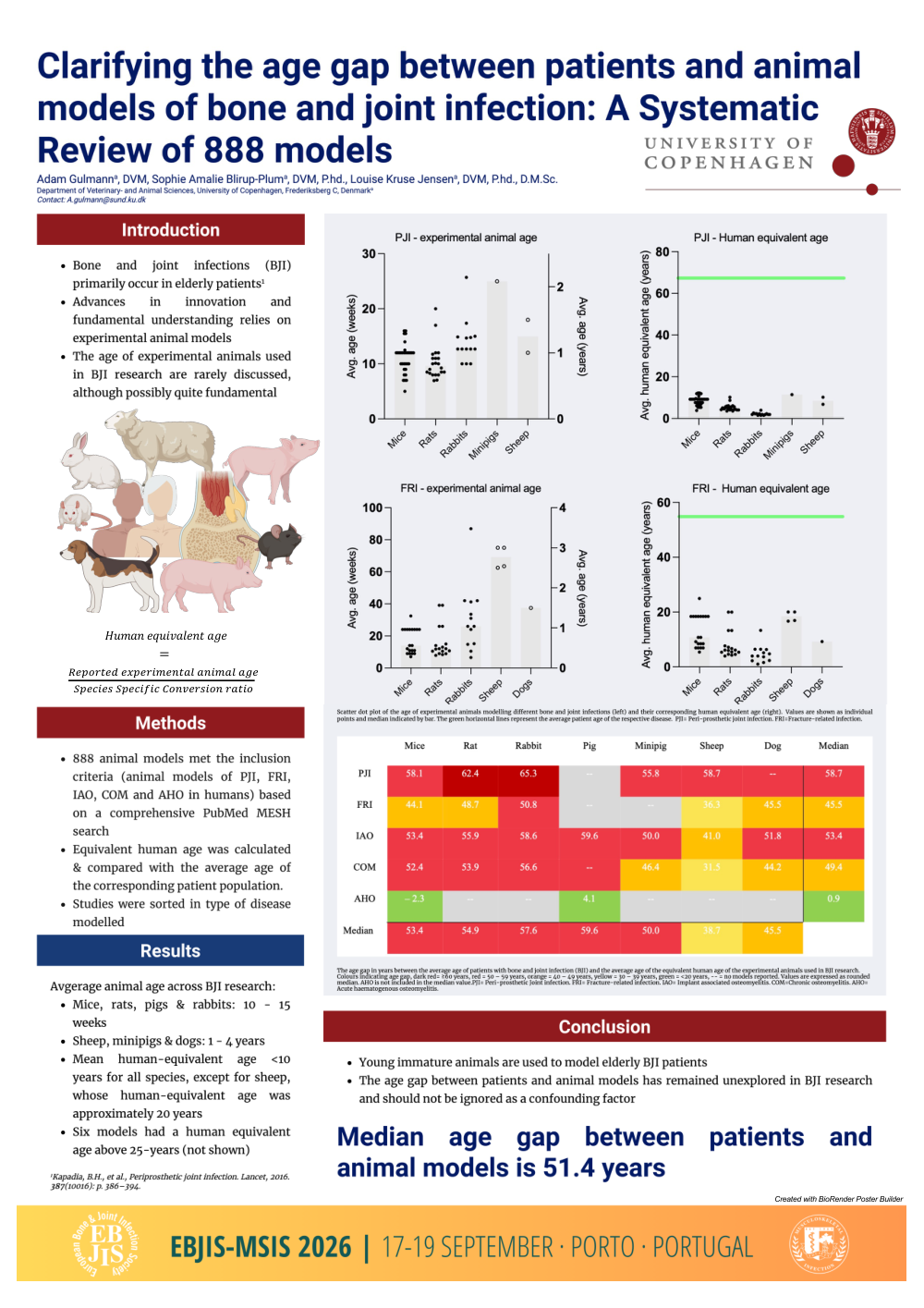
Avgerage animal age across BJI research:
- Mice, rats, pigs & rabbits: 10 - 15 weeks
- Sheep, minipigs & dogs: 1 - 4 years
- Mean human-equivalent age <10 years for all species, except for sheep, whose human-equivalent age was approximately 20 years
- Six models had a human equivalent age above 25-years (not shown)
Conclusion:
- Youngimmature animalsare used to model elderly BJI patients
- The age gap between patients and animal models has remained unexplored in BJI research and should not be ignored as a confounding factor
-
Median age gap between patients and animal models is 51.4 years