477 posters, 14 topics, 2,065 authors, 1,055 institutions
ePostersLive by SciGen Technologies S.A. All rights reserved.
The Joint EBJIS-MSIS 2026 Conference
17 - 19 September, 2026 | Porto, Portugal

EP179
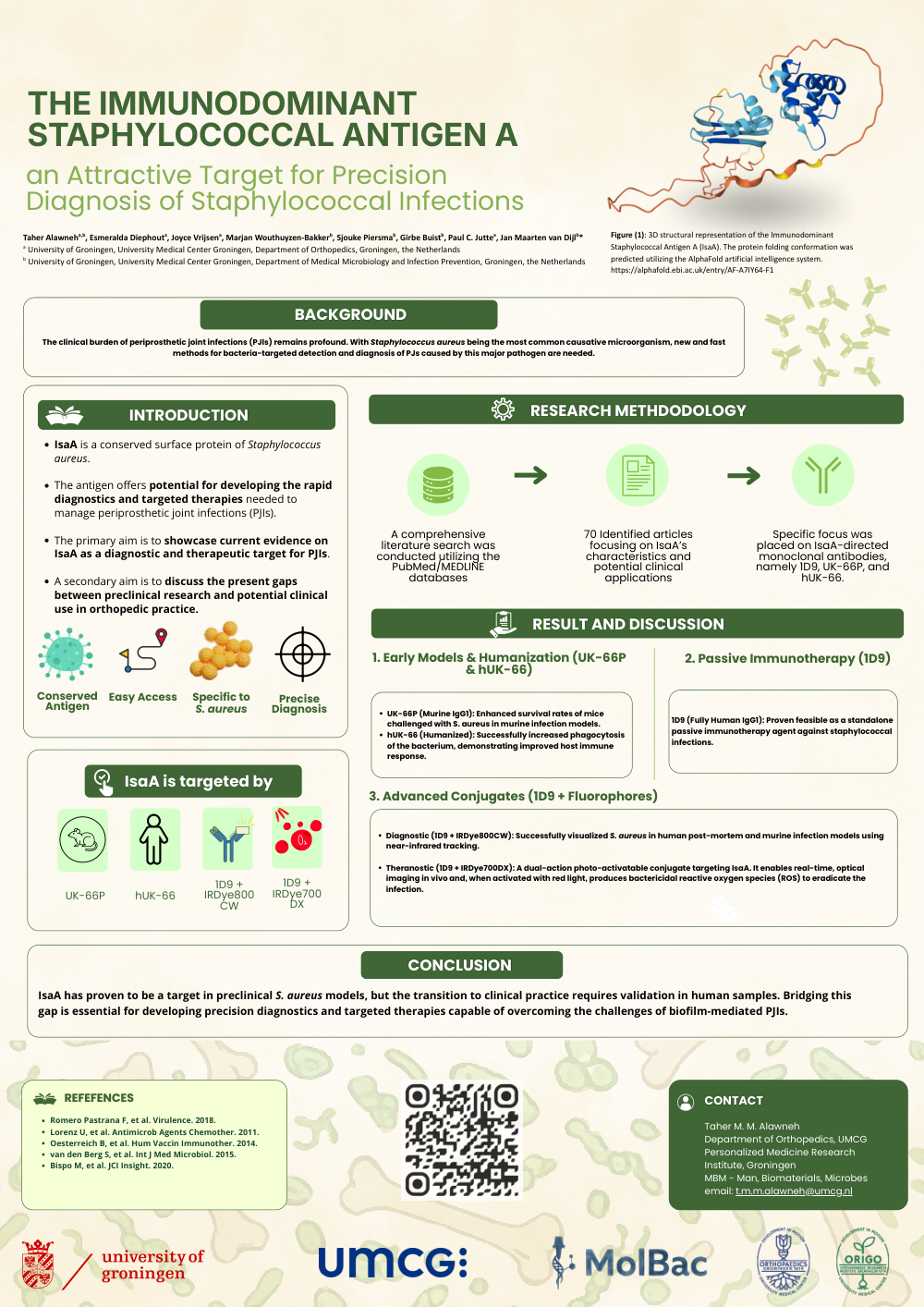
The Immunodominant Staphylococcal Antigen A an Attractive Target for Precision Diagnosis of Staphylococcal Infections
Poster Presenter
Authors
Taher Alawneh, Esmeralda Diephout, Joyce Vrijsen, Marjan Wouthuyzen-Bakker, Sjouke Piersma, Girbe Buist, Paul Jutte, Jan Maarten van Dijl
Affiliations
University of Groningen, University Medical Center Groningen, Department of Orthopedics, Groningen, Netherlands; University of Groningen, University Medical Center Groningen, University of Groningen, University Medical Center Groningen, Department of Orthopedics, Groningen, Netherlands, University of Groningen, University Medical Center Groningen, Department of Medical Microbiology and Infection Prevention, Groningen, Netherlands, University Medical Center Groningen
Part of Topic
Microbiology
Staphylococcus aureus is a leading causative agent of periprosthetic joint infections (PJIs). PJIs are difficult to treat due to bacterial biofilm formation, and they result in prolonged hospitalization, revision surgery and significant morbidity. Hence, there is an urgent need for more effective control strategies to diagnose and treat staphylococcal PJIs. Here we review current evidence that the immunodominant staphylococcal antigen A (IsaA) is an appropriate target for diagnosis and therapy of PJI. Importantly, IsaA is invariantly exposed on the surface of all S. aureus lineages that colonize and infect humans, and it is a proven target for monoclonal antibodies, specifically the fully human monoclonal 1D9, the murine monoclonal UK-66P and its humanized derivative hUK-66. Using 1D9 conjugated with near-infrared (NIR) fluorophores, S. aureus infection was visualized in human post-mortem and murine models. Dual-labeled 1D9 carrying a NIR fluorophore and Zirconium-89 allowed real-time bacteria-targeted fluorescence imaging and positron emission tomography of murine implant infections, and it also allowed image-guided surgical implant debridement. Furthermore, UK-66P enhanced the survival of mice challenged with S. aureus, whereas hUK-66 increased S. aureus opsonophagocytosis by human immune cells. Lastly, antibody-mediated IsaA targeting may be applied in theranostic strategies. 1D9 conjugated with photo-activatable fluorophores that produce bactericidal reactive oxygen species upon red light exposure allow both bacteria-targeted fluorescence imaging and bacterial elimination. In conclusion, preclinical studies highlight IsaA as a feasible target for diagnosis and treatment of S. aureus infection, setting the stage for IsaA-targeted precision diagnostics and drugs to overcome current challenges imposed by PJIs.
1. Romero Pastrana, F., et al., Noninvasive optical and nuclear imaging of Staphylococcus-specific infection with a human monoclonal antibody-based probe. Virulence, 2018. 9(1): p. 262-272.
2. Lorenz, U., et al., Functional antibodies targeting IsaA of Staphylococcus aureus augment host immune response and open new perspectives for antibacterial therapy. Antimicrob Agents Chemother, 2011. 55(1): p. 165-73.
3. Oesterreich, B., et al., Characterization of the biological anti-staphylococcal functionality of hUK-66 IgG1, a humanized monoclonal antibody as substantial component for an immunotherapeutic approach. Hum Vaccin Immunother, 2014. 10(4): p. 926-37.
4. van den Berg, S., et al., A human monoclonal antibody targeting the conserved staphylococcal antigen IsaA protects mice against Staphylococcus aureus bacteremia. Int J Med Microbiol, 2015. 305(1): p. 55-64.
5. Bispo, M., et al., Fighting Staphylococcus aureus infections with light and photoimmunoconjugates. JCI Insight, 2020. 5(22).