501 posters, 2 videos, 1 audios, 8 topics, 37 sessions, 395 authors, 307 institutions
ePostersLive by SciGen Technologies S.A. All rights reserved.
23rd Annual Pain Medicine Meeting 2024
November 21-23, 2024 | Caesars Palace, Las Vegas, Nevada

5881
DURABLE MULTI-YEAR RELIEF OF SHOULDER PAIN FOLLOWING 60-DAY PNS TREATMENT: A CROSS-SECTIONAL FOLLOW-UP SURVEY STUDY
Poster Presenter
Authors
Affiliations
Part of Topic
Scientific Abstracts > Chronic Pain
Durable Multi-Year Relief of Shoulder Pain Following 60-Day PNS Treatment:
A Cross-Sectional Follow-Up Survey Study
Kevin Vorenkamp, MD, FASA1; Gemayel Lee, MD2; Denise Lester, MD, FASAM3; Chaitanya Konda, DO4; Steven Cohen, MD5; Nate D.
Crosby, PhD6; Joseph W. Boggs, PhD6
1. Duke University, Durham, NC; 2. Relive You Center for Advanced Pain Management; 3. Central Virginia VA Healthcare System; 4. UT Southwestern, Dallas, TX; 5. Northwestern University, Chicago, IL; 6. SPR Therapeutics, Cleveland, OH
BACKGROUND
• Shoulder pain is highly prevalent and can become
chronic and disabling.1,2
• Minimally invasive interventions that provide
durable relief can improve outcomes while helping
avoid costly and higher risk procedures.3,4
• Real-world data can help elucidate
the impact of treatments in routine
clinical care.5
• The present survey study sought
to evaluate durability of shoulder
pain relief following percutaneous
60-day peripheral nerve stimulation
(PNS) treatment.
METHODS
• IRB-approved cross-sectional follow-up survey of
patients who:
o underwent 60-day PNS treatment of shoulder pain
o were at least 6 months from the start of treatment
o responded with ≥50% pain relief at the end of
treatment (EOT)
• Outcomes included patient-reported percent pain
relief, average and worst pain scores, and patient
global impression of change (PGIC) in quality of
life, physical function, and sleep.
• Patients also reported on the use or avoidance of
other treatments and interventions for their
shoulder pain since the 60-day PNS treatment
including any new or changes in medications.
• Data are presented as mean ± SD.
RESULTS
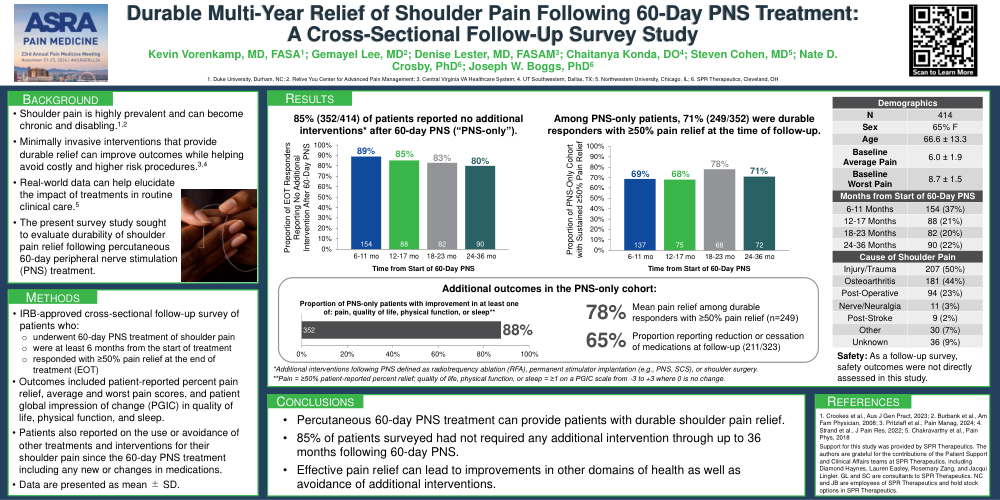
85% (352/414) of patients reported no additional
interventions* after 60-day PNS (“PNS-only”).
Among PNS-only patients, 71% (249/352) were durable
responders with ≥50% pain relief at the time of follow-up.
*Additional interventions following PNS defined as radiofrequency ablation (RFA), permanent stimulator implantation (e.g., PNS, SCS), or shoulder surgery.
Additional outcomes in the PNS-only cohort:
65% Proportion reporting reduction or cessation
of medications at follow-up (211/323)
Proportion of PNS-only patients with improvement in at least one
of: pain, quality of life, physical function, or sleep**
CONCLUSIONS
• Percutaneous 60-day PNS treatment can provide patients with durable shoulder pain relief.
• 85% of patients surveyed had not required any additional intervention through up to 36
months following 60-day PNS.
• Effective pain relief can lead to improvements in other domains of health as well as
avoidance of additional interventions.
REFERENCES
1. Crookes et al., Aus J Gen Pract, 2023; 2. Burbank et al., Am
Fam Physician, 2008; 3. Pritzlaff et al., Pain Manag, 2024; 4.
Strand et al., J Pain Res, 2022; 5. Chakravarthy et al., Pain
Phys, 2018
Support for this study was provided by SPR Therapeutics. The
authors are grateful for the contributions of the Patient Support
and Clinical Affairs teams at SPR Therapeutics, including
Diamond Haynes, Lauren Easley, Rosemary Zang, and Jacqui
Lingler. GL and SC are consultants to SPR Therapeutics. NC
and JB are employees of SPR Therapeutics and hold stock
options in SPR Therapeutics.