501 posters, 2 videos, 1 audios, 8 topics, 37 sessions, 395 authors, 307 institutions
ePostersLive by SciGen Technologies S.A. All rights reserved.
23rd Annual Pain Medicine Meeting 2024
November 21-23, 2024 | Caesars Palace, Las Vegas, Nevada

5667
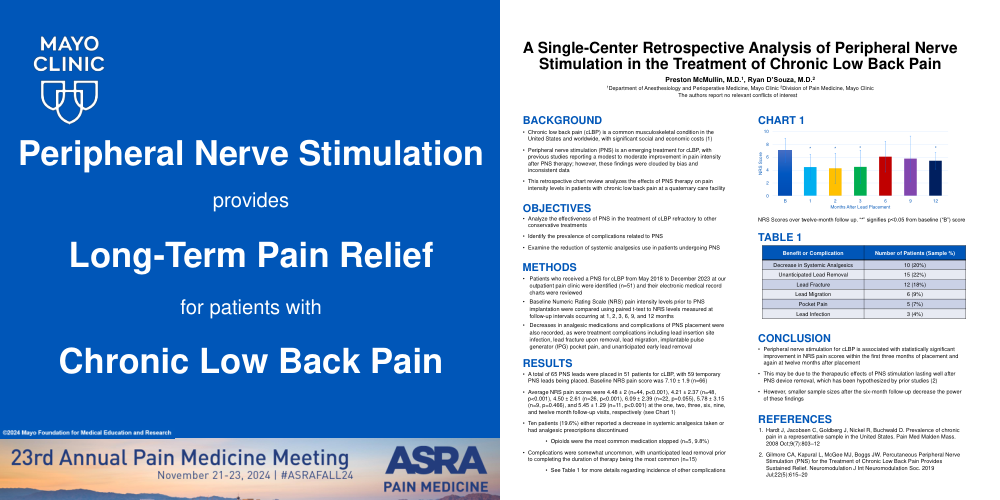
A SINGLE-CENTER RETROSPECTIVE ANALYSIS OF PERIPHERAL NERVE STIMULATION IN THE TREATMENT OF CHRONIC LOW BACK PAIN
Poster Presenter
Authors
Affiliations
Part of Topic
Scientific Abstracts > Chronic Pain
BACKGROUND
•Chronic low back pain (cLBP) is a common musculoskeletal condition in the United States and worldwide, with significant social and economic costs (1)
•Peripheral nerve stimulation (PNS) is an emerging treatment for cLBP, with previous studies reporting a modest to moderate improvement in pain intensity after PNS therapy; however, these findings were clouded by bias and inconsistent data
•This retrospective chart review analyzes the effects of PNS therapy on pain intensity levels in patients with chronic low back pain at a quaternary care facility
OBJECTIVES
•Analyze the effectiveness of PNS in the treatment of cLBP refractory to other conservative treatments
•Identify the prevalence of complications related to PNS
•Examine the reduction of systemic analgesics use in patients undergoing PNS
METHODS
•Patients who received a PNS for cLBP from May 2018 to December 2023 at our outpatient pain clinic were identified (n=51) and their electronic medical record charts were reviewed
•Baseline Numeric Rating Scale (NRS) pain intensity levels prior to PNS implantation were compared using paired t-test to NRS levels measured at follow-up intervals occurring at 1, 2, 3, 6, 9, and 12 months
•Decreases in analgesic medications and complications of PNS placement were also recorded, as were treatment complications including lead insertion site infection, lead fracture upon removal, lead migration, implantable pulse generator (IPG) pocket pain, and unanticipated early lead removal
RESULTS
•A total of 65 PNS leads were placed in 51 patients for cLBP, with 59 temporary PNS leads being placed. Baseline NRS pain score was 7.10 ± 1.9 (n=66)
•Average NRS pain scores were 4.48 ± 2 (n=44, p<0.001), 4.21 ± 2.37 (n=48, p<0.001), 4.50 ± 2.61 (n=26, p<0.001), 6.09 ± 2.39 (n=22, p=0.055), 5.78 ± 3.15 (n=9, p=0.466), and 5.45 ± 1.29 (n=11, p<0.001) at the one, two, three, six, nine, and twelve month follow-up visits, respectively (see Chart 1)
•Ten patients (19.6%) either reported a decrease in systemic analgesics taken or had analgesic prescriptions discontinued
•Opioids were the most common medication stopped (n=5, 9.8%)
•Complications were somewhat uncommon, with unanticipated lead removal prior to completing the duration of therapy being the most common (n=15)
•See Table 1 for more details regarding incidence of other complications
CONCLUSION
•Peripheral nerve stimulation for cLBP is associated with statistically significant improvement in NRS pain scores within the first three months of placement and again at twelve months after placement
•This may be due to the therapeutic effects of PNS stimulation lasting well after PNS device removal, which has been hypothesized by prior studies (2)
•However, smaller sample sizes after the six-month follow-up decrease the power of these findings
REFERENCES
1.Hardt J, Jacobsen C, Goldberg J, Nickel R, Buchwald D. Prevalence of chronic pain in a representative sample in the United States. Pain Med Malden Mass. 2008 Oct;9(7):803–12
2.Gilmore CA, Kapural L, McGee MJ, Boggs JW. Percutaneous Peripheral Nerve Stimulation (PNS) for the Treatment of Chronic Low Back Pain Provides Sustained Relief. Neuromodulation J Int Neuromodulation Soc. 2019 Jul;22(5):615–20