501 posters, 2 videos, 1 audios, 8 topics, 37 sessions, 395 authors, 307 institutions
ePostersLive by SciGen Technologies S.A. All rights reserved.
23rd Annual Pain Medicine Meeting 2024
November 21-23, 2024 | Caesars Palace, Las Vegas, Nevada

5668
THE ADENOSINE-3 RECEPTOR AS ANALGESIC TARGET: COMPUTER MODELING OF ALLOSTERIC INTERACTION
Poster Presenter
Part of Topic
Scientific Abstracts > Emerging Technology
The Adenosine-3 Receptor as Analgesic Target: Computer Modeling of Allosteric Interaction
Robert B. Raffa, PhD Joseph V. Pergolizzi Jr., MD and Michael Innaurato – Neumentum Inc. (Summit NJ)
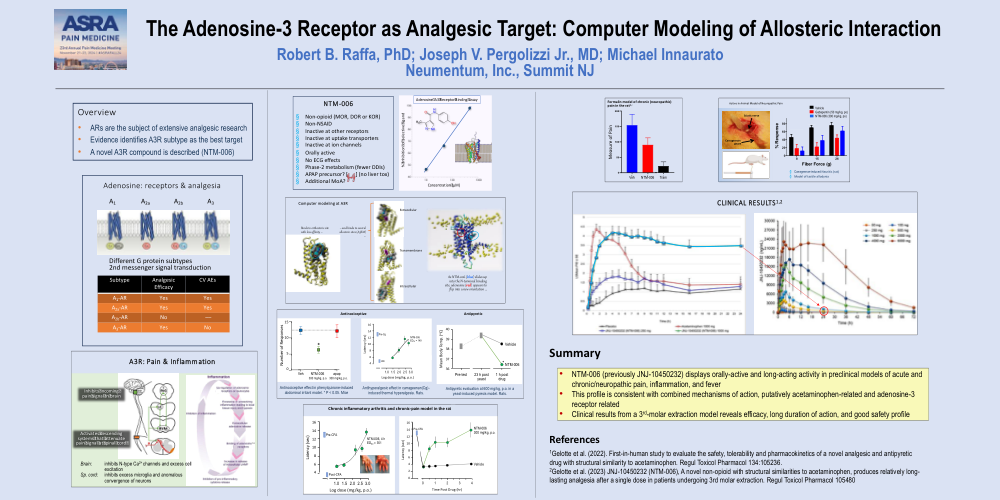
Introduction: As part of ongoing efforts to identify non-opioid, non-NSAID analgesic receptor targets for investigation as possible development leads, the adenosine receptors have been explored. Of the three known subtypes, the adenosine-3 receptor (A3R) has been suggested as having particular promise, with good margin of safety). And at least one compound in development has demonstrated efficacy in a clinical model (3rd molar extraction). It has demonstrated anti-nociceptive and anti-pyretic activity in animal models predictive of analgesic efficacy against acute pain, and in addition is active in a preclinical model of neuropathic pain. Based on radioligand binding data and in vivo profile, we speculated that NTM-006 allosterically modulates the adenosine A3 receptor (A3R). We report on molecular modeling that supports this hypothesis.
Materials & Methods: A variety of computer modeling techniques were utilized in order to assess if an A3R-targeted compound displays affinity for the orthosteric A3R binding site of adenosine. Alternative molecular interaction (such as allosteric modulation) with A3R was also explored.
Results: Molecular modeling studies now suggest a novel combination of binding modes with the A3R are possible. The modeling to-date predicts: (1) low affinity to the orthosteric site where endogenous adenosine binds (adenosine itself also binds with relatively low affinity to this orthosteric binding site); (2) binding to an N-terminal extracellular site suggested by prior molecular dynamics calculation as an allosteric binding site; (3) fit into a cytostolic binding site suggested based on analogy to allosteric modulators of other G protein-coupled receptors, and (4) fit into a pocket in the transmembrane domain of the A3R identified in a cryo-EM structure as a possible allosteric binding site. In this case, the tested compound leaves the pocket and migrates upward out of the lipid membrane. As the compound transits, the conformation of adenosine in the orthosteric binding pocket appears to be allosterically modulated.
Conclusion: The present study utilized molecular modeling techniques in order to test the hypothesis that allosteric modulation of the A3R could be consistent with a ligand’s in vitro, animal model, and clinical characteristics of analgesic efficacy, safety, and long-duration of action. The results suggest the identification of multiple potential allosteric sites on the A3R. At least one of the sites is accessed after passage into the cell membrane. Given the broad analgesic efficacy and anti-inflammatory activity of the test compound, it seems reasonable to postulate that the overall MOA of such compounds can include the contribution of allosteric modulation of the A3R.