501 posters, 2 videos, 1 audios, 8 topics, 37 sessions, 395 authors, 307 institutions
ePostersLive by SciGen Technologies S.A. All rights reserved.
23rd Annual Pain Medicine Meeting 2024
November 21-23, 2024 | Caesars Palace, Las Vegas, Nevada

5838
ORAL KETAMINE ASSOCIATED WITH MINIMAL ADVERSE SIDE EFFECTS IN CHRONIC PAIN PATIENTS
Poster Presenter
Authors
Affiliations
Part of Topic
Scientific Abstracts > Chronic Pain
Introduction:
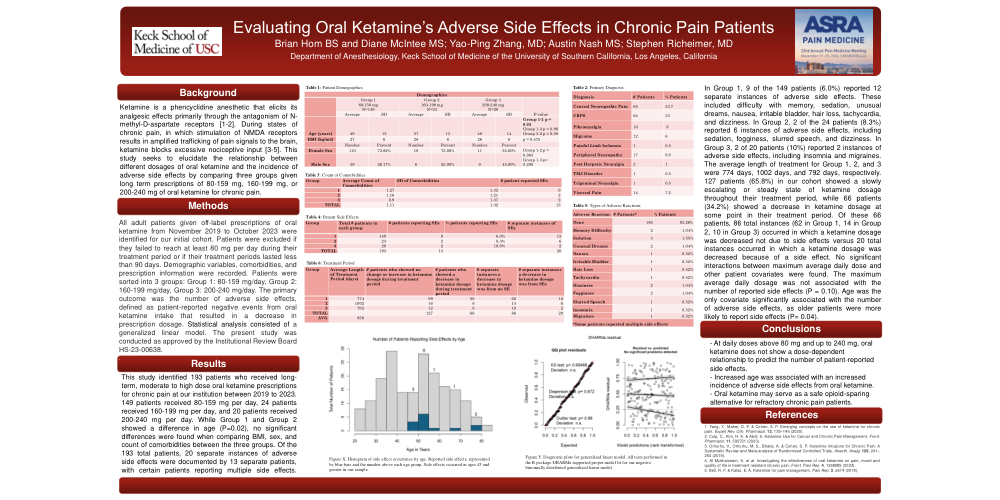
Ketamine is a phencyclidine anesthetic that elicits its analgesic effects primarily through the antagonism of N-methyl-D-aspartate receptors [1-2]. During states of chronic pain, in which stimulation of NMDA receptors results in amplified trafficking of pain signals to the brain, ketamine blocks excessive nociceptive input [3-5]. This study seeks to elucidate the relationship between different dosages of oral ketamine and the incidence of adverse side effects by comparing three groups given long term prescriptions of 80-159 mg, 160-199 mg, or 200-240 mg of oral ketamine for chronic pain.
Methods:
All adult patients given off-label prescriptions of oral ketamine from November 2019 to October 2023 were identified for our initial cohort. Patients were excluded if they failed to reach at least 80 mg per day during their treatment period or if their treatment periods lasted less than 90 days. Demographic variables, comorbidities, and prescription information were recorded. Patients were sorted into 3 groups: Group 1: 80-159 mg/day, Group 2: 160-199 mg/day, Group 3: 200-240 mg/day. The primary outcome was the number of adverse side effects, defined as patient-reported negative events from oral ketamine intake that resulted in a decrease in prescription dosage. Statistical analysis consisted of a generalized linear model. The present study was conducted as approved by the Institutional Review Board HS-23-00638.
Results:
This study identified 193 patients who received long-term, moderate to high dose oral ketamine prescriptions for chronic pain at our institution between 2019 to 2023. 149 patients received 80-159 mg per day, 24 patients received 160-199 mg per day, and 20 patients received 200-240 mg per day. While Group 1 and Group 2 showed a difference in age (P=0.02), no significant differences were found when comparing BMI, sex, and count of comorbidities between the three groups. Of the 193 total patients, 20 separate instances of adverse side effects were documented by 13 separate patients, with certain patients reporting multiple side effects. In Group 1, 9 of the 149 patients (6.0%) reported 12 separate instances of adverse side effects. These included difficulty with memory, sedation, unusual dreams, nausea, irritable bladder, hair loss, tachycardia, and dizziness. In Group 2, 2 of the 24 patients (8.3%) reported 6 instances of adverse side effects, including sedation, fogginess, slurred speech, and dizziness. In Group 3, 2 of 20 patients (10%) reported 2 instances of adverse side effects, including insomnia and migraines. The average length of treatment for Group 1, 2, and 3 were 774 days, 1002 days, and 792 days, respectively. 127 patients (65.8%) in our cohort showed a slowly escalating or steady state of ketamine dosage throughout their treatment period, while 66 patients (34.2%) showed a decrease in ketamine dosage at some point in their treatment period. Of these 66 patients, 86 total instances (62 in Group 1, 14 in Group 2, 10 in Group 3) occurred in which a ketamine dosage was decreased not due to side effects versus 20 total instances occurred in which a ketamine dosage was decreased because of a side effect. No significant interactions between maximum average daily dose and other patient covariates were found. The maximum average daily dosage was not associated with the number of reported side effects (P = 0.10). Age was the only covariate significantly associated with the number of adverse side effects, as older patients were more likely to report side effects (P= 0.04).
Conclusion:
At daily doses above 80 mg and up to 240 mg, oral ketamine does not show a dose-dependent relationship to predict the number of patient-reported side effects. Increased age was associated with an increased incidence of adverse side effects from oral ketamine. Oral ketamine may serve as a safe opioid-sparing alternative for refractory chronic pain patients.
References: