501 posters, 2 videos, 1 audios, 8 topics, 37 sessions, 395 authors, 307 institutions
ePostersLive by SciGen Technologies S.A. All rights reserved.
23rd Annual Pain Medicine Meeting 2024
November 21-23, 2024 | Caesars Palace, Las Vegas, Nevada

6102
INCIDENCE AND ETIOLOGY OF IMPEDIMENTS TO SPINAL CORD STIMULATOR TRIAL PROGRESSION
Poster Presenter
Authors
Affiliations
Part of Topic
Scientific Abstracts > Chronic Pain
Incidence and Etiology of Impediments to Spinal Cord Stimulator Trial Progression
Erin Alpaugh1, Esha Vaidya2 , Jason S. Kilgore, PhD3 , David A. Provenzano, MD1
1Pain Diagnostics and Interventional Care, Sewickley, Pennsylvania, 2Lewis Katz School of Medicine at Temple University, Philadelphia, Pennsylvania, 3Department of Biology, Washington & Jefferson College, Washington, Pennsylvania
Introduction
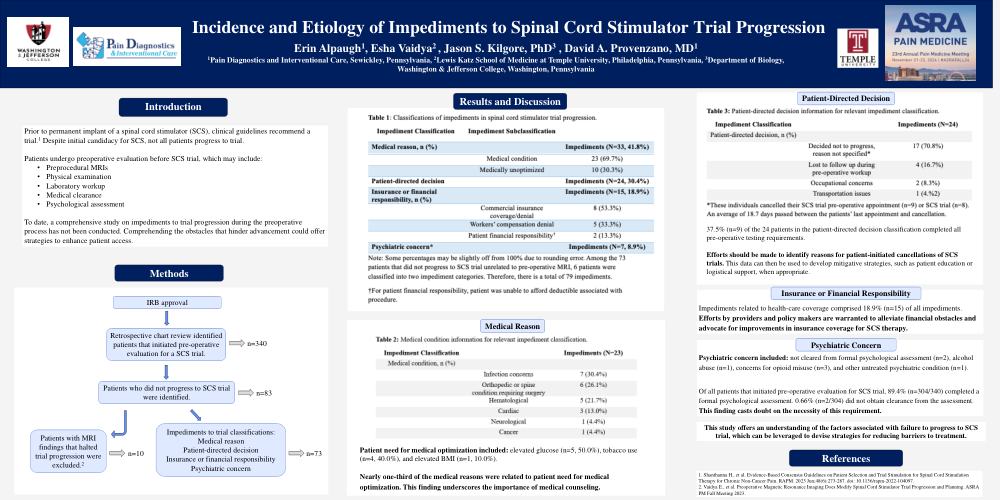
Prior to permanent implant of a spinal cord stimulator (SCS), clinical guidelines recommend a trial.1 Despite initial candidacy for SCS, not all patients progress to trial. Patients undergo preoperative evaluation before SCS trial, which may include:
• Preprocedural MRIs
• Physical examination
• Laboratory workup
• Medical clearance
• Psychological assessment
To date, a comprehensive study on impediments to trial progression during the preoperative process has not been conducted. Comprehending the obstacles that hinder advancement could offer strategies to enhance patient access.
Medical Reason
Patient need for medical optimization included: elevated glucose (n=5, 50.0%), tobacco use (n=4, 40.0%), and elevated BMI (n=1, 10.0%).
Nearly one-third of the medical reasons were related to patient need for medical optimization. This finding underscores the importance of medical counseling.
Patient-Directed Decision
37.5% (n=9) of the 24 patients in the patient-directed decision classification completed all pre-operative testing requirements.
Efforts should be made to identify reasons for patient-initiated cancellations of SCS trials. This data can then be used to develop mitigative strategies, such as patient education or logistical support, when appropriate.
Insurance or Financial Responsibility
Impediments related to health-care coverage comprised 18.9% (n=15) of all impediments. Efforts by providers and policy makers are warranted to alleviate financial obstacles and advocate for improvements in insurance coverage for SCS therapy.
Psychiatric Concern
Psychiatric concern included: not cleared from formal psychological assessment (n=2), alcohol abuse (n=1), concerns for opioid misuse (n=3), and other untreated psychiatric condition (n=1).
Of all patients that initiated pre-operative evaluation for SCS trial, 89.4% (n=304/340) completed a formal psychological assessment. 0.66% (n=2/304) did not obtain clearance from the assessment. This finding casts doubt on the necessity of this requirement.
References
1. Shanthanna H., et al. Evidence-Based Consensus Guidelines on Patient Selection and Trial Stimulation for Spinal Cord Stimulation Therapy for Chronic Non-Cancer Pain. RAPM. 2023 Jun;48(6):273-287. doi: 10.1136/rapm-2022-104097.
2. Vaidya E., et al. Preoperative Magnetic Resonance Imaging Does Modify Spinal Cord Stimulator Trial Progression and Planning. ASRA PM Fall Meeting 2023.