501 posters, 2 videos, 1 audios, 8 topics, 37 sessions, 395 authors, 307 institutions
ePostersLive by SciGen Technologies S.A. All rights reserved.
23rd Annual Pain Medicine Meeting 2024
November 21-23, 2024 | Caesars Palace, Las Vegas, Nevada

5823
PREVALENCE OF NEEDLE BENDING FOR FLUOROSCOPICALLY-GUIDED INJECTIONS
Poster Presenter
Authors
Affiliations
Part of Topic
Scientific Abstracts > Chronic Pain
PREVALENCE OF NEEDLE BENDING FOR FLUOROSCOPICALLY-GUIDED INJECTIONS
Travis Blanton, J. Sharif Palmer, Jennifer Windsor, Andrew Olsen, Mohammed Ali, Chong Kim
Introduction
Fluoroscopically-guided injections are typically accomplished using straight Quincke spinal needles. Radiofrequency ablations typically utilize needles with ~10 degree bends several centimeters from the tip in order to facilitate target lesioning. In clinical practice, bending straight Quincke spinal needles prior to fluoroscopically-guided injections has been observed by these authors with varying frequency. A literature review did not yield any publications that discuss the prevalence and risk profile of this activity. The purpose of this research is to assess the prevalence of needle bending nationwide, as well as the rationale for bending and incidence of associated needlestick injury.
Methods
A survey was distributed to attending pain physicians at 103 institutions with ACGME-accredited Pain Medicine Fellowships. Respondents were kept anonymous.
Results
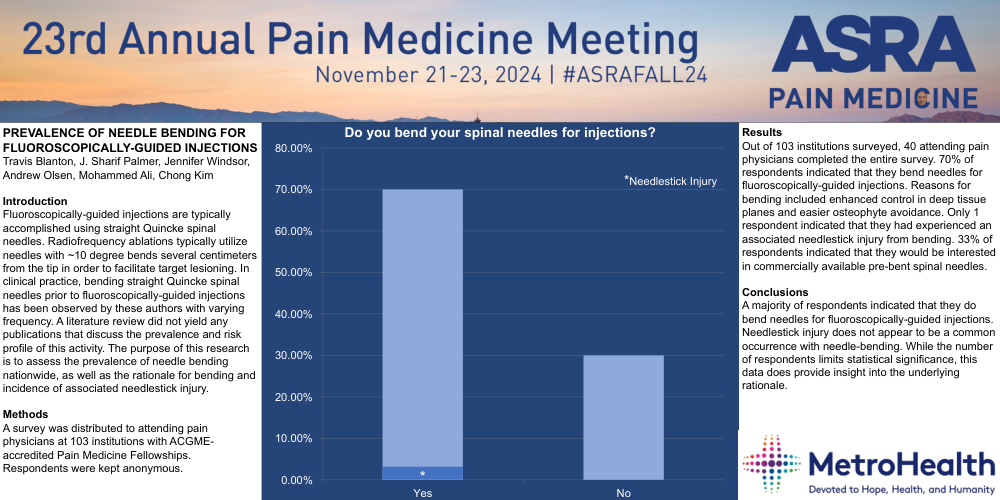
Out of 103 institutions surveyed, 40 attending pain physicians completed the entire survey. 70% of respondents indicated that they bend needles for fluoroscopically-guided injections. Reasons for bending included enhanced control in deep tissue planes and easier osteophyte avoidance. Only 1 respondent indicated that they had experienced an associated needlestick injury from bending. 33% of respondents indicated that they would be interested in commercially available pre-bent spinal needles.
Conclusions
A majority of respondents indicated that they do bend needles for fluoroscopically-guided injections. Needlestick injury does not appear to be a common occurrence with needle-bending. While the number of respondents limits statistical significance, this data does provide insight into the underlying rationale.