501 posters, 2 videos, 1 audios, 8 topics, 37 sessions, 395 authors, 307 institutions
ePostersLive by SciGen Technologies S.A. All rights reserved.
23rd Annual Pain Medicine Meeting 2024
November 21-23, 2024 | Caesars Palace, Las Vegas, Nevada

5676
FLUOROSCOPY-GUIDED TRANSGLUTEAL PUDENDAL NERVE BLOCK FOR PUDENDAL NEURALGIA: A RETROSPECTIVE CASE SERIES
Poster Presenter
Authors
Affiliations
Part of Topic
Scientific Abstracts > Chronic Pain
Fluoroscopy-Guided Transgluteal Pudendal Nerve Block and Pulsed Radiofrequency Ablation for Pudendal Neuralgia: A Retrospective Case Series
-
● The pelvic region is innervated by the pudendal nerve which provides sympathetic activity, sensory, and motor function
-
● Nerve injury and compression can lead to painful neuropathy
-
● Pudendal neuralgia is a distressing condition that presents with pain in the
anatomic distribution of the pudendal nerve with inciting events including childbirth, abdomino/pelvic surgeries, cycling, and other musculoskeletal related changes(2)
-
● A positive anesthetic pudendal nerve block is one of the essential criteria for diagnosing this condition and can also provide a therapeutic benefit
-
● There are multiple approaches in which a pudendal nerve block can be performed including transvaginal and transperineal (utilized in OB/GYN), and transgluteal needle insertion performed via landmark-based, ultrasound, or CT-guided(1)(3)
-
● In our clinic, we utilize a fluoroscopy-guided prone approach (first described by Choi et al., in 2006) to combat the limitations of earlier approaches including cost, unreliable results, and procedural difficulty(3)
-
● Pulsed radiofrequency ablation has been shown to be an effective treatment for neuropathic pain exhibiting therapeutic effects in pudendal neuralgia(6)(7)
-
● We will share our experience with patients who were subsequently treated with radiofrequency ablation after short-term relief post pudendal nerve block
-
● The objective of this retrospective analysis is to present our results and longitudinal follow-up of fluoroscopy-guided transgluteal pudendal nerve blocks and pulsed radiofrequency ablations
-
This is an IRB-approved retrospective case series
-
● 101 patients who met four out of the five Nantes criteria (pain in the anatomical
territory of the pudendal nerve, pain worsened by sitting, pain that does not wake the patient up at night, and no objective sensory loss on clinical examination) received a fluoroscopy-guided transgluteal pudendal nerve block(3)
-
● Subsequently, eight patients who met five Nantes criteria(now including positive pudendal nerve block test) with less than two weeks of pain relief underwent fluoroscopy-guided transgluteal pulsed radiofrequency ablation of the pudendal nerve
-
● Therapeutic success (using worst-case analysis) was defined as a ≥30% reduction in pain for patients receiving a nerve block and ≥50% reduction in pain for patients receiving a radiofrequency ablation(3)
-
● Success rates were calculated and the duration of therapeutic relief was recorded
A: Nerve block B: Pulsed radiofrequency ablation
● A: 22G needle advanced to the medial base of ischial spine
● B: Radiofrequency cannula positioned near ischial spine tip
● A&B: Contrast administered to confirm injection site/cannula is not intravascular
-
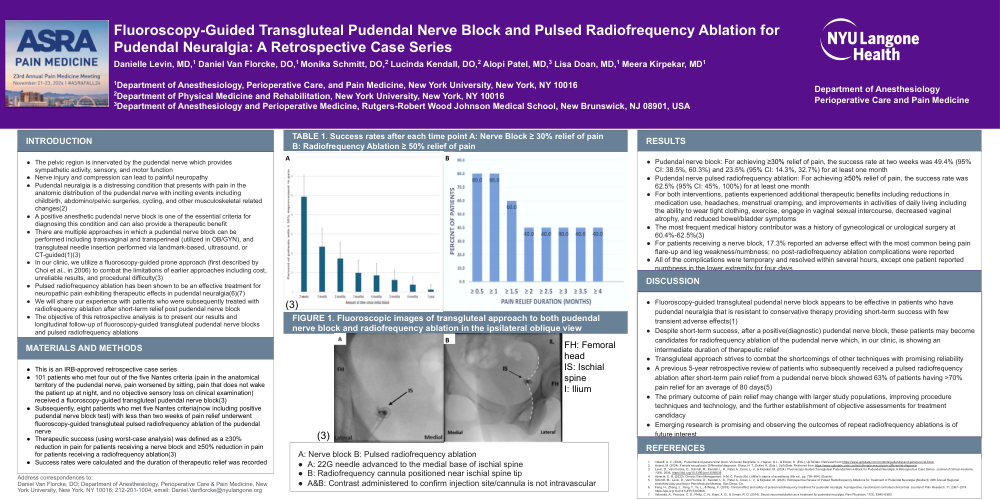
Pudendal nerve block: For achieving ≥30% relief of pain, the success rate at two weeks was 49.4% (95% CI: 38.5%, 60.3%) and 23.5% (95% CI: 14.3%, 32.7%) for at least one month
-
● Pudendal nerve pulsed radiofrequency ablation: For achieving ≥50% relief of pain, the success rate was 62.5% (95% CI: 45%, 100%) for at least one month
-
● For both interventions, patients experienced additional therapeutic benefits including reductions in medication use, headaches, menstrual cramping, and improvements in activities of daily living including the ability to wear tight clothing, exercise, engage in vaginal sexual intercourse, decreased vaginal atrophy, and reduced bowel/bladder symptoms
-
● The most frequent medical history contributor was a history of gynecological or urological surgery at 60.4%-62.5%(3)
-
● For patients receiving a nerve block, 17.3% reported an adverse effect with the most common being pain flare-up and leg weakness/numbness; no post-radiofrequency ablation complications were reported
-
● All of the complications were temporary and resolved within several hours, except one patient reported numbness in the lower extremity for four days
-
Fluoroscopy-guided transgluteal pudendal nerve block appears to be effective in patients who have pudendal neuralgia that is resistant to conservative therapy providing short-term success with few transient adverse effects(1)
-
● Despite short-term success, after a positive(diagnostic) pudendal nerve block, these patients may become candidates for radiofrequency ablation of the pudendal nerve which, in our clinic, is showing an intermediate duration of therapeutic relief
-
● Transgluteal approach strives to combat the shortcomings of other techniques with promising reliability
-
● A previous 5-year retrospective review of patients who subsequently received a pulsed radiofrequency ablation after short-term pain relief from a pudendal nerve block showed 63% of patients having >70%
pain relief for an average of 80 days(5)
-
● The primary outcome of pain relief may change with larger study populations, improving procedure
techniques and technology, and the further establishment of objective assessments for treatment
candidacy
-
● Emerging research is promising and observing the outcomes of repeat radiofrequency ablations is of
future interest
-
Vidaeff, A. C. (2024). Pudendal and paracervical block. Vincenzo Berghella, V., Hepner, D.L., & Eckler, K. (Eds.), UpToDate. Retrieved from https://www.uptodate.com/contents/pudendal-and-paracervical-block
-
Anand, M. (2024). Female sexual pain: Differential diagnosis. Sharp, H. T., Eckler, K. (Eds.), UpToDate. Retrieved from https://www.uptodate.com/contents/female-sexual-pain-differential-diagnosis
-
Levin, D., Van Florcke, D., Schmitt, M., Kendall, L. K., Patel, A., Doan, L. V., & Kirpekar, M. (2024). Fluoroscopy-Guided Transgluteal Pudendal Nerve Block for Pudendal Neuralgia: A Retrospective Case Series. Journal of clinical medicine,
13(9), 2636. https://doi.org/10.3390/jcm13092636
-
Abrecht, C. R. (2022). Chronic Pain Management. In M. C. Pardo (Ed.), Miller’s basics of anesthesia (8th ed., pp. 799–804). Elsevier.
-
Schmitt, M., Levin, D., Van Florcke, D., Kendall, L. K., Patel, A., Doan, L. V., & Kirpekar, M. (2023). Retrospective Review of Pulsed Radiofrequency Ablations for Treatment of Pudendal Neuralgia [Abstract]. 49th Annual Regional
Anesthesiology and Acute Pain Medicine Meeting, San Diego, CA.
-
Fang, H., Zhang, J., Yang, Y., Ye, L., & Wang, X. (2018). Clinical effect and safety of pulsed radiofrequency treatment for pudendal neuralgia: A prospective, randomized controlled clinical trial. Journal of Pain Research, 11, 2367–2374.
https://doi.org/10.2147/JPR.S167866
-
Valovska, A., Peccora, C. D., Philip, C. N., Kaye, A. D., & Urman, R. D. (2014). Sacral neuromodulation as a treatment for pudendal neuralgia. Pain Physician, 17(5), E645–E650.