501 posters, 2 videos, 1 audios, 8 topics, 37 sessions, 395 authors, 307 institutions
ePostersLive by SciGen Technologies S.A. All rights reserved.
23rd Annual Pain Medicine Meeting 2024
November 21-23, 2024 | Caesars Palace, Las Vegas, Nevada

6125
STIMULATION OF THE ENTIRE ERECTOR SPINAE VS. THE LUMBAR MULTIFIDUS MUSCLE FOR THE TREATMENT OF LOW BACK PAIN: A CASE SERIES
Poster Presenter
Authors
Affiliations
Part of Topic
Scientific Abstracts > Case Series
Introduction
Chronic low back pain (CLBP) is a significant challenge, especially when traditional treatments fail to provide long-term relief.
Since low back pain is a major health issue in the U.S., focusing on developing better treatment technologies is essential.
Considering that the Lumbar Multifidus (LM) dysfunction contributes to CLBP, that it is one of the primary stabilizers of the spine, and that there is limited work done on stimulation of the Entire Erector Spinae for CLBP, we describe our experience treating patients with CLBP with peripheral nerve stimulation (PNS) of the LM and Entire Erector Spinae.
Methods
We retrospectively chart reviewed 28 patients at MetroHealth System who were implanted with the Micro Lead-SPRINT PNS System.
After Institutional Review Board (IRB) exemption, patients treated between August 2021 and January 2024 were included.
Data were collected from electronic medical records, including symptoms, prior treatments, opioid use, pain scores pre- and post-procedure, pain management regimens, overall improvement, complications, and PNS procedure details.
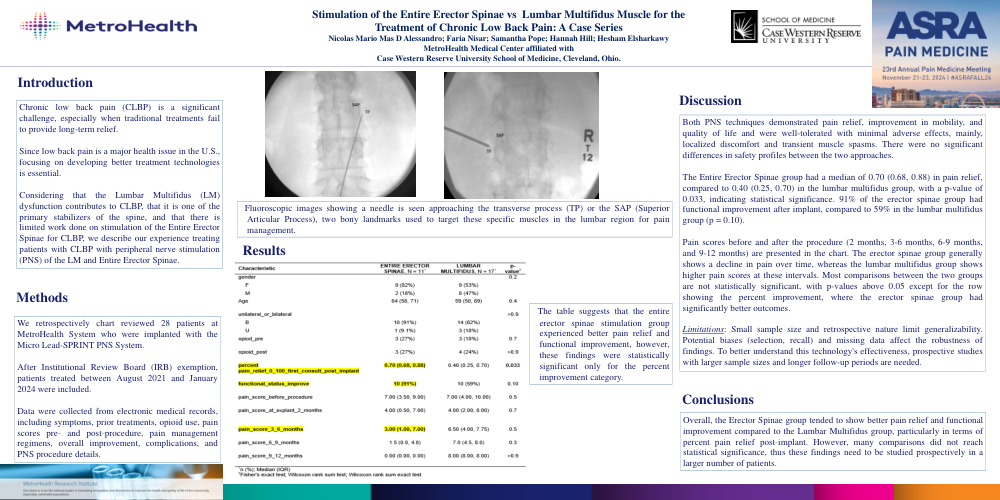
Fluoroscopic images showing a needle is seen approaching the transverse process (TP) or the SAP (Superior Articular Process), two bony landmarks used to target these specific muscles in the lumbar region for pain management.
The table suggests that the entire erector spinae stimulation group experienced better pain relief and functional improvement, however, these findings were statistically significant only for the percent improvement category.
Discussion
Both PNS techniques demonstrated pain relief, improvement in mobility, and quality of life and were well-tolerated with minimal adverse effects, mainly, localized discomfort and transient muscle spasms. There were no significant differences in safety profiles between the two approaches.
The Entire Erector Spinae group had a median of 0.70 (0.68, 0.88) in pain relief, compared to 0.40 (0.25, 0.70) in the lumbar multifidus group, with a p-value of 0.033, indicating statistical significance. 91% of the erector spinae group had functional improvement after implant, compared to 59% in the lumbar multifidus group (p = 0.10).
Pain scores before and after the procedure (2 months, 3-6 months, 6-9 months, and 9-12 months) are presented in the chart. The erector spinae group generally shows a decline in pain over time, whereas the lumbar multifidus group shows higher pain scores at these intervals. Most comparisons between the two groups are not statistically significant, with p-values above 0.05 except for the row showing the percent improvement, where the erector spinae group had significantly better outcomes.
Limitations: Small sample size and retrospective nature limit generalizability. Potential biases (selection, recall) and missing data affect the robustness of findings. To better understand this technology's effectiveness, prospective studies with larger sample sizes and longer follow-up periods are needed.
Conclusions
Overall, the Erector Spinae group tended to show better pain relief and functional improvement compared to the Lumbar Multifidus group, particularly in terms of percent pain relief post-implant. However, many comparisons did not reach statistical significance, thus these findings need to be studied prospectively in a larger number of patients.