501 posters, 2 videos, 1 audios, 8 topics, 37 sessions, 395 authors, 307 institutions
ePostersLive by SciGen Technologies S.A. All rights reserved.
23rd Annual Pain Medicine Meeting 2024
November 21-23, 2024 | Caesars Palace, Las Vegas, Nevada

6256
STELLATE GANGLION BLOCK IN A PATIENT WITH UNTREATED LONG QT SYNDROME AFTER CARDIAC ARREST
Poster Presenter
Authors
Affiliations
Part of Topic
Scientific Abstracts > Regional Anesthesia
Stellate Ganglion Block in a Patient with Untreated Long QT Syndrome after Cardiac Arrest
Mihir Desai DO, Lyndsey Chitty DNP, David McEnerney DO
Introduction
•In modern practice, a stellate ganglion block (SGB) is commonly used to treat pain syndromes of the head, neck, upper extremity, and upper chest.
•Most commonly, SGBs are used to treat complex regional pain syndrome, post-herpetic neuralgia, various orofacial neuralgias, which are often a result of overactivation of the sympathetic nervous system [1].
•Due to the stellate ganglion’s anatomic location, it is precisely targeted with fluoroscopic or ultrasound guidance.
•Important risks of the SGB are vertebral artery injury, pneumothorax, retropharyngeal hematoma, or recurrent laryngeal nerve palsy [2].
•Alternatively, the SGB can be used to treat conditions such as post-traumatic stress disorder, post-menopausal hot flashes, and ventricular arrythmias.
•This case shows the use of a SGB in treating refractory ventricular tachycardia (VT) due to ventricular electrical storm (VES) [3].
Case Presentation
•A 32-year-old female with past medical history of obesity, insulin-dependent diabetes, and untreated long QT syndrome presented after cardiac arrest.
•She was defibrillated in the field by paramedics after being found in pulseless electrical activity followed by ventricular fibrillation.
•She underwent CPR with successful return of spontaneous circulation after arriving to the ED.
•Her ICU admission was initially complicated by multiple transient episodes of monomorphic ventricular tachycardia despite being on multiple antiarrhythmic agents (nadolol, amiodarone).
•On admission day 2, patient went into polymorphic ventricular tachycardia, requiring three defibrillations followed by being placed on a lidocaine infusion at 1mg/min.
•The patient continued to have ventricular ectopy on telemetry, so the electrophysiology cardiology team consulted the pain service for a SGB.
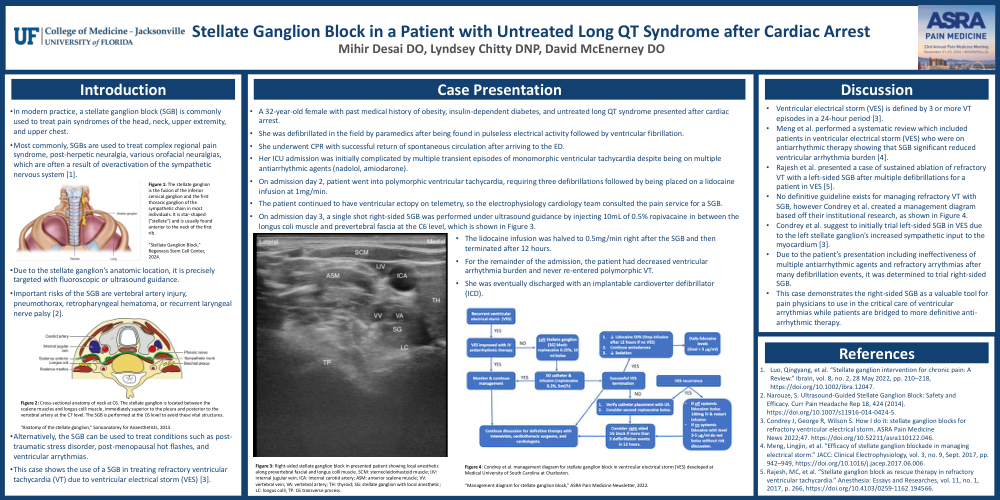
•On admission day 3, a single shot right-sided SGB was performed under ultrasound guidance by injecting 10mL of 0.5% ropivacaine in between the longus coli muscle and prevertebral fascia at the C6 level, which is shown in Figure 3.
•The lidocaine infusion was halved to 0.5mg/min right after the SGB and then terminated after 12 hours.
•For the remainder of the admission, the patient had decreased ventricular arrhythmia burden and never re-entered polymorphic VT.
•She was eventually discharged with an implantable cardioverter defibrillator (ICD).
Discussion
•Ventricular electrical storm (VES) is defined by 3 or more VT episodes in a 24-hour period [3].
•Meng et al. performed a systematic review which included patients in ventricular electrical storm (VES) who were on antiarrhythmic therapy showing that SGB significant reduced ventricular arrhythmia burden [4].
•Rajesh et al. presented a case of sustained ablation of refractory VT with a left-sided SGB after multiple defibrillations for a patient in VES [5].
•No definitive guideline exists for managing refractory VT with SGB, however Condrey et al. created a management diagram based off their institutional research, as shown in Figure 4.
•Condrey et al. suggest to initially trial left-sided SGB in VES due to the left stellate ganglion’s increased sympathetic input to the myocardium [3].
•Due to the patient’s presentation including ineffectiveness of multiple antiarrhythmic agents and refractory arrythmias after many defibrillation events, it was determined to trial right-sided SGB.
•This case demonstrates the right-sided SGB as a valuable tool for pain physicians to use in the critical care of ventricular arrythmias while patients are bridged to more definitive anti-arrhythmic therapy.
References
1.Luo, Qingyang, et al. “Stellate ganglion intervention for chronic pain: A Review.” Ibrain, vol. 8, no. 2, 28 May 2022, pp. 210–218, https://doi.org/10.1002/ibra.12047.
2.Narouze, S. Ultrasound-Guided Stellate Ganglion Block: Safety and Efficacy. Curr Pain Headache Rep 18, 424 (2014). https://doi.org/10.1007/s11916-014-0424-5.
3.Condrey J, George R, Wilson S. How I do it: stellate ganglion blocks for refractory ventricular electrical storm. ASRA Pain Medicine News 2022;47. https://doi.org/10.52211/asra110122.046.
4.Meng, Lingjin, et al. “Efficacy of stellate ganglion blockade in managing electrical storm.” JACC: Clinical Electrophysiology, vol. 3, no. 9, Sept. 2017, pp. 942–949, https://doi.org/10.1016/j.jacep.2017.06.006.
5.Rajesh, MC, et al. “Stellate ganglion block as rescue therapy in refractory ventricular tachycardia.” Anesthesia: Essays and Researches, vol. 11, no. 1, 2017, p. 266, https://doi.org/10.4103/0259-1162.194566.