501 posters, 2 videos, 1 audios, 8 topics, 37 sessions, 395 authors, 307 institutions
ePostersLive by SciGen Technologies S.A. All rights reserved.
23rd Annual Pain Medicine Meeting 2024
November 21-23, 2024 | Caesars Palace, Las Vegas, Nevada

6187
EVALUATING ANESTHESIA TECHNIQUES & OUTCOMES IN OUTPATIENT TOTAL JOINT ARTHROPLASTY
Poster Presenter
Part of Topic
Scientific Abstracts > Regional Anesthesia
Evaluating Anesthesia Techniques & Outcomes in Outpatient Total Joint Arthroplasty
Anthony Rios B.S., Jordan Metcalfe R.N., Jerry Jones M.D.
Department of Anesthesia, College of Medicine, The University of Tennessee Health Science Center
Introduction
Total Hip Arthroplasty (THA) and Total Knee Arthroplasty (TKA) are prevalent procedures for severe hip and knee conditions. There is debate regarding the most appropriate anesthetic techniques for outpatient TKA and THA. Further, there is little guidance on selecting appropriate patients for ambulatory surgery centers (ASC). This study aims to evaluate the determinants of successful ASC total joint arthroplasty and to provide evidence that general anesthesia combined with peripheral nerve blocks is a safe and valid consideration in the private practice setting.
Methods
Following IRB approval, medical charts were retrospectively analyzed from 15 months (January 2023 to March 2024) of TKA and THA patients undergoing general anesthesia at an orthopedic ASC. Demographics and categorical parameters were described for postoperative care unit (PACU) time, pain scores, oral and intravenous (IV) opioid use. Statistical analyses were performed using SPSS version 29. Complications and the need for direct and delayed hospital admission were analyzed. The anesthesia group determined exclusion criteria for all ASC cases.
Results
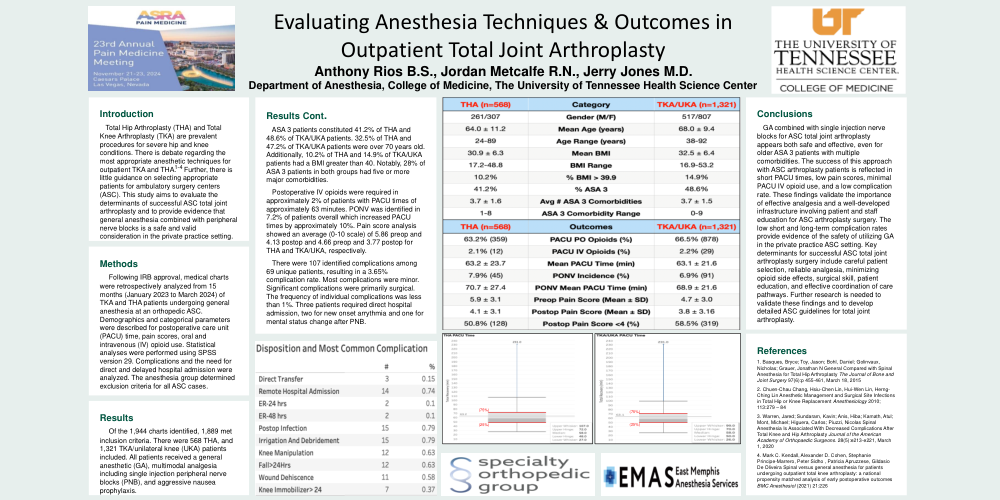
Of the 1,944 charts identified, 1,889 met inclusion criteria. There were 568 THA, and 1,321 TKA/unilateral knee (UKA) patients included. All patients received a general anesthetic (GA), multimodal analgesia including single injection peripheral nerve blocks (PNB), and aggressive nausea prophylaxis.
Results Cont.
ASA 3 patients constituted 41.2% of THA and 48.6% of TKA/UKA patients. 32.5% of THA and 47.2% of TKA/UKA patients were over 70 years old. Additionally, 10.2% of THA and 14.9% of TKA/UKA patients had a BMI greater than 40. Notably, 28% of ASA 3 patients in both groups had five or more major comorbidities.
Postoperative IV opioids were required in approximately 2% of patients with PACU times of approximately 63 minutes. PONV was identified in 7.2% of patients overall which increased PACU times by approximately 10%. Pain score analysis showed an average (0-10 scale) of 5.86 preop and 4.13 postop and 4.66 preop and 3.77 postop for THA and TKA/UKA, respectively.
There were 107 identified complications among 69 unique patients, resulting in a 3.65% complication rate. Most complications were minor. Significant complications were primarily surgical. The frequency of individual complications was less than 1%. Three patients required direct hospital admission, two for new onset arrythmia and one for mental status change after PNB.
Conclusions
GA combined with single injection nerve blocks for ASC total joint arthroplasty appears both safe and effective, even for older ASA 3 patients with multiple comorbidities. The success of this approach with ASC arthroplasty patients is reflected in short PACU times, low pain scores, minimal PACU IV opioid use, and a low complication rate. These findings validate the importance of effective analgesia and a well-developed infrastructure involving patient and staff education for ASC arthroplasty surgery. The low short and long-term complication rates provide evidence of the safety of utilizing GA in the private practice ASC setting. Key determinants for successful ASC total joint arthroplasty surgery include careful patient selection, reliable analgesia, minimizing opioid side effects, surgical skill, patient education, and effective coordination of care pathways. Further research is needed to validate these findings and to develop detailed ASC guidelines for total joint arthroplasty.
References
1. Basques, Bryce; Toy, Jason; Bohl, Daniel; Golinvaux, Nicholas; Grauer, Jonathan N General Compared with Spinal Anesthesia for Total Hip Arthroplasty The Journal of Bone and Joint Surgery 97(6):p 455-461, March 18, 2015
2. Chuen-Chau Chang, Hsiu-Chen Lin, Hui-Wen Lin, Herng-Ching Lin Anesthetic Management and Surgical Site Infections in Total Hip or Knee Replacement Anesthesiology 2010; 113:279 – 84
3. Warren, Jared; Sundaram, Kavin; Anis, Hiba; Kamath, Atul; Mont, Michael; Higuera, Carlos; Piuzzi, Nicolas Spinal Anesthesia Is Associated With Decreased Complications After Total Knee and Hip Arthroplasty Journal of the American Academy of Orthopaedic Surgeons. 28(5):e213-e221, March 1, 2020
4. Mark C. Kendall, Alexander D. Cohen, Stephanie Principe‑Marrero, Peter Sidho , Patricia Apruzzese, Gildasio De Oliveira Spinal versus general anesthesia for patients undergoing outpatient total knee arthroplasty: a national propensity matched analysis of early postoperative outcomes BMC Anesthesiol (2021) 21:226