501 posters, 2 videos, 1 audios, 8 topics, 37 sessions, 395 authors, 307 institutions
ePostersLive by SciGen Technologies S.A. All rights reserved.
23rd Annual Pain Medicine Meeting 2024
November 21-23, 2024 | Caesars Palace, Las Vegas, Nevada

5904
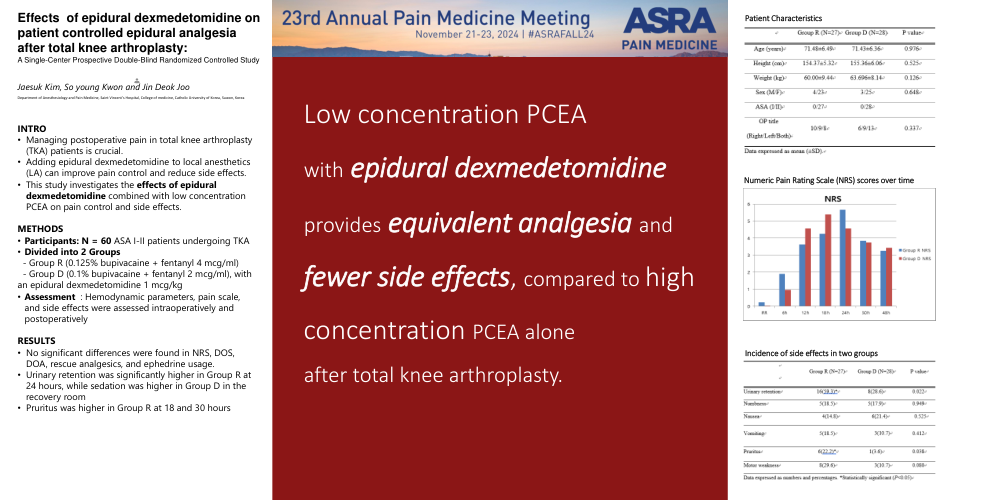
EFFECTS OF EPIDURAL DEXMEDETOMIDINE ON PATIENT CONTROLLED EPIDURAL ANALGESIA AFTER TOTAL KNEE REPLACEMENT ARTHROPLASTY
Poster Presenter
Authors
Affiliations
Part of Topic
Scientific Abstracts > Regional Anesthesia
Effects of epidural dexmedetomidine on
patient controlled epidural analgesia
after total knee arthroplasty:
A Single-Center Prospective Double-Blind Randomized Controlled Study
Jaesuk Kim, So young Kwon and Jin Deok Joo
Department of Anesthesiology and Pain Medicine, Saint Vincent’s Hospital, College of medicine, Catholic University of Korea, Suwon, Korea
INTRO
• Managing postoperative pain in total knee arthroplasty
(TKA) patients is crucial.
• Adding epidural dexmedetomidine to local anesthetics
(LA) can improve pain control and reduce side effects.
• This study investigates the effects of epidural
dexmedetomidine combined with low concentration
PCEA on pain control and side effects.
METHODS
• Participants: N = 60 ASA I-II patients undergoing TKA
• Divided into 2 Groups
- Group R (0.125% bupivacaine + fentanyl 4 mcg/ml)
- Group D (0.1% bupivacaine + fentanyl 2 mcg/ml), with
an epidural dexmedetomidine 1 mcg/kg
• Assessment : Hemodynamic parameters, pain scale,
and side effects were assessed intraoperatively and
postoperatively
RESULTS
• No significant differences were found in NRS, DOS,
DOA, rescue analgesics, and ephedrine usage.
• Urinary retention was significantly higher in Group R at
24 hours, while sedation was higher in Group D in the
recovery room
• Pruritus was higher in Group R at 18 and 30 hours