501 posters, 2 videos, 1 audios, 8 topics, 37 sessions, 395 authors, 307 institutions
ePostersLive by SciGen Technologies S.A. All rights reserved.
23rd Annual Pain Medicine Meeting 2024
November 21-23, 2024 | Caesars Palace, Las Vegas, Nevada

5758
BILATERAL ERECTOR SPINAE PLANE CATHETERS: AN EFFECTIVE NOVEL STRATEGY FOR ANALGESIA IN ACUTE PANCREATITIS
Poster Presenter
Authors
Affiliations
Part of Topic
Scientific Abstracts > Regional Anesthesia
Bilateral Erector Spinae Plane Catheters: An Effective Novel Strategy for Analgesia in Acute Pancreatitis
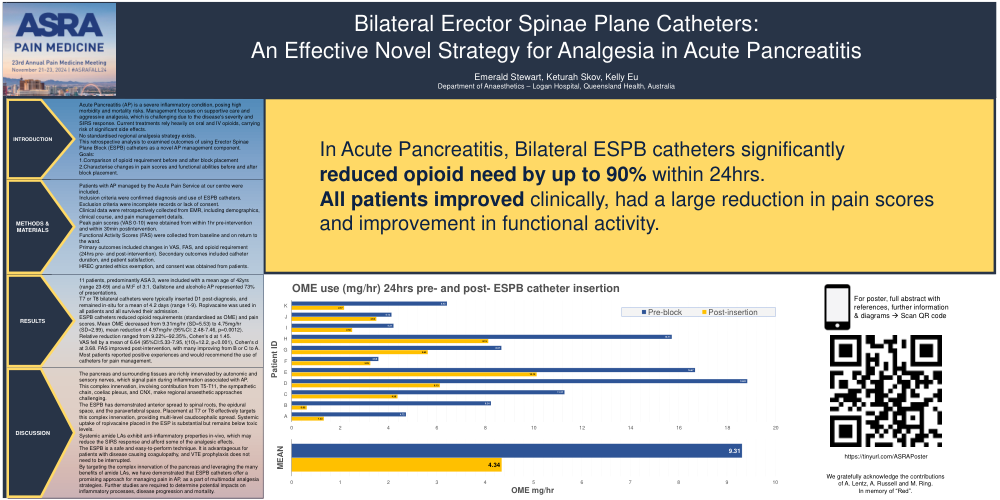
In Acute Pancreatitis, Bilateral ESPB catheters significantly reduced opioid need by up to 90% within 24hrs.
All patients improved clinically, had a large reduction in pain scores and improvement in functional activity.
Introduction:
Acute Pancreatitis (AP) is a severe inflammatory condition, posing high morbidity and mortality risks. Management focuses on supportive care and aggressive analgesia, which is challenging due to the disease's severity and SIRS response. Current treatments rely heavily on oral and IV opioids, carrying risk of significant side effects. No standardised regional analgesia strategy exists.
This retrospective analysis to examined outcomes of using Erector Spinae Plane Block (ESPB) catheters as a novel AP management component.
Goals:
11 patients, predominantly ASA 3, were included with a mean age of 42yrs (range 23-69) and a M:F of 3:1. Gallstone and alcoholic AP represented 73% of presentations.
T7 or T8 bilateral catheters were typically inserted D1 post-diagnosis, and remained in-situ for a mean of 4.2 days (range 1-9). Ropivacaine was used in all patients and all survived their admission.
ESPB catheters reduced opioid requirements (standardised as OME) and pain scores. Mean OME decreased from 9.31mg/hr (SD=5.53) to 4.75mg/hr (SD=2.99), mean reduction of 4.97mg/hr (95%CI: 2.48-7.46, p=0.0012). Relative reduction ranged from 9.22%–92.35%, Cohen's d at 1.45.
VAS fell by a mean of 6.64 (95%CI:5.33-7.95, t(10)=12.2, p<0.001), Cohen's d at 3.68. FAS improved post-intervention, with many improving from B or C to A. Most patients reported positive experiences and would recommend the use of catheters for pain management.
Discussion:
The pancreas and surrounding tissues are richly innervated by autonomic and sensory nerves, which signal pain during inflammation associated with AP.
This complex innervation, involving contribution from T5-T11, the sympathetic chain, coeliac plexus, and CNX, make regional anaesthetic approaches challenging.
The ESPB has demonstrated anterior spread to spinal roots, the epidural space, and the paravertebral space. Placement at T7 or T8 effectively targets this complex innervation, providing multi-level caudocephalic spread. Systemic uptake of ropivacaine placed in the ESP is substantial but remains below toxic levels.
Systemic amide LAs exhibit anti-inflammatory properties in-vivo, which may reduce the SIRS response and afford some of the analgesic effects.
The ESPB is a safe and easy-to-perform technique. It is advantageous for patients with disease causing coagulopathy, and VTE prophylaxis does not need to be interrupted.
By targeting the complex innervation of the pancreas and leveraging the many benefits of amide LAs, we have demonstrated that ESPB catheters offer a promising approach for managing pain in AP, as a part of multimodal analgesia strategies. Further studies are required to determine potential impacts on inflammatory processes, disease progression and mortality.