501 posters, 2 videos, 1 audios, 8 topics, 37 sessions, 395 authors, 307 institutions
ePostersLive by SciGen Technologies S.A. All rights reserved.
23rd Annual Pain Medicine Meeting 2024
November 21-23, 2024 | Caesars Palace, Las Vegas, Nevada

5921
EMERGING TECHNOLOGY FOR AUTOMATED AI-DRIVEN FACIAL EXPRESSION ANALYSIS FOR PAIN DETECTION IN PATIENTS WITH COMMUNICATION BARRIER
Poster Presenter
Authors
Affiliations
Part of Topic
Scientific Abstracts > Emerging Technology
Emerging technology for Automated AI-driven Facial Expression Analysis for Detection of Pain and Distress in Patients with Communication Barrier
Introduction
Chronic pain is a prevalent, debilitating, and increasing problem. According to a CDC report in 2021, an estimated 20.9% of U.S. adults (51.6 million individuals) experienced chronic pain, with 6.9% (17.1 million individuals) experiencing high-impact chronic pain [1].
Patients with verbal communication barriers, such as dementia, brain injuries, stroke, and autism are at high risk for underdiagnosis of chronic pain, which results in behavioral changes, unnecessary hospital admissions, overusing medications, and an increase in morbidity and mortality [2,3].
Methods
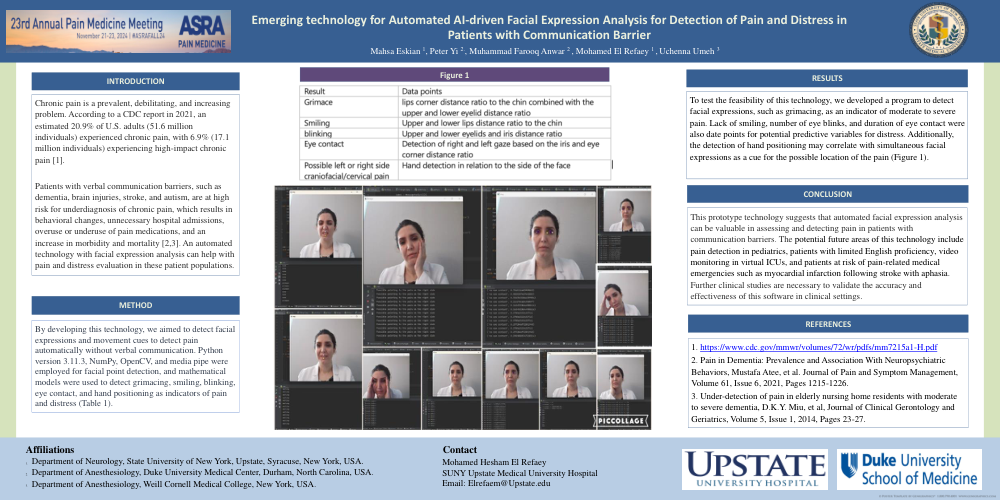
By developing this technology, we aimed to detect facial expressions and movement cues to detect pain automatically without verbal communication. Python version 3.11.3, NumPy, OpenCV, and media pipe were employed for facial point detection, and mathematical models were used to detect grimacing, smiling, blinking, eye contact, and hand positioning as indicators of pain and distress (Table 1).
Results
To test the feability of this technology, , we developed a program to detect facial expressions, such as grimacing, as an indicator of moderate to severe pain. Lack of smiling, number of eye blinks, and duration of eye contact were also date points for potential predictive variables for distress. Additionally, detection of hand positioning may correlate with simultaneous facial expressions as a cue for the possible location of the pain (Figure 1).
Conclusions
This initial test suggests that automated facial expression analysis can be a valuable tool in assessing and detecting pain in patients with communication barriers. The potential future areas of this technology include pain detection in pediatrics, patients with limited English proficiency, video monitoring in virtual ICU, and patients at risk of pain-related medical emergencies such as myocardial infarction following stroke with aphasia. Further clinical studies are necessary to validate the accuracy and effectiveness of this software in clinical settings.