501 posters, 2 videos, 1 audios, 8 topics, 37 sessions, 395 authors, 307 institutions
ePostersLive by SciGen Technologies S.A. All rights reserved.
23rd Annual Pain Medicine Meeting 2024
November 21-23, 2024 | Caesars Palace, Las Vegas, Nevada

6310
A CASE OF CHRONIC ABDOMINAL PAIN FROM ACUTE INTERMITTENT PORPHYRIA ACQUIRING RELIEF FROM SPLANCHNIC NERVE RADIOFREQUENCY NEUROTOMY
Poster Presenter
Authors
Affiliations
Part of Topic
Scientific Abstracts > Chronic Pain
A Case of Chronic Abdominal Pain from Acute Intermittent Porphyria Acquiring Relief from Splanchnic Nerve Radiofrequency Ablation
Jimmy To, DO, Jasvinder Singh, MD
Department of Rehabilitation Medicine, University of Minnesota School of Medicine, Minneapolis, MN, USA
Introduction
Acute intermittent porphyria (AIP) is a rare, autosomal-dominant, metabolic disorder that involves a deficiency in the hydroxymethylbilane synthase (HMBS) enzyme, the third enzyme in the heme synthesis pathway, resulting in a build-up of porphyrin precursors in the body1. Diagnostic confirmation typically includes quantitative measurement of porphobilinogen (PBG) and delta-aminoevulinic acid (ALA)1. Acute attacks of AIP are often triggered by multiple factors including but not limited to certain prescribed or recreational drugs, hormonal changes, excess alcohol consumption, fasting, and infections1. These attacks can last up to a week and symptoms include severe abdominal pain, behavioral changes, seizures, and peripheral neuropathy leading to muscle weakness2. Treatment often involves avoiding potential triggers as well as intravenous hematin2. Many patients with AIP have persistent abdominal pain that does not resolve with medications like intravenous hematin and narcotics. Interventional measures such as nerve blocks have been considered for pain management but this has not been well-documented3.
Materials and Methods
Retrospective review was performed including review of existing relevant literature. As the case report is regarding one patient devoid of patient identifiable information, it is exempt from Institutional Review Board (IRB) review requirements as per the University of Minnesota Investigator Manual (HRP-103) policy.
Case Presentation
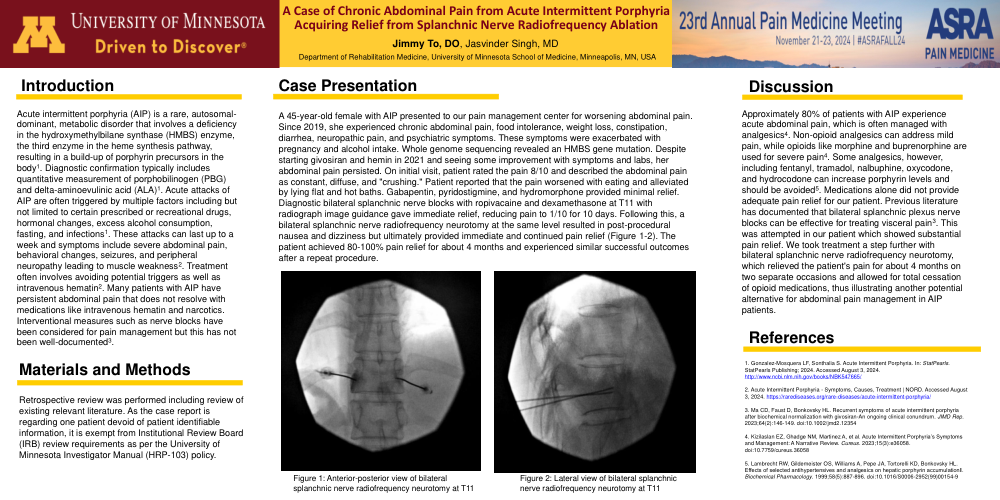
A 45-year-old female with AIP presented to our pain management center for worsening abdominal pain. Since 2019, she experienced chronic abdominal pain, food intolerance, weight loss, constipation, diarrhea, neuropathic pain, and psychiatric symptoms. These symptoms were exacerbated with pregnancy and alcohol intake. Whole genome sequencing revealed an HMBS gene mutation. Despite starting givosiran and hemin in 2021 and seeing some improvement with symptoms and labs, her abdominal pain persisted. On initial visit, patient rated the pain 8/10 and described the abdominal pain as constant, diffuse, and "crushing." Patient reported that the pain worsened with eating and alleviated by lying flat and hot baths. Gabapentin, pyridostigmine, and hydromorphone provided minimal relief. Diagnostic bilateral splanchnic nerve blocks with ropivacaine and dexamethasone at T11 with radiograph image guidance gave immediate relief, reducing pain to 1/10 for 10 days. Following this, a bilateral splanchnic nerve radiofrequency neurotomy at the same level resulted in post-procedural nausea and dizziness but ultimately provided immediate and continued pain relief (Figure 1-2). The patient achieved 80-100% pain relief for about 4 months and experienced similar successful outcomes after a repeat procedure.
Discussion
Approximately 80% of patients with AIP experience acute abdominal pain, which is often managed with analgesics4. Non-opioid analgesics can address mild pain, while opioids like morphine and buprenorphine are used for severe pain4. Some analgesics, however, including fentanyl, tramadol, nalbuphine, oxycodone, and hydrocodone can increase porphyrin levels and should be avoided5. Medications alone did not provide adequate pain relief for our patient. Previous literature has documented that bilateral splanchnic plexus nerve blocks can be effective for treating visceral pain3. This was attempted in our patient which showed substantial pain relief. We took treatment a step further with bilateral splanchnic nerve radiofrequency neurotomy, which relieved the patient's pain for about 4 months on two separate occasions and allowed for total cessation of opioid medications, thus illustrating another potential alternative for abdominal pain management in AIP patients.
References
1. Gonzalez-Mosquera LF, Sonthalia S. Acute Intermittent Porphyria. In: StatPearls. StatPearls Publishing; 2024. Accessed August 3, 2024. http://www.ncbi.nlm.nih.gov/books/NBK547665/
2. Acute Intermittent Porphyria - Symptoms, Causes, Treatment | NORD. Accessed August 3, 2024. https://rarediseases.org/rare-diseases/acute-intermittent-porphyria/
3. Ma CD, Faust D, Bonkovsky HL. Recurrent symptoms of acute intermittent porphyria after biochemical normalization with givosiran-An ongoing clinical conundrum. JIMD Rep. 2023;64(2):146-149. doi:10.1002/jmd2.12354
4. Kizilaslan EZ, Ghadge NM, Martinez A, et al. Acute Intermittent Porphyria’s Symptoms and Management: A Narrative Review. Cureus. 2023;15(3):e36058. doi:10.7759/cureus.36058
5. Lambrecht RW, Gildemeister OS, Williams A, Pepe JA, Tortorelli KD, Bonkovsky HL. Effects of selected antihypertensives and analgesics on hepatic porphyrin accumulation‖. Biochemical Pharmacology. 1999;58(5):887-896. doi:10.1016/S0006-2952(99)00154-9