501 posters, 2 videos, 1 audios, 8 topics, 37 sessions, 395 authors, 307 institutions
ePostersLive by SciGen Technologies S.A. All rights reserved.
23rd Annual Pain Medicine Meeting 2024
November 21-23, 2024 | Caesars Palace, Las Vegas, Nevada

6272
EFFICACY OF COOLED-RADIOFREQUENCY ABLATION OF THE GENICULAR NERVE AS TREATMENT FOR CHRONIC KNEE PAIN: A RETROSPECTIVE STUDY
Poster Presenter
Authors
Affiliations
University of Wisconsin School of Medicine and Public Health
Part of Topic
Scientific Abstracts > Chronic Pain
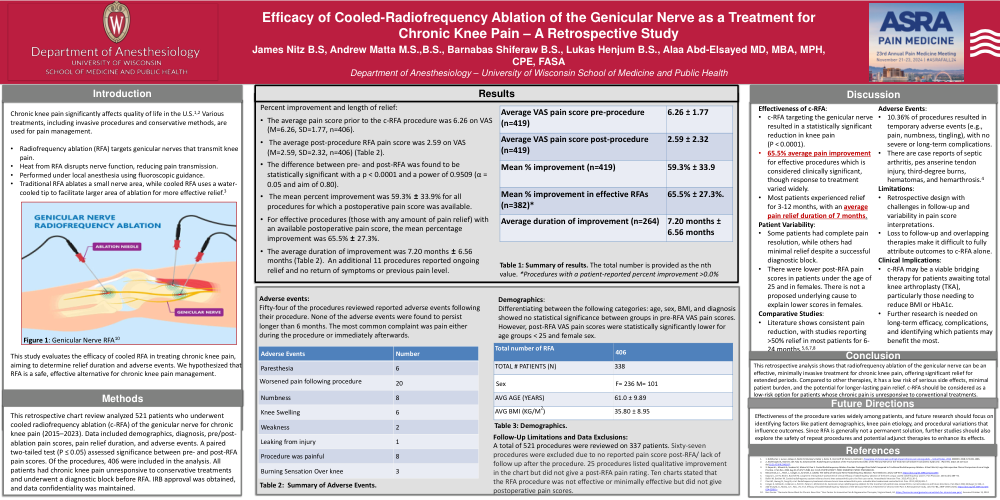
Efficacy of Cooled-Radiofrequency Ablation of the Genicular Nerve as a Treatment for Chronic Knee Pain – A Retrospective Study
James Nitz B.S, Andrew Matta M.S.,B.S., Barnabas Shiferaw B.S., Lukas Henjum B.S., Alaa Abd-Elsayed MD, MBA, MPH, CPE, FASA
Department of Anesthesiology – University of Wisconsin School of Medicine and Public Health
Chronic knee pain significantly affects quality of life in the U.S.1,2 Various treatments, including invasive procedures and conservative methods, are used for pain management.
This study evaluates the efficacy of cooled RFA in treating chronic knee pain, aiming to determine relief duration and adverse events. We hypothesized that RFA is a safe, effective alternative for chronic knee pain management.
Percent improvement and length of relief:
Adverse events:
Fifty-four of the procedures reviewed reported adverse events following their procedure. None of the adverse events were found to persist longer than 6 months. The most common complaint was pain either during the procedure or immediately afterwards.
Demographics:
Differentiating between the following categories: age, sex, BMI, and diagnosis showed no statistical significance between groups in pre-RFA VAS pain scores. However, post-RFA VAS pain scores were statistically significantly lower for age groups < 25 and female sex.
A total of 521 procedures were reviewed on 337 patients. Sixty-seven procedures were excluded due to no reported pain score post-RFA/ lack of follow up after the procedure. 25 procedures listed qualitative improvement in the chart but did not give a post-RFA pain rating. Ten charts stated that the RFA procedure was not effective or minimally effective but did not give postoperative pain scores.
Effectiveness of c-RFA:
Patient Variability:
Comparative Studies:
Adverse Events:
Limitations:
Clinical Implications:
This retrospective analysis shows that radiofrequency ablation of the genicular nerve can be an effective, minimally invasive treatment for chronic knee pain, offering significant relief for extended periods. Compared to other therapies, it has a low risk of serious side effects, minimal patient burden, and the potential for longer-lasting pain relief. c-RFA should be considered as a low-risk option for patients whose chronic pain is unresponsive to conventional treatments.
Effectiveness of the procedure varies widely among patients, and future research should focus on identifying factors like patient demographics, knee pain etiology, and procedural variations that influence outcomes. Since RFA is generally not a permanent solution, further studies should also explore the safety of repeat procedures and potential adjunct therapies to enhance its effects.