501 posters, 2 videos, 1 audios, 8 topics, 37 sessions, 395 authors, 307 institutions
ePostersLive by SciGen Technologies S.A. All rights reserved.
23rd Annual Pain Medicine Meeting 2024
November 21-23, 2024 | Caesars Palace, Las Vegas, Nevada

6225
COMPARISON OF A NOVEL POSTERIOR INTEGRATED FIXATION SACROILIAC JOINT FUSION APPROACH TO THE POSTEROLATERAL AND LATERAL APPROACHES
Poster Presenter
Authors
Affiliations
Part of Topic
Scientific Abstracts > Chronic Pain
Comparison of a Novel Posterior Integrated Transfixation Sacroiliac Joint Fusion Approach to the Posterolateral and Lateral Approaches:
A Cadaveric Biomechanical and Computational Analysis of Fixation, Invasiveness, and Fusion Area
INTRODUCTION
•Sacroiliac joint dysfunction is implicated in 15-30% of low back pain.1
•Implant site, design, interface with bone, and approach differentiate primary (lateral, posterolateral, posterior) and secondary (anterior, posteromedial) arthrodesis techniques. 2-5
•Currently no comparative cadaveric study of fixation efficacy, invasiveness, and fusion potential. 4-7
OBJECTIVES
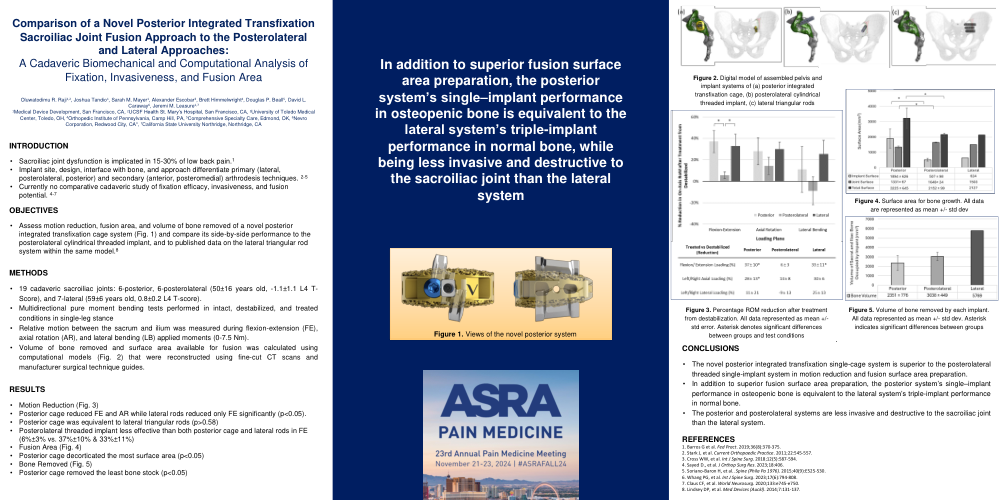
•Assess motion reduction, fusion area, and volume of bone removed of a novel posterior integrated transfixation cage system (Fig. 1) and compare its side-by-side performance to the posterolateral cylindrical threaded implant, and to published data on the lateral triangular rod system within the same model.8
METHODS
•19 cadaveric sacroiliac joints: 6-posterior, 6-posterolateral (50±16 years old, -1.1±1.1 L4 T-Score), and 7-lateral (59±6 years old, 0.8±0.2 L4 T-score).
•Multidirectional pure moment bending tests performed in intact, destabilized, and treated conditions in single-leg stance
•Relative motion between the sacrum and ilium was measured during flexion-extension (FE), axial rotation (AR), and lateral bending (LB) applied moments (0-7.5 Nm).
•Volume of bone removed and surface area available for fusion was calculated using computational models (Fig. 2) that were reconstructed using fine-cut CT scans and manufacturer surgical technique guides.
RESULTS
•Motion Reduction (Fig. 3)
•Posterior cage reduced FE and AR while lateral rods reduced only FE significantly (p<0.05).
•Posterior cage was equivalent to lateral triangular rods (p>0.58)
•Posterolateral threaded implant less effective than both posterior cage and lateral rods in FE (6%±3% vs. 37%±10% & 33%±11%)
•Fusion Area (Fig. 4)
•Posterior cage decorticated the most surface area (p<0.05)
•Bone Removed (Fig. 5)
•Posterior cage removed the least bone stock (p<0.05)
CONCLUSIONS
•The novel posterior integrated transfixation single-cage system is superior to the posterolateral threaded single-implant system in motion reduction and fusion surface area preparation.
•In addition to superior fusion surface area preparation, the posterior system’s single–implant performance in osteopenic bone is equivalent to the lateral system’s triple-implant performance in normal bone.
•The posterior and posterolateral systems are less invasive and destructive to the sacroiliac joint than the lateral system.