Loading...

501 posters, 2 videos, 1 audios, 8 topics, 37 sessions, 395 authors, 307 institutions

ePostersLive by SciGen Technologies S.A. All rights reserved.

23rd Annual Pain Medicine Meeting 2024

November 21-23, 2024 | Caesars Palace, Las Vegas, Nevada

23rd Annual Pain Medicine Meeting 2024 banner

6064

SHOULDER SURGERY AVOIDANCE THROUGH MULTIPLE YEARS FOLLOWING 60-DAY PNS TREATMENT: OUTCOMES FROM A CROSS-SECTIONAL FOLLOW-UP SURVEY
Poster Presenter

Nathan Crosby

Part of Topic

Scientific Abstracts > Chronic Pain

Shoulder Surgery Avoidance Through Multiple Years Following 60-Day PNS Treatment: Outcomes from a Cross-Sectional Follow-Up Survey Study

Kevin Vorenkamp, MD, FASA1; Gemayel Lee, MD2; Denise Lester, MD, FASAM3; Chaitanya Konda, DO4; Steven P. Cohen, MD5;
Nate D. Crosby, PhD6; Joseph W. Boggs, PhD6

1. Duke University, Durham, NC; 2. Relive You Center for Advanced Pain Management; 3. Central Virginia VA Healthcare System; 4. UT Southwestern, Dallas, TX; 5. Northwestern University, Chicago, IL; 6. SPR Therapeutics, Cleveland, OH


•Shoulder pain is highly prevalent and can become chronic and disabling.1,2
•Refractory pain can result in major procedures like surgery that are invasive, costly, and pose significant risk to patients.
•Common shoulder surgeries like arthroscopic rotator cuff repair and shoulder arthroplasty carry significant costs, risks, and high rates of postoperative opioid use.3
•The present study evaluated outcomes including surgery avoidance in a shoulder pain population following percutaneous 60-day peripheral nerve stimulation (PNS) treatment.
 
•IRB-approved cross-sectional follow-up survey of patients who:
ounderwent 60-day PNS treatment of shoulder pain
owere at least 6 months from the start of treatment
oresponded with ≥50% pain relief at the end of treatment (EOT)
•Outcomes included patient-reported percent pain relief, average and worst pain scores, and patient global impression of change (PGIC) in quality of life, physical function, and sleep.
•Patients also reported on the use or avoidance of other treatments and interventions for their shoulder pain since the 60-day PNS treatment including any new or changes in medications.
•Data presented as mean ± SD.
 

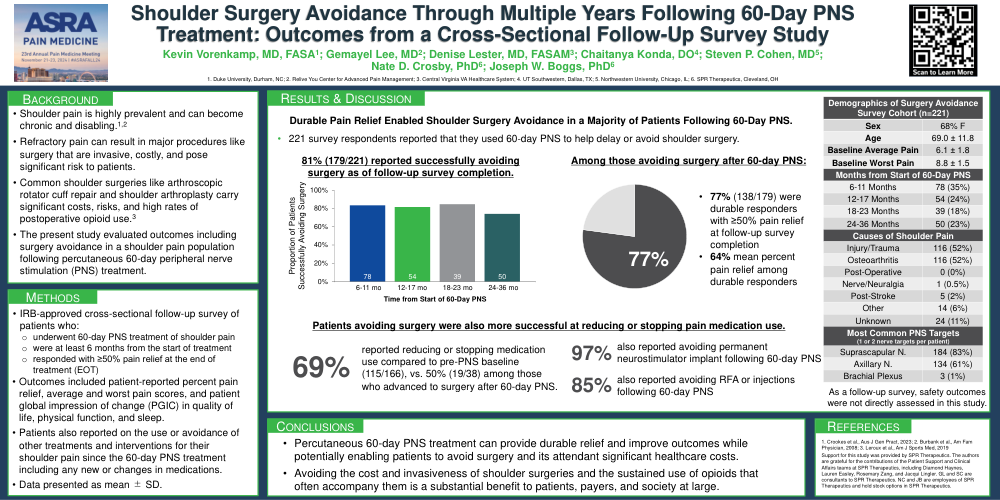
Durable Pain Relief Enabled Shoulder Surgery Avoidance in a Majority of Patients Following 60-Day PNS.

•221 survey respondents reported that they used 60-day PNS to help delay or avoid shoulder surgery.

81% (179/221) reported successfully avoiding surgery as of follow-up survey completion.

Among those avoiding surgery after 60-day PNS:

•77% (138/179) were durable responders with ≥50% pain relief at follow-up survey completion
•64% mean percent pain relief among durable responders

Patients avoiding surgery were also more successful at reducing or stopping pain medication use.

69% reported reducing or stopping medication use compared to pre-PNS baseline (115/166), vs. 50% (19/38) among those who advanced to surgery after 60-day PNS.


97% 

also reported avoiding permanent neurostimulator implant following 60-day PNS

85%

also reported avoiding RFA or injections following 60-day PNS


•Percutaneous 60-day PNS treatment can provide durable relief and improve outcomes while potentially enabling patients to avoid surgery and its attendant significant healthcare costs.
•Avoiding the cost and invasiveness of shoulder surgeries and the sustained use of opioids that often accompany them is a substantial benefit to patients, payers, and society at large.
23rd Annual Pain Medicine Meeting 2024 » banner
Copyright © 2015-2026, ePostersLive® SciGen is a registered trademark of SciGen Technologies S.A. Patent pending.

This website and third-party tools we use rely on cookies for the best user experience. By selecting "I agree", you agree to cookie usage as described in our Privacy Policy.