Loading...

501 posters, 2 videos, 1 audios, 8 topics, 37 sessions, 395 authors, 307 institutions

ePostersLive by SciGen Technologies S.A. All rights reserved.

23rd Annual Pain Medicine Meeting 2024

November 21-23, 2024 | Caesars Palace, Las Vegas, Nevada

23rd Annual Pain Medicine Meeting 2024 banner

5944

COMPARISON OF UNIMPEDED MAGNETIC RESONANCE IMAGING ACCESS BY SPINAL CORD STIMULATION MANUFACTURER: A RETROSPECTIVE CLAIMS STUDY
Poster Presenter

Nicolas Gasquet

Authors

Nicolas Gasquet

Affiliations

Medtronic plc

Part of Topic

Scientific Abstracts > Chronic Pain

Comparison of unimpeded magnetic resonance imaging access by Spinal Cord Stimulation manufacturer: A retrospective claims study


Authors

Nomen Azeem1, Yair Safriel2,3, Samir Sheth4, Marilyn Moucharite5, Nicolas Gasquet5, Christine Ricker5, Charlotte Wu5


Introduction

Spinal cord stimulation (SCS) systems have varying degrees of magnetic resonance imaging (MRI) compatibility. While all SCS manufacturers have some level of MRI compatibility, an impedance-independent system enables patients to undergo an MRI with out-of-range lead impedance values.

Objective

Compare the real-world trends in MRI utilization among patients treated with impedance-independent SCS systems that enable MRI access in the presence of out-of-range lead impedance versus all other SCS devices.


Methods

•Medicare Research Identifiable File (RIF) administrative claims data (2016-2021) were used to identify patients.
•Patients with an initial SCS implant during 2018 were selected, with a one-year baseline and three-year follow-up.
•Linkage of claims data with Medtronic (MDT) device registration was used to identify patients implanted with MDT impedance-independent systems (MDT-SCS) vs. other SCS devices (non-MDT SCS)
•Rates of MRI in follow-up for MDT-SCS vs. non-MDT SCS were calculated  for the overall study population, among explants only and adjusted using Cox Proportional Hazards Ratio model with covariates for sex, age group, race and CCI score.
 

Main Results

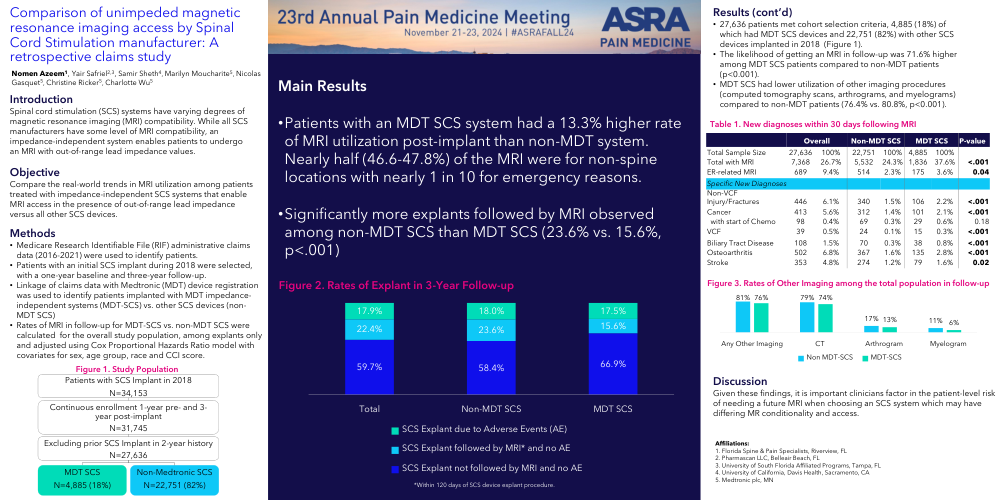
•Patients with an MDT SCS system had a 13.3% higher rate of MRI utilization post-implant than non-MDT system. Nearly half (46.6-47.8%) of the MRI were for non-spine locations with nearly 1 in 10 for emergency reasons.
•Significantly more explants followed by MRI observed among non-MDT SCS than MDT SCS (23.6% vs. 15.6%, p<.001)
 

Results (cont’d)

•27,636 patients met cohort selection criteria, 4,885 (18%) of which had MDT SCS devices and 22,751 (82%) with other SCS devices implanted in 2018  (Figure 1).
•The likelihood of getting an MRI in follow-up was 71.6% higher among MDT SCS patients compared to non-MDT patients (p<0.001).
•MDT SCS had lower utilization of other imaging procedures (computed tomography scans, arthrograms, and myelograms) compared to non-MDT patients (76.4% vs. 80.8%, p<0.001).


Discussion

Given these findings, it is important clinicians factor in the patient-level risk of needing a future MRI when choosing an SCS system which may have differing MR conditionality and access.


Affiliations:

1. Florida Spine & Pain Specialists, Riverview, FL
2. Pharmascan LLC, Belleair Beach, FL
3. University of South Florida Affiliated Programs, Tampa, FL
4. University of California, Davis Health, Sacramento, CA
5. Medtronic plc, MN

23rd Annual Pain Medicine Meeting 2024 » banner
Copyright © 2015-2026, ePostersLive® SciGen is a registered trademark of SciGen Technologies S.A. Patent pending.

This website and third-party tools we use rely on cookies for the best user experience. By selecting "I agree", you agree to cookie usage as described in our Privacy Policy.