501 posters, 2 videos, 1 audios, 8 topics, 37 sessions, 395 authors, 307 institutions
ePostersLive by SciGen Technologies S.A. All rights reserved.
23rd Annual Pain Medicine Meeting 2024
November 21-23, 2024 | Caesars Palace, Las Vegas, Nevada

5871
PAIN OUTCOMES IN MULTIPLE SCLEROSIS PATIENTS ON S1PR MODULATORS: SECONDARY ANALYSIS OF A US NATIONAL SURVEY DATA
Poster Presenter
Authors
Affiliations
Part of Topic
Scientific Abstracts > Chronic Pain
TITLE: Pain Outcomes in Multiple Sclerosis Patients on S1PR modulators: Secondary Analysis of a US National Survey Data
BACKGROUND
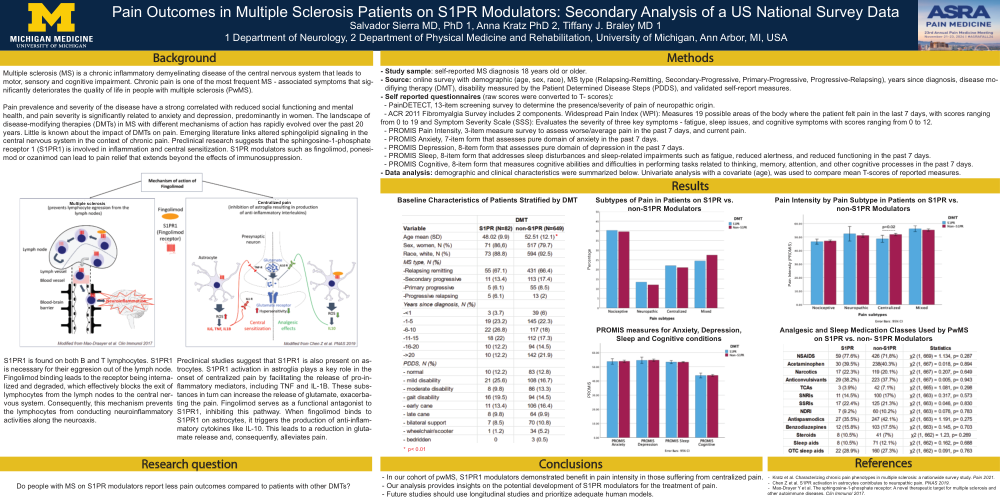
Multiple sclerosis (MS) is a chronic inflammatory demyelinating disease of the central nervous system that leads to motor, sensory and cognitive impairment. Chronic pain is one of the most frequent MS - associated symptoms that significantly deteriorates the quality of life in people with multiple sclerosis (PwMS). Pain prevalence and severity of the disease have a strong correlated with reduced social functioning and mental health, and pain severity is significantly related to anxiety and depression, predominantly in women. The landscape of disease-modifying therapies (DMTs) in MS with different mechanisms of action has rapidly evolved over the past 20 years. Little is known about the impact of DMTs on pain. Emerging literature links altered sphingolipid signaling in the central nervous system in the context of chronic pain. Preclinical research suggests that the sphingosine-1-phosphate receptor 1 (S1PR1) is involved in inflammation and central sensitization. S1PR modulators such as fingolimod, ponesimod or ozanimod can lead to pain relief that extends beyond the effects of immunosuppression
S1PR1 is found on both B and T lymphocytes. S1PR1 is necessary for their eggresion out of the lymph node. Fingolimod binding leads to the receptor being internalized and degraded, which effectively blocks the exit of lymphocytes from the lymph nodes to the central nervous system. Consequently, this mechanism prevents the lymphocytes from conducting neuroinflammatory activities along the neuroaxis.
Preclinical studies suggest that S1PR1 is also present on astrocytes. S1PR1 activation in astroglia plays a key role in the onset of centralized pain by facilitating the release of pro-inflammatory mediators, including TNF and IL-1B. These substances in turn can increase the release of glutamate, exacerbating the pain. Fingolimod serves as a functional antagonist to S1PR1, inhibiting this pathway. When fingolimod binds to S1PR1 on astrocytes, it triggers the production of anti-inflammatory cytokines like IL-10. This leads to a reduction in glutamate release and, consequently, alleviates pain.
RESEARCH QUESTION
Do people with MS on S1PR modulators report less pain outcomes compared to patients with other DMTs?
METHODS
- Study sample: self-reported MS diagnosis 18 years old or older. - Source: online survey with demographic (age, sex, race), MS type (Relapsing-Remitting, Secondary-Progressive, Primary-Progressive, Progressive-Relapsing), years since diagnosis, disease modifiying therapy (DMT), disability measured by the Patient Determined Disease Steps (PDDS), and validated self-report measures.
- Self reported questionnaires (raw scores were converted to T- scores):
- PainDETECT, 13-item screening survey to determine the presence/severity of pain of neuropathic origin.
- ACR 2011 Fibromyalgia Survey includes 2 components. Widespread Pain Index (WPI): Measures 19 possible areas of the body where the patient felt pain in the last 7 days, with scores ranging from 0 to 19 and Symptom Severity Scale (SSS): Evaluates the severity of three key symptoms - fatigue, sleep issues, and cognitive symptoms with scores ranging from 0 to 12.
- PROMIS Pain Intensity, 3-item measure survey to assess worse/average pain in the past 7 days, and current pain. - PROMIS Anxiety, 7-item form that assesses pure domain of anxiety in the past 7 days.
- PROMIS Depression, 8-item form that assesses pure domain of depression in the past 7 days.
- PROMIS Sleep, 8-item form that addresses sleep disturbances and sleep-related impairments such as fatigue, reduced alertness, and reduced functioning in the past 7 days.
- PROMIS Cognitive, 8-item form that measures cognitive abilities and difficulties in performing tasks related to thinking, memory, attention, and other cognitive processes in the past 7 days.
- Data analysis: demographic and clinical characteristics were summarized below. Univariate analysis with a covariate (age), was used to compare mean T-scores of reported measures.
CONCLUSIONS
- In our cohort of pwMS, S1PR1 modulators demonstrated benefit in pain intensity in those suffering from centralized pain.
- Our analysis provides insights on the potential development of S1PR modulators for the treatment of pain.
- Future studies should use longitudinal studies and prioritize adequate human models.