501 posters, 2 videos, 1 audios, 8 topics, 37 sessions, 395 authors, 307 institutions
ePostersLive by SciGen Technologies S.A. All rights reserved.
23rd Annual Pain Medicine Meeting 2024
November 21-23, 2024 | Caesars Palace, Las Vegas, Nevada

5761
UK MEDICAL CANNABIS REGISTRY: AN ANALYSIS OF CLINICAL OUTCOMES OF MEDICINAL CANNABIS THERAPY FOR CANCER PAIN
Poster Presenter
Authors
Affiliations
Part of Topic
Scientific Abstracts > Chronic Pain
Introduction
Cancer pain is a prevalent condition, affecting 44.5% of cancer patients, with limited pharmacotherapeutic options1,2. Pre-clinical studies have shown that cannabinoids and terpenes can affect the transmission of nociceptive signals, as well as the emotional and cognitive manifestations of pain3,4. However, the efficacy of cannabis-based medicinal products (CBMPs) in cancer pain remains contentious5. This study aims to evaluate the change in patient-reported outcome measures (PROMs) and adverse events (AEs) associated with CBMPs prescribed for cancer pain patients.
Methods
Study Design: Case series using prospectively collected clinical data from the UK Medical Cannabis Registry. The primary outcome was the changes in PROMs from baseline to follow-up at 1, 3 and 6 months. The secondary outcome was the incidence of adverse events. Analysis included a repeated measures ANOVA, post-hoc multiple pairwise comparisons with Bonferroni correction. Logistic regression was also conducted. p<0.050 was considered statistically significant.
Results
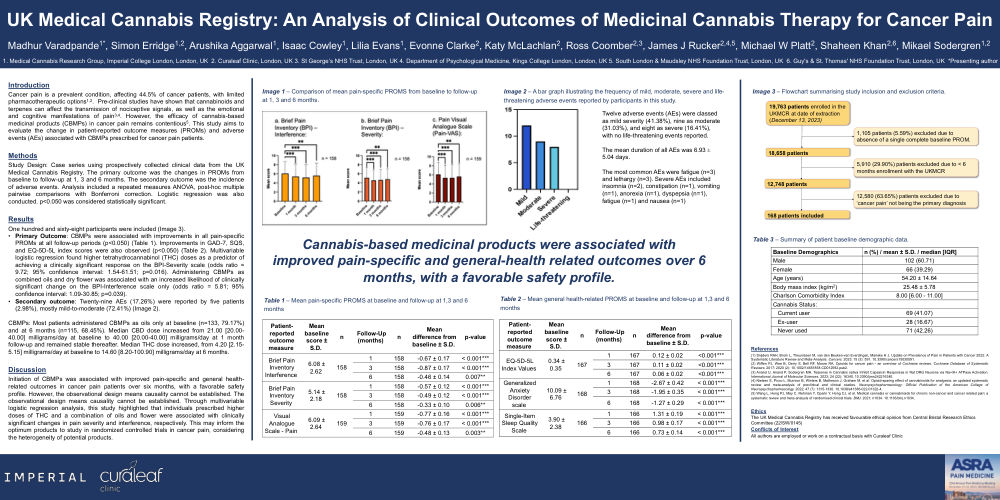
One hundred and sixty-eight participants were included (Image 3).
CBMPs: Most patients administered CBMPs as oils only at baseline (n=133, 79.17%) and at 6 months (n=115, 68.45%). Median CBD dose increased from 21.00 [20.00-40.00] milligrams/day at baseline to 40.00 [20.00-40.00] milligrams/day at 1 month follow-up and remained stable thereafter. Median THC dose increased, from 4.20 [2.15-5.15] milligrams/day at baseline to 14.60 [8.20-100.90] milligrams/day at 6 months.
Discussion
Initiation of CBMPs was associated with improved pain-specific and general health-related outcomes in cancer pain patients over six months, with a favorable safety profile. However, the observational design means causality cannot be established. The observational design means causality cannot be established. Through multivariable logistic regression analysis, this study highlighted that individuals prescribed higher doses of THC and a combination of oils and flower were associated with clinically significant changes in pain severity and interference, respectively. This may inform the optimum products to study in randomized controlled trials in cancer pain, considering the heterogeneity of potential products.