501 posters, 2 videos, 1 audios, 8 topics, 37 sessions, 395 authors, 307 institutions
ePostersLive by SciGen Technologies S.A. All rights reserved.
23rd Annual Pain Medicine Meeting 2024
November 21-23, 2024 | Caesars Palace, Las Vegas, Nevada

5967
EFFICACY OF BILATERAL CERVICAL RFA FOR REFRACTORY CERVICOGENIC HEADACHES: A CASE SERIES UNDER NEW MEDICARE GUIDELINES
Poster Presenter
Authors
Affiliations
Part of Topic
Scientific Abstracts > Case Series
Title: Efficacy of Bilateral Cervical Radiofrequency Ablation for Refractory Cervicogenic Headaches: A Case Series Exploring Outcomes Under New Medicare Guidelines
Nikhil Grandhi, DO
Background: Cervicogenic headaches are a chronic condition that affects up to 4% of the adult population. While initial treatments often involve non-invasive methods, some patients require more advanced interventions. A unilateral approach to radiofrequency ablation has long been the staple intervention that has been covered by most insurances. However, with recent changes, bilateral radiofrequency ablation of cervical medial branch nerves has shown promise, but its efficacy and safety remain under-studied.
Objective: To evaluate the effectiveness and tolerability of bilateral C2-3 medial branch RFA in patients with refractory cervicogenic headaches.
Methods: This case series included 13 patients (10 females and 3 males; age range 30-80 years) diagnosed with cervicogenic headaches resistant to non-invasive treatments. All patients met the inclusion criteria of at least 80% pain relief after two consecutive diagnostic medial branch blocks with persistent pain reduction of at least 50% or more at their 6 month follow up. Patients then underwent bilateral radiofrequency ablation at the C2-3 junction with consistent follow up over the next 18 months.
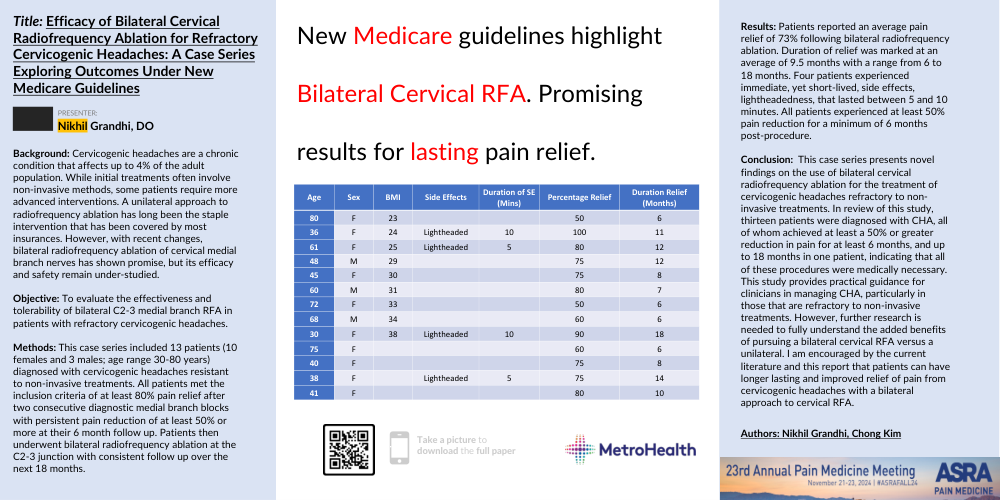
Results: Patients reported an average pain relief of 73% following bilateral radiofrequency ablation. Duration of relief was marked at an average of 9.5 months with a range from 6 to 18 months. Four patients experienced immediate, yet short-lived, side effects, lightheadedness, that lasted between 5 and 10 minutes. All patients experienced at least 50% pain reduction for a minimum of 6 months post-procedure.
Conclusion: This case series presents novel findings on the use of bilateral cervical radiofrequency ablation for the treatment of cervicogenic headaches refractory to non-invasive treatments. In review of this study, thirteen patients were diagnosed with CHA, all of whom achieved at least a 50% or greater reduction in pain for at least 6 months, and up to 18 months in one patient, indicating that all of these procedures were medically necessary. This study provides practical guidance for clinicians in managing CHA, particularly in those that are refractory to non-invasive treatments. However, further research is needed to fully understand the added benefits of pursuing a bilateral cervical RFA versus a unilateral. I am encouraged by the current literature and this report that patients can have longer lasting and improved relief of pain from cervicogenic headaches with a bilateral approach to cervical RFA.