501 posters, 2 videos, 1 audios, 8 topics, 37 sessions, 395 authors, 307 institutions
ePostersLive by SciGen Technologies S.A. All rights reserved.
23rd Annual Pain Medicine Meeting 2024
November 21-23, 2024 | Caesars Palace, Las Vegas, Nevada

5842
A RETROSPECTIVE ANALYSIS OF PATIENT AND HOSPITAL-LEVEL FACTORS PREDICTING THE USE OF GENERAL ANESTHESIA FOR TOTAL HIP ARTHROPLASTY
Poster Presenter
Authors
Affiliations
Part of Topic
Scientific Abstracts > Regional Anesthesia
A Retrospective Analysis of Patient- and Hospital-Level Factors Predicting the Use of General Anesthesia for Total Hip Arthroplasty
Introduction:
Some studies showed that using neuraxial anesthesia (NA) reduced in-hospital complications, surgical duration, and hospital length of stay compared to general anesthesia (GA) for total hip arthroplasty (THA) [1], while others showed no significant differences [2]. Variability in anesthetic choice exists, introducing the risk of differences in care across racial and ethnic demographics [3].Schaar et al. found that Black patients had lower odds and Asian patients higher odds of receiving NA compared to White patients for hip fracture surgery, but the influence of hospital-level factors on anesthesia choice was not investigated [4].
Objectives:
Data from the State Inpatient Databases, Healthcare Cost and Utilization Project was used to analyze New York state THA cases (found using ICD-10 codes) from 2015-2017 with available GA or NA use data. Nested logistic regression models were developed to predict the likelihood of receiving GA or NA. Model 1 included race/ethnicity as the only covariateModel 2 added the following other patient-level covariates: age, sex, primary insurance payer, median income quartile, and adjustments for Elixhauser comorbidities. Model 3 added the following hospital-level covariates: year of procedure, hospital THA volume quartile, hospital safety-net burden, and rural-urban geography. An area under the receiver operative characteristic (AUROC) curve was calculated to assess model discrimination and performance. Calibration belts assessed model calibration and standardized differences addressed sampling bias.
Results:
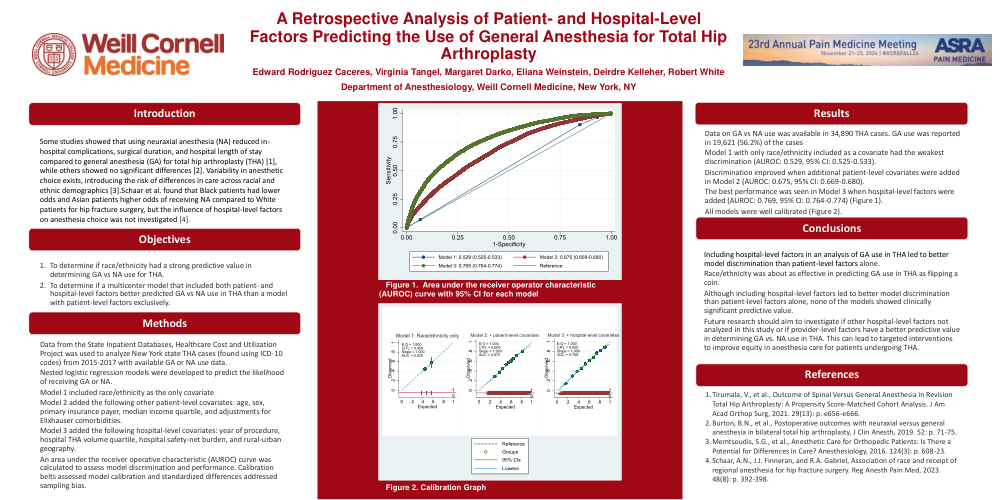
Data on GA vs NA use was available in 34,890 THA cases. GA use was reported in 19,621 (56.2%) of the cases. Model 1 with only race/ethnicity included as a covariate had the weakest discrimination (AUROC: 0.529, 95% CI: 0.525-0.533). Discrimination improved when additional patient-level covariates were added in Model 2 (AUROC: 0.675, 95% CI: 0.669-0.680). The best performance was seen in Model 3 when hospital-level factors were added (AUROC: 0.769, 95% CI: 0.764-0.774) (Figure 1). All models were well calibrated (Figure 2).
Conclusions:
Including hospital-level factors in an analysis of GA use in THA led to better model discrimination than patient-level factors alone. Race/ethnicity was about as effective in predicting GA use in THA as flipping a coin. Although including hospital-level factors led to better model discrimination than patient-level factors alone, none of the models showed clinically significant predictive value. Future research should aim to investigate if other hospital-level factors not analyzed in this study or if provider-level factors have a better predictive value in determining GA vs. NA use in THA. This can lead to targeted interventions to improve equity in anesthesia care for patients undergoing THA.
References: