501 posters, 2 videos, 1 audios, 8 topics, 37 sessions, 395 authors, 307 institutions
ePostersLive by SciGen Technologies S.A. All rights reserved.
23rd Annual Pain Medicine Meeting 2024
November 21-23, 2024 | Caesars Palace, Las Vegas, Nevada

6294
PERIPHERAL NERVE STIMULATION FOR HEMIPLEGIC SHOULDER PAIN: A SYSTEMATIC REVIEW
Poster Presenter
Authors
Affiliations
Part of Topic
Scientific Abstracts > Chronic Pain
Peripheral Nerve Stimulation for Hemiplegic Shoulder Pain: A Systematic Review
OBJECTIVE
•We present a systematic review of the safety and efficacy of peripheral nerve stimulation (PNS), a promising new neuromodulation modality for refractory hemiplegic shoulder pain (HSP).
METHODS
•A systematic review involving a comprehensive search of relevant literature was performed in six major databases. We considered clinical trials published between January 1970-June 2024 which assessed PNS for pain relief in chronic stroke survivors suffering from hemiplegic shoulder pain with or without shoulder subluxation.
RESULTS
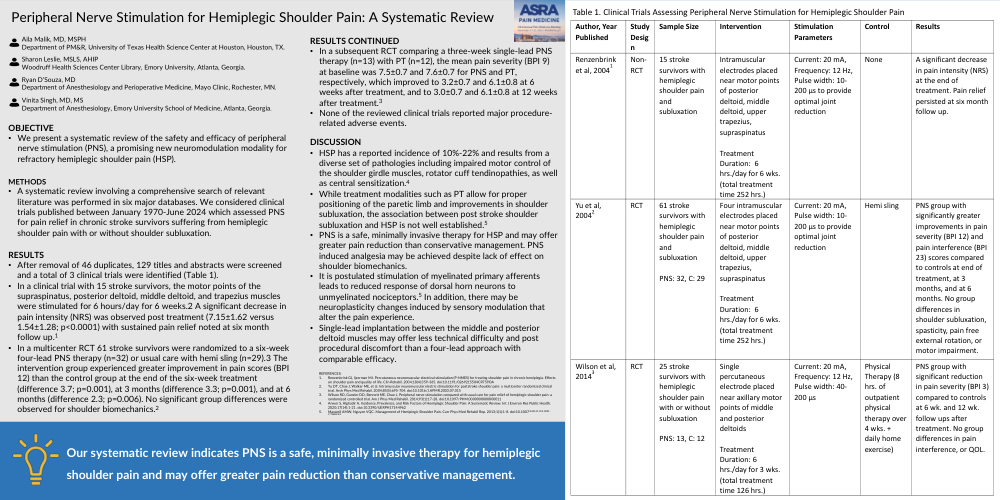
•After removal of 46 duplicates, 129 titles and abstracts were screened and a total of 3 clinical trials were identified (Table 1).
•In a clinical trial with 15 stroke survivors, the motor points of the supraspinatus, posterior deltoid, middle deltoid, and trapezius muscles were stimulated for 6 hours/day for 6 weeks.2 A significant decrease in pain intensity (NRS) was observed post treatment (7.15±1.62 versus 1.54±1.28; p<0.0001) with sustained pain relief noted at six month follow up.1
•In a multicenter RCT 61 stroke survivors were randomized to a six-week four-lead PNS therapy (n=32) or usual care with hemi sling (n=29).3 The intervention group experienced greater improvement in pain scores (BPI 12) than the control group at the end of the six-week treatment (difference 3.7; p=0.001), at 3 months (difference 3.3; p=0.001), and at 6 months (difference 2.3; p=0.006). No significant group differences were observed for shoulder biomechanics.2
•In a subsequent RCT comparing a three-week single-lead PNS therapy (n=13) with PT (n=12), the mean pain severity (BPI 9) at baseline was 7.5±0.7 and 7.6±0.7 for PNS and PT, respectively, which improved to 3.2±0.7 and 6.1±0.8 at 6 weeks after treatment, and to 3.0±0.7 and 6.1±0.8 at 12 weeks after treatment.3
•None of the reviewed clinical trials reported major procedure-related adverse events.
DISCUSSION
•HSP has a reported incidence of 10%-22% and results from a diverse set of pathologies including impaired motor control of the shoulder girdle muscles, rotator cuff tendinopathies, as well as central sensitization.4
•While treatment modalities such as PT allow for proper positioning of the paretic limb and improvements in shoulder subluxation, the association between post stroke shoulder subluxation and HSP is not well established.5
•PNS is a safe, minimally invasive therapy for HSP and may offer greater pain reduction than conservative management. PNS induced analgesia may be achieved despite lack of effect on shoulder biomechanics.
•It is postulated stimulation of myelinated primary afferents leads to reduced response of dorsal horn neurons to unmyelinated nociceptors.5 In addition, there may be neuroplasticity changes induced by sensory modulation that alter the pain experience.
•Single-lead implantation between the middle and posterior deltoid muscles may offer less technical difficulty and post procedural discomfort than a four-lead approach with comparable efficacy.