501 posters, 2 videos, 1 audios, 8 topics, 37 sessions, 395 authors, 307 institutions
ePostersLive by SciGen Technologies S.A. All rights reserved.
23rd Annual Pain Medicine Meeting 2024
November 21-23, 2024 | Caesars Palace, Las Vegas, Nevada

5849
A SUPERVISED MACHINE LEARNING APPROACH TO IDENTIFICATION OF RISK FACTORS FOR SPINAL CORD STIMULATOR EXPLANTATION
Poster Presenter
Authors
Affiliations
Part of Topic
Scientific Abstracts > Chronic Pain
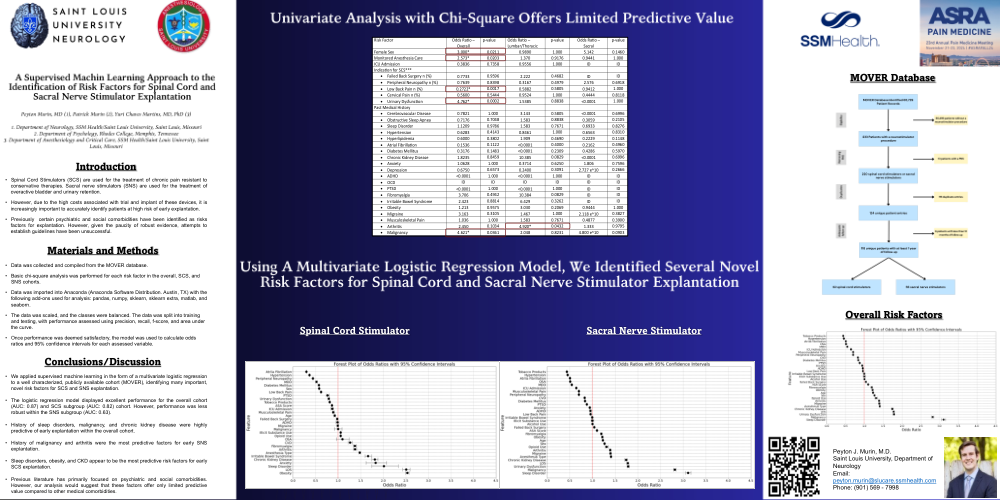
A Supervised Machine Learning Approach to the Identification of Risk Factors for Spinal Cord and Sacral Nerve Stimulator Explantation
Introduction: Spinal Cord Stimulators (SCS) are used for the treatment of chronic pain resistant to conservative therapies. Sacral nerve stimulators (SNS) are used for the treatment of overactive bladder and urinary retention. However, due to the high costs associated with trial and implant of these devices, it is increasingly important to accurately identify patients at high risk of early explantation. Previously certain psychiatric and social comorbidities have been identified as risks factors for explantation. However, given the paucity of robust evidence, attempts to establish guidelines have been unsuccessful.
Materials and Methods: Data was collected and compiled from the MOVER database. Basic chi-square analysis was performed for each risk factor in the overall, SCS, and SNS cohorts. Data was imported into Anaconda (Anaconda Software Distribution. Austin, TX) with the following add-ons used for analysis: pandas, numpy, sklearn, sklearn extra, matlab, and seaborn. The data was scaled, and the classes were balanced. The data was split into training and testing, with performance assessed using precision, recall, f-score, and area under the curve. Once performance was deemed satisfactory, the model was used to calculate odds ratios and 95% confidence intervals for each assessed variable.
Conclusions/Discussion: We applied supervised machine learning in the form of a multivariate logistic regression to a well characterized, publicly available cohort (MOVER), identifying many important, novel risk factors for SCS and SNS explantation. The logistic regression model displayed excellent performance for the overall cohort (AUC: 0.87) and SCS subgroup (AUC: 0.82) cohort. However, performance was less robust within the SNS subgroup (AUC: 0.63). History of sleep disorders, malignancy, and chronic kidney disease were highly predictive of early explantation within the overall cohort. History of malignancy and arthritis were the most predictive factors for early SNS explantation. Sleep disorders, obesity, and CKD appear to be the most predictive risk factors for early SCS explantation. Previous literature has primarily focused on psychiatric and social comorbidities. However, our analysis would suggest that these factors offer only limited predictive value compared to other medical comorbidities.