501 posters, 2 videos, 1 audios, 8 topics, 37 sessions, 395 authors, 307 institutions
ePostersLive by SciGen Technologies S.A. All rights reserved.
23rd Annual Pain Medicine Meeting 2024
November 21-23, 2024 | Caesars Palace, Las Vegas, Nevada

6284
SEMAGLUTIDE SETBACK: HOW WEIGHT LOSS MEDICATIONS CAN DISRUPT INTERVENTIONAL PAIN PROCEDURES
Poster Presenter
Authors
Affiliations
Part of Topic
Scientific Abstracts > Chronic Pain
Semaglutide Setback: How Weight Loss Medications can Disrupt Interventional Pain Procedures
___________________________________
Peter Atallah, DO; Elliott Berry, MD; Michael Atallah, BS; Leslie Wong, DO; Karthik Kamath, DO; Vinay Kudur, DO
Department of Physical Medicine and Rehabilitation Nassau University Medical Center, East Meadow, New York
Introduction:
A 63 year old female with chronic lumbar radiculopathy was forced to postpone her scheduled lumbar epidural steroid injection because she had forgotten to hold her semaglutide medication prior to the procedure.
Case Presentation:
The patient had been suffering from chronic low back pain and lumbar radiculopathy, which progressively worsened despite multiple conservative treatments. She was scheduled for an elective L3-L4 Interlaminar Epidural Steroid Injection under Monitored Anesthesia Care (MAC). However, one day before the procedure, it was discovered that the patient had just received her weekly semaglutide injection. She had forgotten that her semaglutide should be held at least one week prior to the procedure. Consequently, the patient was deemed unable to undergo MAC, and the injection was postponed.
Discussion:
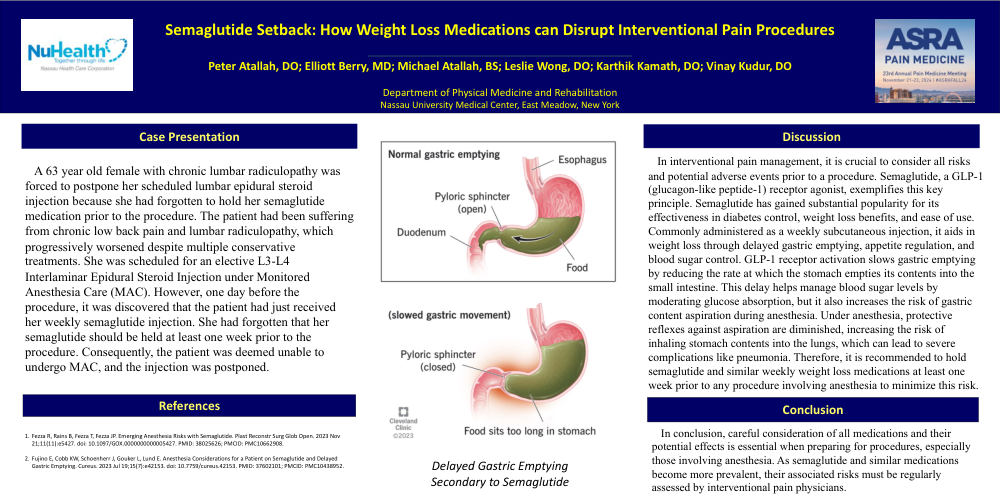
In interventional pain management, it is crucial to consider all risks and potential adverse events prior to a procedure. Semaglutide, a GLP-1 (glucagon-like peptide-1) receptor agonist, exemplifies this key principle. Semaglutide has gained substantial popularity for its effectiveness in diabetes control, weight loss benefits, and ease of use. Commonly administered as a weekly subcutaneous injection, it aids in weight loss through delayed gastric emptying, appetite regulation, and blood sugar control. GLP-1 receptor activation slows gastric emptying by reducing the rate at which the stomach empties its contents into the small intestine. This delay helps manage blood sugar levels by moderating glucose absorption, but it also increases the risk of gastric content aspiration during anesthesia. Under anesthesia, protective reflexes against aspiration are diminished, increasing the risk of inhaling stomach contents into the lungs, which can lead to severe complications like pneumonia. Therefore, it is recommended to hold semaglutide and similar weekly weight loss medications at least one week prior to any procedure involving anesthesia to minimize this risk.
Conclusion:
In conclusion, careful consideration of all medications and their potential effects is essential when preparing for procedures, especially those involving anesthesia. As semaglutide and similar medications become more prevalent, their associated risks must be regularly assessed by interventional pain physicians.
References:
1. Fezza R, Rains B, Fezza T, Fezza JP. Emerging Anesthesia Risks with Semaglutide. Plast Reconstr Surg Glob Open. 2023 Nov 21;11(11):e5427. doi: 10.1097/GOX.0000000000005427. PMID: 38025626; PMCID: PMC10662908.
2. Fujino E, Cobb KW, Schoenherr J, Gouker L, Lund E. Anesthesia Considerations for a Patient on Semaglutide and Delayed Gastric Emptying. Cureus. 2023 Jul 19;15(7):e42153. doi: 10.7759/cureus.42153. PMID: 37602101; PMCID: PMC10438952.