501 posters, 2 videos, 1 audios, 8 topics, 37 sessions, 395 authors, 307 institutions
ePostersLive by SciGen Technologies S.A. All rights reserved.
23rd Annual Pain Medicine Meeting 2024
November 21-23, 2024 | Caesars Palace, Las Vegas, Nevada

6165
POST-STROKE NEUROPATHIC PAIN
Poster Presenter
Authors
Affiliations
Part of Topic
Scientific Abstracts > Chronic Pain
POST-STROKE NEUROPATHIC PAIN
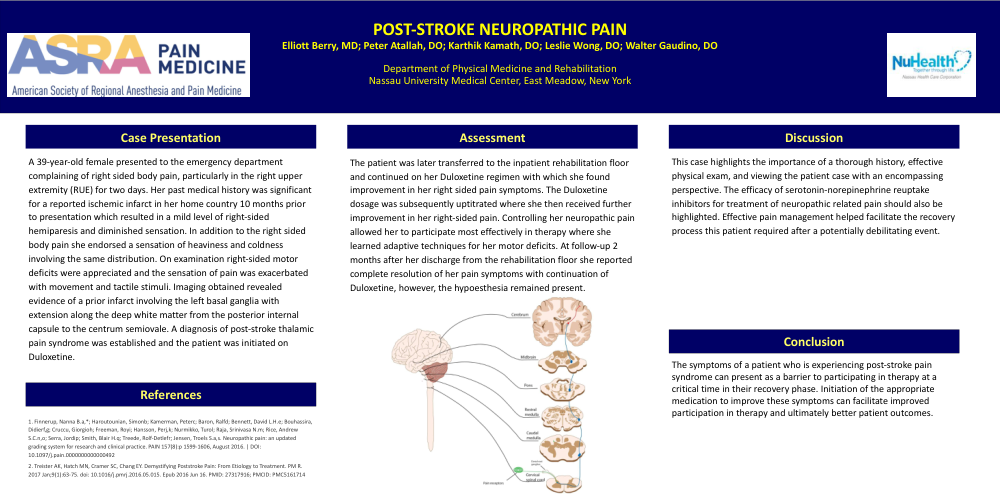
A 39-year-old female presented to the emergency department complaining of right sided body pain, particularly in the right upper extremity (RUE) for two days. Her past medical history was significant for a reported ischemic infarct in her home country 10 months prior to presentation which resulted in a mild level of right-sided hemiparesis and diminished sensation. In addition to the right sided body pain she endorsed a sensation of heaviness and coldness involving the same distribution. On examination right-sided motor deficits were appreciated and the sensation of pain was exacerbated with movement and tactile stimuli. Imaging obtained revealed evidence of a prior infarct involving the left basal ganglia with extension along the deep white matter from the posterior internal capsule to the centrum semiovale. A diagnosis of post-stroke thalamic pain syndrome was established and the patient was initiated on Duloxetine.
The patient was later transferred to the inpatient rehabilitation floor and continued on her Duloxetine regimen with which she found improvement in her right sided pain symptoms. The Duloxetine dosage was subsequently uptitrated where she then received further improvement in her right-sided pain. Controlling her neuropathic pain allowed her to participate most effectively in therapy where she learned adaptive techniques for her motor deficits. At follow-up 2 months after her discharge from the rehabilitation floor she reported complete resolution of her pain symptoms with continuation of Duloxetine, however, the hypoesthesia remained present.
This case highlights the importance of a thorough history, effective physical exam, and viewing the patient case with an encompassing perspective. The efficacy of serotonin-norepinephrine reuptake inhibitors for treatment of neuropathic related pain should also be highlighted. Effective pain management helped facilitate the recovery process this patient required after a potentially debilitating event.
The symptoms of a patient who is experiencing post-stroke pain syndrome can present as a barrier to participating in therapy at a critical time in their recovery phase. Initiation of the appropriate medication to improve these symptoms can facilitate improved participation in therapy and ultimately better patient outcomes.