501 posters, 2 videos, 1 audios, 8 topics, 37 sessions, 395 authors, 307 institutions
ePostersLive by SciGen Technologies S.A. All rights reserved.
23rd Annual Pain Medicine Meeting 2024
November 21-23, 2024 | Caesars Palace, Las Vegas, Nevada

5784
MANAGEMENT AND RESOLUTION OF POST-DURAL PUNCTURE HEADACHE WITH USE OF METOCLOPRAMIDE IN AN OBSTETRIC PATIENT
Poster Presenter
Authors
Affiliations
Part of Topic
Scientific Abstracts > Regional Anesthesia
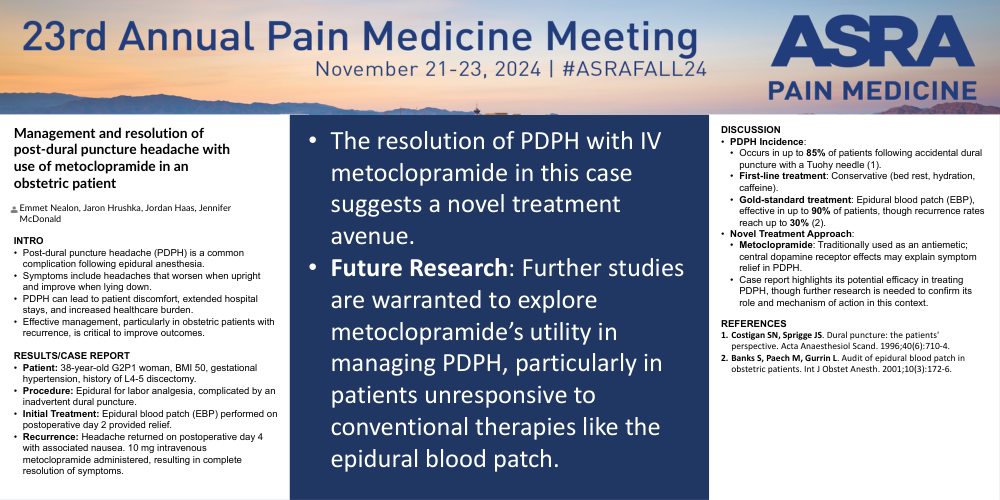
Management and resolution of post-dural puncture headache with use of metoclopramide in an obstetric patient
Emmet Nealon, Jaron Hrushka, Jordan Haas, Jennifer McDonald
INTRO
Post-dural puncture headache (PDPH) is a common complication following epidural anesthesia.
Symptoms include headaches that worsen when upright and improve when lying down.
PDPH can lead to patient discomfort, extended hospital stays, and increased healthcare burden.
Effective management, particularly in obstetric patients with recurrence, is critical to improve outcomes.
RESULTS/CASE REPORT
Patient: 38-year-old G2P1 woman, BMI 50, gestational hypertension, history of L4-5 discectomy.
Procedure: Epidural for labor analgesia, complicated by an inadvertent dural puncture.
Initial Treatment: Epidural blood patch (EBP) performed on postoperative day 2 provided relief.
Recurrence: Headache returned on postoperative day 4 with associated nausea. 10 mg intravenous metoclopramide administered, resulting in complete resolution of symptoms.
DISCUSSION
PDPH Incidence: Occurs in up to 85% of patients following accidental dural puncture with a Tuohy needle (1).
First-line treatment: Conservative (bed rest, hydration, caffeine).
Gold-standard treatment: Epidural blood patch (EBP), effective in up to 90% of patients, though recurrence rates reach up to 30% (2).
Novel Treatment Approach: Metoclopramide: Traditionally used as an antiemetic; central dopamine receptor effects may explain symptom relief in PDPH.
Case report highlights its potential efficacy in treating PDPH, though further research is needed to confirm its role and mechanism of action in this context.
The resolution of PDPH with IV metoclopramide in this case suggests a novel treatment avenue.
Future Research: Further studies are warranted to explore metoclopramide’s utility in managing PDPH, particularly in patients unresponsive to conventional therapies like the epidural blood patch.
REFERENCES
Costigan SN, Sprigge JS. Dural puncture: the patients' perspective. Acta Anaesthesiol Scand. 1996;40(6):710-4.
Banks S, Paech M, Gurrin L. Audit of epidural blood patch in obstetric patients. Int J Obstet Anesth. 2001;10(3):172-6.