501 posters, 2 videos, 1 audios, 8 topics, 37 sessions, 395 authors, 307 institutions
ePostersLive by SciGen Technologies S.A. All rights reserved.
23rd Annual Pain Medicine Meeting 2024
November 21-23, 2024 | Caesars Palace, Las Vegas, Nevada

6217
CHANGES IN THE LANDSCAPE OF CLINICAL BACKGROUNDS OF PAIN MEDICINE FELLOWS FROM 2019-2024
Poster Presenter
Authors
Affiliations
Part of Topic
Scientific Abstracts > Education
CHANGES IN THE LANDSCAPE OF CLINICAL BACKGROUNDS OF PAIN MEDICINE FELLOWS FROM 2019-2024
Vasanth Selvam DO1, Nivetha Srinivasan MD2, Aditi Master MD2, Alejandro Hallo-Carrasco MD2 ,Jean Daniel Eloy MD2
Good Samaritan University Hospital1, Rutgers New Jersey Medical School2
INTRODUCTION
•The dynamic field of pain medicine benefits from the diverse clinical backgrounds of physicians, such as anesthesiology, PM&R, neurology, and other specialties.
•There has been a noticeable shift in the clinical backgrounds of residents pursuing pain medicine
•This study aims to provide an analysis of pain medicine fellows and program directors from 2020 to 2024.
METHODS
•We assessed public data from ACGME-accredited pain programs, focusing on the backgrounds of fellows from the graduating classes of 2020 to 2024.
•Additional information was gathered from social media platforms of programs and professional networking sites to identify further fellows.
•Collected information included gender, race, residency specialties, and fellowship graduation years
•Linear regression analysis was applied to assess trends in the distribution of fellows across specialties.
RESULTS
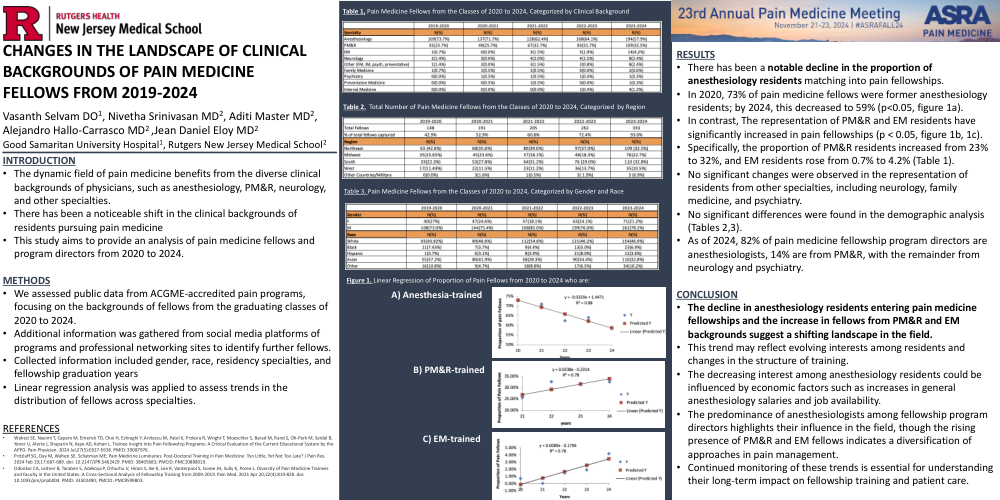
•There has been a notable decline in the proportion of anesthesiology residents matching into pain fellowships.
•In 2020, 73% of pain medicine fellows were former anesthesiology residents; by 2024, this decreased to 59% (p<0.05, figure 1a).
•In contrast, The representation of PM&R and EM residents have significantly increased in pain fellowships (p < 0.05, figure 1b, 1c).
•Specifically, the proportion of PM&R residents increased from 23% to 32%, and EM residents rose from 0.7% to 4.2% (Table 1).
•No significant changes were observed in the representation of residents from other specialties, including neurology, family medicine, and psychiatry.
•No significant differences were found in the demographic analysis (Tables 2,3).
•As of 2024, 82% of pain medicine fellowship program directors are anesthesiologists, 14% are from PM&R, with the remainder from neurology and psychiatry.
CONCLUSION
•The decline in anesthesiology residents entering pain medicine fellowships and the increase in fellows from PM&R and EM backgrounds suggest a shifting landscape in the field.
•This trend may reflect evolving interests among residents and changes in the structure of training.
•The decreasing interest among anesthesiology residents could be influenced by economic factors such as increases in general anesthesiology salaries and job availability.
•The predominance of anesthesiologists among fellowship program directors highlights their influence in the field, though the rising presence of PM&R and EM fellows indicates a diversification of approaches in pain management.
•Continued monitoring of these trends is essential for understanding their long-term impact on fellowship training and patient care.
REFERENCES
•Wahezi SE, Naeimi T, Caparo M, Emerick TD, Choi H, Eshraghi Y, Anitescu M, Patel K, Przkora R, Wright T, Moeschler S, Barad M, Rand S, Oh-Park M, Seidel B, Yener U, Alerte J, Shaparin N, Kaye AD, Kohan L. Trainee Insight into Pain Fellowship Programs: A Critical Evaluation of the Current Educational System by the APPD. Pain Physician. 2024 Jul;27(5):E627-E636. PMID: 39087976.
•Pritzlaff SG, Day M, Wahezi SE, Schatman ME; Pain Medicine Luminaries. Post-Doctoral Training in Pain Medicine: Too Little, Yet Not Too Late? J Pain Res. 2024 Feb 19;17:687-689. doi: 10.2147/JPR.S462429. PMID: 38405683; PMCID: PMC10888019.
•Odonkor CA, Leitner B, Taraben S, Adekoya P, Orhurhu V, Hirani S, Ike K, Lee R, Vanterpool S, Goree JH, Sully K, Poree L. Diversity of Pain Medicine Trainees and Faculty in the United States: A Cross-Sectional Analysis of Fellowship Training from 2009-2019. Pain Med. 2021 Apr 20;22(4):819-828. doi: 10.1093/pm/pnab004. PMID: 33502490; PMCID: PMC8599803.