501 posters, 2 videos, 1 audios, 8 topics, 37 sessions, 395 authors, 307 institutions
ePostersLive by SciGen Technologies S.A. All rights reserved.
23rd Annual Pain Medicine Meeting 2024
November 21-23, 2024 | Caesars Palace, Las Vegas, Nevada

6140
BLOCKED BUT NOT FORGOTTEN - THE ENIGMA OF POST-NERVE BLOCK PAIN: A CASE REPORT
Poster Presenter
Part of Topic
Scientific Abstracts > Acute Pain
Blocked but Not Forgotten - The Enigma of Post-Nerve Block Pain: A Case Report
Karthik Kamath, Gillian McGuire, Leslie Wong, Jenzel Espares, Peter Atallah, Elliott Berry, Ajendra Sohal Nassau University Medical Center (NUMC)
Introduction
32-year-old female presented to the Physical Medicine & Rehabilitation clinic with pain in the left medial foot and anterior tibial area, which she attributes to a nerve block received during plantar fasciitis surgery. She experienced immediate pain during a tibial nerve block, which continued throughout the procedure and has since resulted in constant paresthesias described as burning and gnawing, worsening at night. During her visit, she reported no muscle weakness or tightness, and no functional deficits were found, with strength and sensation intact in both lower extremities. Peripheral nerve injury (PNI) is suspected, but initial physical exam findings were normal.
Materials and Methods
As the case report is devoid of patient identifiable information, it is exempt from IRB review requirements as per Nassau University Medical Center policy.
Results/Case Report
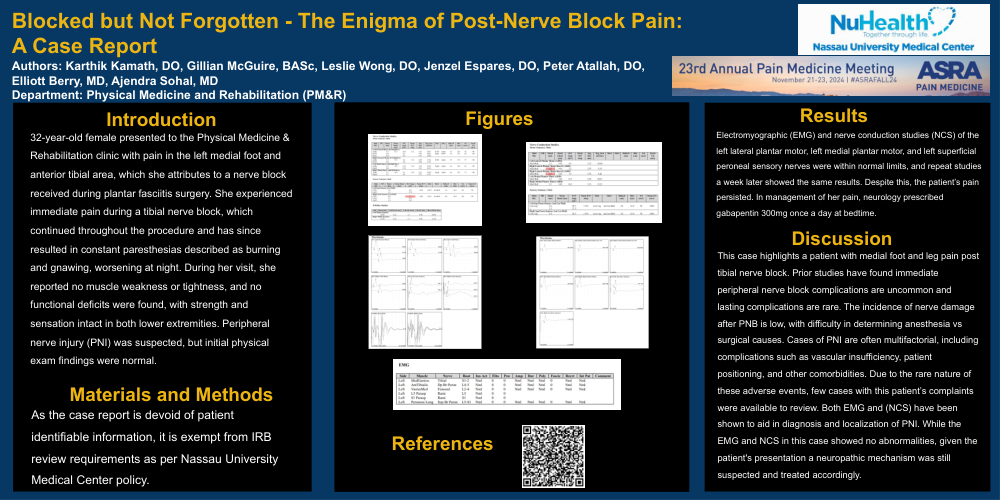
Electromyographic (EMG) and nerve conduction studies (NCS) of the left lateral plantar motor, left medial plantar motor, and left superficial peroneal sensory nerves were also within normal limits, and repeat studies a week later showed the same results. Despite this, her pain persists. In management of her pain, she followed up with neurology and was given a prescription for gabapentin 300mg once daily.
Discussion
This case highlights a patient with medial foot and leg pain post tibial nerve block. Prior studies have found immediate peripheral nerve block complications are uncommon and lasting complications are rare. The incidence of nerve damage after PNB is low, with difficulty in determining anesthesia vs surgical causes. Cases of PNI are often multifactorial, including complications such as vascular insufficiency, patient positioning, and other comorbidities. Due to the rare nature of these adverse events, few cases with this patient’s complaints were available to review. Both EMG and (NCS) have been shown to aid in diagnosis and localization of PNI. While the EMG and NCS in this case showed no abnormalities, given the patient presentation a neuropathic mechanism is still suspected.
References
Anderson JG, Bohay DR, Maskill JD, et al. Complications after popliteal block for foot and ankle surgery. Foot Ankle Int 2015;36(10):1138-43. https://doi.org/10.1177/1071100715589741.
Kahn RL, Ellis SJ, Cheng J, et al. The incidence of complications is low following foot and ankle surgery for which peripheral nerve blocks are used for postoperative pain management. HSS J 2018;14(2):134- 42. https://doi.org/10.1007/s11420-017-9588-y.
Lauf JA, Huggins P, Long J, et al. Regional nerve block complication analysis following peripheral nerve block during foot and ankle surgical procedures. Cureus 2020;12(7). https://doi.org/10.7759/cureus.9434.
O'Flaherty D, McCartney CJL, Ng SC, et al. Nerve injury after peripheral nerve blockade: current understanding and guidelines. BJA Educ 2018;18(12):384-90. https://doi.org/10.1016/j.bjae.2018.09.004.
Sahu RL. Percutaneous planter fasciitis release under local anesthesia: A prospective study. Chin J Traumatol 2017;20(2):87-89. https://doi.org/10.1016/j.cjtee.2017.01.002.