501 posters, 2 videos, 1 audios, 8 topics, 37 sessions, 395 authors, 307 institutions
ePostersLive by SciGen Technologies S.A. All rights reserved.
23rd Annual Pain Medicine Meeting 2024
November 21-23, 2024 | Caesars Palace, Las Vegas, Nevada

6244
SCS CANDIDATES WITH PAINFUL DIABETIC PERIPHERAL NEUROPATHY: PATIENT DEMOGRAPHICS AND PAIN PRESENTATION FROM THE SENSE SCS STUDY.
Poster Presenter
Authors
Affiliations
Part of Topic
Scientific Abstracts > Chronic Pain
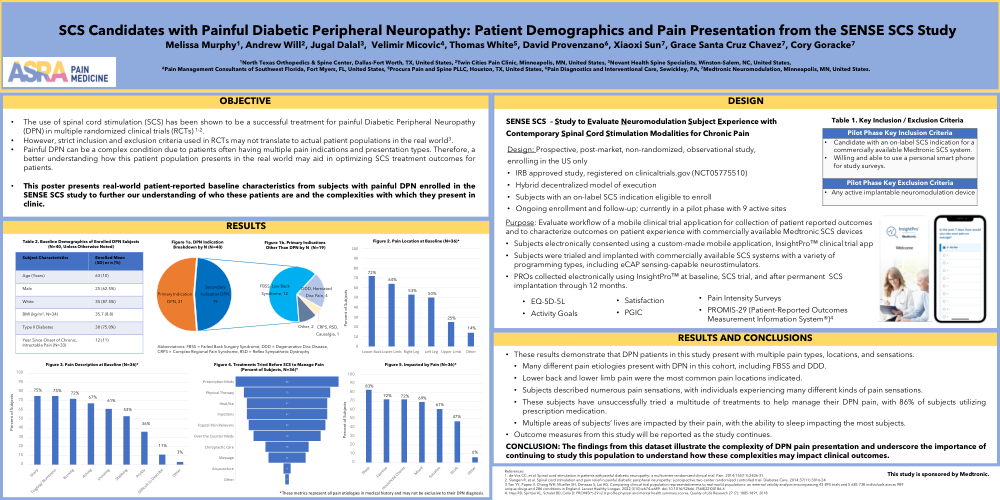
SCS Candidates with Painful Diabetic Peripheral Neuropathy: Patient Demographics and Pain Presentation from the SENSE SCS Study
Melissa Murphy1, Andrew Will2, Jugal Dalal3, Velimir Micovic4, Thomas White5, David Provenzano6, Xiaoxi Sun7, Grace Santa Cruz Chavez7, Cory Goracke7
1North Texas Orthopedics & Spine Center, Dallas-Fort Worth, TX, United States, 2Twin Cities Pain Clinic, Minneapolis, MN, United States, 3Novant Health Spine Specialists, Winston-Salem, NC, United States, 4Pain Management Consultants of Southwest Florida, Fort Myers, FL, United States, 5Procura Pain and Spine PLLC, Houston, TX, United States, 6Pain Diagnostics and Interventional Care, Sewickley, PA, 7Medtronic Neuromodulation, Minneapolis, MN, United States.
OBJECTIVE
SENSE SCS – Study to Evaluate Neuromodulation Subject Experience with Contemporary Spinal Cord Stimulation Modalities for Chronic Pain
Design: Prospective, post-market, non-randomized, observational study, enrolling in the US only
Ongoing enrollment and follow-up; currently in a pilot phase with 9 active sites
Purpose: Evaluate workflow of a mobile clinical trial application for collection of patient reported outcomes and to characterize outcomes on patient experience with commercially available Medtronic SCS devices
CONCLUSION: The findings from this dataset illustrate the complexity of DPN pain presentation and underscore the importance of continuing to study this population to understand how these complexities may impact clinical outcomes.
REFERENCES
1. de Vos CC, et al. Spinal cord stimulation in patients with painful diabetic neuropathy: a multicentre randomized clinical trial. Pain. 2014;155(11):2426-31.
2. Slangen R, et al. Spinal cord stimulation and pain relief in painful diabetic peripheral neuropathy: a prospective two-center randomized controlled trial. Diabetes Care. 2014;37(11):3016-24.
3.Tan YY, Papez V, Chang WH, Mueller SH, Denaxas S, Lai AG. Comparing clinical trial population representativeness to real-world populations: an external validity analysis encompassing 43 895 trials and 5 685 738 individuals across 989 unique drugs and 286 conditions in England. Lancet Healthy Longev. 2022;3(10):e674-e689. doi:10.1016/S2666-7568(22)00186-6
4. Hays RD, Spritzer KL, Schalet BD, Cella D: PROMIS(*)-29 v2.0 profile physical and mental health summary scores. Quality of Life Research 27 (7): 1885-1891, 2018.