501 posters, 2 videos, 1 audios, 8 topics, 37 sessions, 395 authors, 307 institutions
ePostersLive by SciGen Technologies S.A. All rights reserved.
23rd Annual Pain Medicine Meeting 2024
November 21-23, 2024 | Caesars Palace, Las Vegas, Nevada

5982
MANAGING VZV WITH INNOVATIVE PAIN CONTROL: LUMBAR INTERLAMINAR EPIDURAL STEROID INJECTION AND DECUBITUS POSITIONING
Poster Presenter
Authors
Affiliations
Part of Topic
Scientific Abstracts > Chronic Pain
Managing VZV with Innovative Pain Control: Lumbar Interlaminar Epidural Steroid Injection and Decubitus Positioning
Introduction
Herpetic neuralgia, particularly in the context of varicella-zoster virus (VZV) infection, can lead to significant morbidity, especially in immunocompromised patients. The involvement of the peripheral nervous system, including radiculitis and plexitis, presents a challenging scenario for management, often leading to chronic pain that is difficult to control with conventional therapies. This case report discusses a novel approach to managing chronic pain in a patient with disseminated herpes zoster infection, involving lumbar interlaminar epidural steroid injections and post-procedure positional management aimed at targeting multiple dermatomal levels.
Results/Case Report
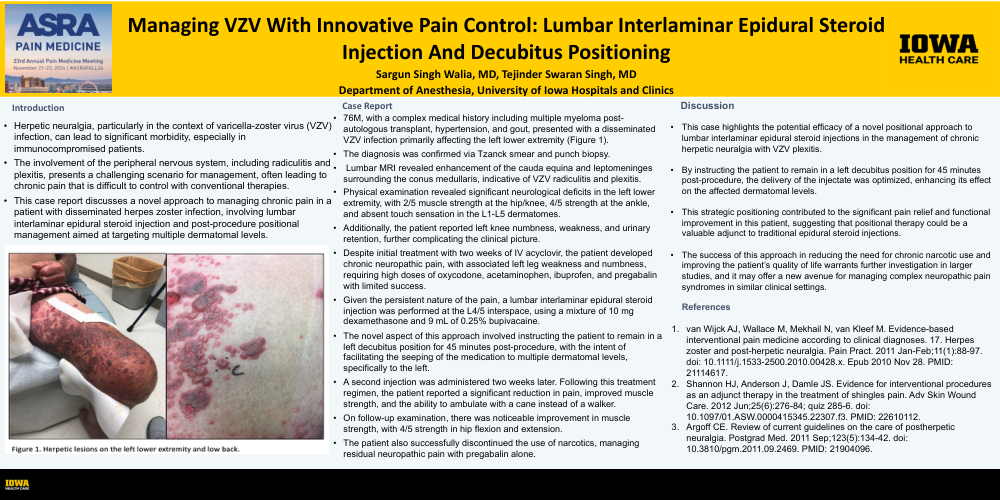
76 year old male, with a complex medical history including multiple myeloma post-autologous transplant, hypertension, and gout, presented with a disseminated VZV infection primarily affecting the left lower extremity (Figure 1). The diagnosis was confirmed via Tzanck smear and punch biopsy. MRI revealed enhancement of the cauda equina and leptomeninges surrounding the conus medullaris, indicative of VZV radiculitis and plexitis.
Physical examination revealed significant neurological deficits in the left lower extremity, with 2/5 muscle strength at the hip/knee, 4/5 strength at the ankle, and absent touch sensation in the L1-L5 dermatomes. Additionally, the patient reported left knee numbness, weakness, and urinary retention, further complicating the clinical picture.
Despite initial treatment with two weeks of IV acyclovir, the patient developed chronic neuropathic pain, with associated left leg weakness and numbness, requiring high doses of oxycodone, acetaminophen, ibuprofen and pregabalin with limited success. Given the persistent nature of the pain, a lumbar interlaminar epidural steroid injection was performed at the L4/5 interspace, using a mixture of 10 mg dexamethasone and 9 mL of 0.25% bupivacaine. The novel aspect of this approach involved instructing the patient to remain in a left decubitus position for 45 minutes post-procedure, with the intent of facilitating the seeping of the medication to multiple dermatomal levels specifically to the left.
A second injection was administered two weeks later. Following this treatment regimen, the patient reported a significant reduction in pain, improved muscle strength, and the ability to ambulate with a cane instead of a walker. On follow-up examination, there was noticeable improvement in muscle strength, with 4/5 strength in hip flexion and extension. The patient also successfully discontinued the use of narcotics, managing residual neuropathic pain with pregabalin alone.
Discussion
This case highlights the potential efficacy of a novel positional approach to lumbar interlaminar epidural steroid injections in the management of chronic herpetic neuralgia with VZV plexitis. By instructing the patient to remain in a left decubitus position for 45 minutes post-procedure, the delivery of the injectate was optimized, enhancing its effect on the affected dermatomal levels. This strategic positioning contributed to the significant pain relief and functional improvement in this patient, suggesting that positional therapy could be a valuable adjunct to traditional epidural steroid injections. The success of this approach in reducing the need for chronic narcotic use and improving the patient’s quality of life warrants further investigation in larger studies, and it may offer a new avenue for managing complex neuropathic pain syndromes in similar clinical settings.
References:
- van Wijck AJ, Wallace M, Mekhail N, van Kleef M. Evidence-based interventional pain medicine according to clinical diagnoses. 17. Herpes zoster and post-herpetic neuralgia. Pain Pract. 2011 Jan-Feb;11(1):88-97. doi: 10.1111/j.1533-2500.2010.00428.x. Epub 2010 Nov 28. PMID: 21114617.
- Shannon HJ, Anderson J, Damle JS. Evidence for interventional procedures as an adjunct therapy in the treatment of shingles pain. Adv Skin Wound Care. 2012 Jun;25(6):276-84; quiz 285-6. doi: 10.1097/01.ASW.0000415345.22307.f3. PMID: 22610112.
- Argoff CE. Review of current guidelines on the care of postherpetic neuralgia. Postgrad Med. 2011 Sep;123(5):134-42. doi: 10.3810/pgm.2011.09.2469. PMID: 21904096.