501 posters, 2 videos, 1 audios, 8 topics, 37 sessions, 395 authors, 307 institutions
ePostersLive by SciGen Technologies S.A. All rights reserved.
23rd Annual Pain Medicine Meeting 2024
November 21-23, 2024 | Caesars Palace, Las Vegas, Nevada

5712
VOICES FROM THE PIPELINE: EXPLORING BARRIERS TO DIVERSITY IN PAIN MEDICINE FELLOWSHIP PROGRAMS
Poster Presenter
Authors
Affiliations
Part of Topic
Scientific Abstracts > Education
Voices from the Pipeline: Exploring Barriers to Diversity in Pain Medicine Fellowship Programs
Objective
This study aims to gain insight into the perspectives of minority pain fellows and identify factors influencing their decision to pursue fellowship training programs. Additionally, it seeks to understand the factors contributing to the underrepresentation of racial and ethnic minorities in ACGME pain fellowship programs. We defined racial/ethnic “minority” or underrepresented status as those groups identified as such by the ACGME.
Materials/Methods
Recruitment for this study involved sending an email through the American Society of Regional Anesthesia and Pain Medicine (ASRA) resident committee that invited residents who self-identify as belonging to a racial/ethnic minority in medicine and come from various pipeline pain programs to participate. The invited residents participated in a qualitative interview conducted electronically using audiovisual technology (Zoom©) in a semi-structured format. The interviews were recorded and transcribed, and all personal identifying information was removed before analysis. Each participant received an incentive to take part in the project.
Results
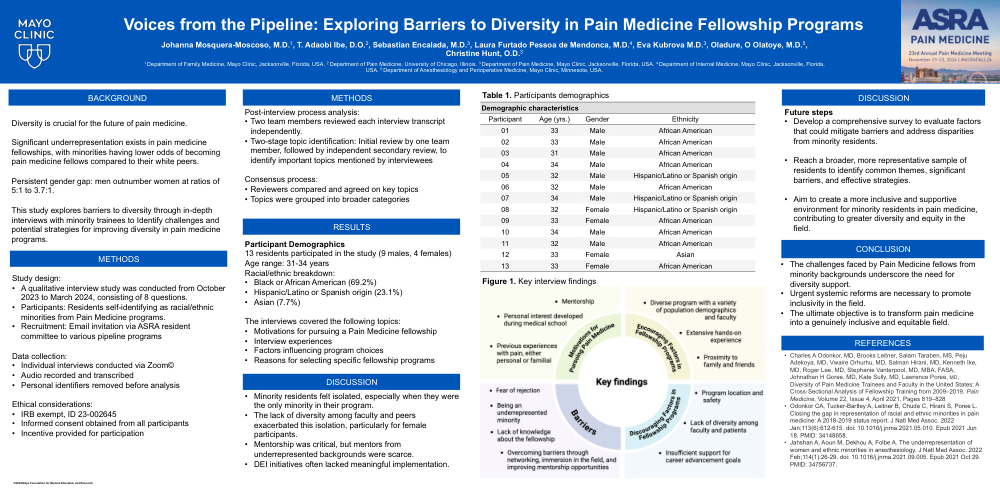
Thirteen residents (9 males, 4 females, aged 31-34 years) were recruited. The breakdown of race/ethnicity was as follows: Black or African American (69.2%), Hispanic/Latino or Spanish origin (23.1%), Asian (7.7%).
In the interviews, participants answered eight questions covering their motivations for pursuing a Pain Medicine fellowship, interview experiences, factors influencing program choices, and reasons for selecting specific programs. The most common reasons for pursuing a career in pain medicine included personal interest developed during medical school, mentorship, and previous experiences with pain, either personal or familial. Barriers included being an underrepresented minority, fear of rejection, and a lack of knowledge about the fellowship until the end of residency. Overcoming these barriers involved networking, immersion in the field, and improving mentorship opportunities.
When asked about the characteristics of the fellowships programs that encouraged most applicants to apply, many mentioned extensive hands-on experience, a diverse program that includes a variety of population demographics and faculty, and the program's proximity to family and friends. Conversely, the most common discouraging factors included program location and safety, lack of diversity among faculty and patients, and insufficient support for career advancement goals.
Future steps:
Based on the insights obtained from these structured interviews, we plan to develop a comprehensive survey questionnaire aimed at evaluating the factors that could mitigate barriers and address disparities for minority resident physicians interested in pursuing a career in pain medicine. This survey will be designed to reach a broader audience within the field to obtain a more extensive and representative sample of responses. We hope to identify common themes, significant barriers, and effective strategies for increasing minority representation in pain medicine fellowships. Through these steps, we aim to create a more inclusive and supportive environment for minority residents in pain medicine, ultimately contributing to greater diversity and equity in the field.