501 posters, 2 videos, 1 audios, 8 topics, 37 sessions, 395 authors, 307 institutions
ePostersLive by SciGen Technologies S.A. All rights reserved.
23rd Annual Pain Medicine Meeting 2024
November 21-23, 2024 | Caesars Palace, Las Vegas, Nevada

6137
UNDERSTANDING THE ROLE OF CENTRAL MECHANISMS IN EVALUATION OF LUMBAR MEDIAL BRANCH BLOCKS: A PILOT STUDY
Poster Presenter
Authors
Affiliations
Part of Topic
Scientific Abstracts > Chronic Pain
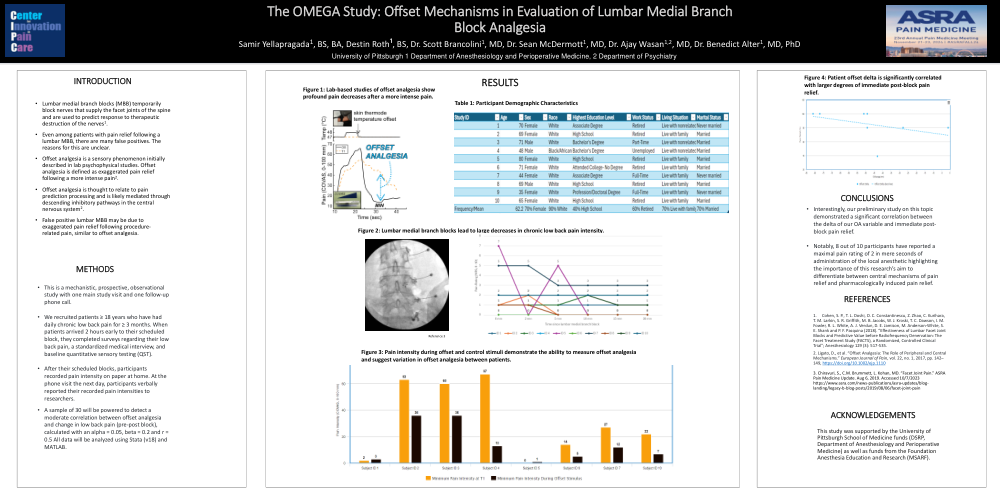
INTRODUCTION RESULTS CONCLUSIONS REFERENCES ACKNOWLEDGEMENTS • Lumbar medial branch blocks (MBB) temporarily block nerves that supply the facet joints of the spine and are used to predict response to therapeutic destruction of the nerves1 . • Even among patients with pain relief following a lumbar MBB, there are many false positives. The reasons for this are unclear. • Offset analgesia is a sensory phenomenon initially described in lab psychophysical studies. Offset analgesia is defined as exaggerated pain relief following a more intense pain2 . • Offset analgesia is thought to relate to pain prediction processing and is likely mediated through descending inhibitory pathways in the central nervous system2 . • False positive lumbar MBB may be due to exaggerated pain relief following procedurerelated pain, similar to offset analgesia. 1. Cohen, S. P., T. L. Doshi, O. C. Constantinescu, Z. Zhao, C. Kurihara, T. M. Larkin, S. R. Griffith, M. B. Jacobs, W. J. Kroski, T. C. Dawson, I. M. Fowler, R. L. White, A. J. Verdun, D. E. Jamison, M. Anderson-White, S. E. Shank and P. F. Pasquina (2018). “Effectiveness of Lumbar Facet Joint Blocks and Predictive Value before Radiofrequency Denervation: The Facet Treatment Study (FACTS), a Randomized, Controlled Clinical Trial”; Anesthesiology 129 (3): 517-535. 2. Ligato, D., et al. “Offset Analgesia: The Role of Peripheral and Central Mechanisms.” European Journal of Pain, vol. 22, no. 1, 2017, pp. 142– 149, https://doi.org/10.1002/ejp.1110 3. Chiravuri, S., C.M. Brummett, L. Kohan, MD. “Facet Joint Pain.” ASRA Pain Medicine Update. Aug 6, 2019. Accessed 10/7/2023 https://www.asra.com/news-publications/asra-updates/bloglanding/legacy-b-blog-posts/2019/08/06/facet-joint-pain This study was supported by the University of Pittsburgh School of Medicine funds (DSRP, Department of Anesthesiology and Perioperative Medicine) as well as funds from the Foundation Anesthesia Education and Research (MSARF). METHODS • This is a mechanistic, prospective, observational study with one main study visit and one follow-up phone call. • We recruited patients ≥ 18 years who have had daily chronic low back pain for ≥ 3 months. When patients arrived 2 hours early to their scheduled block, they completed surveys regarding their low back pain, a standardized medical interview, and baseline quantitative sensory testing (QST). • After their scheduled blocks, participants recorded pain intensity on paper at home. At the phone visit the next day, participants verbally reported their recorded pain intensities to researchers. • A sample of 30 will be powered to detect a moderate correlation between offset analgesia and change in low back pain (pre-post block), calculated with an alpha = 0.05, beta = 0.2 and r = 0.5 All data will be analyzed using Stata (v18) and MATLAB. • Interestingly, our preliminary study on this topic demonstrated a significant correlation between the delta of our OA variable and immediate postblock pain relief. • Notably, 8 out of 10 participants have reported a maximal pain rating of 2 in mere seconds of administration of the local anesthetic highlighting the importance of this research’s aim to differentiate between central mechanisms of pain relief and pharmacologically induced pain relief. Figure 2: Lumbar medial branch blocks lead to large decreases in chronic low back pain intensity. Table 1: Participant Demographic Characteristics Figure 1: Lab-based studies of offset analgesia show profound pain decreases after a more intense pain. Figure 3: Pain intensity during offset and control stimuli demonstrate the ability to measure offset analgesia and suggest variation in offset analgesia betwe